Sixty-two dollars changed hands at a flea market table for a pen that, frankly, I could’ve bought new for less — and that transaction is what got me thinking about this whole tier of collecting in the first place. By the time you’ve filled a stack of notebooks with entries from my under-$50 picks, you start to notice things: how a nib should feel, why a ballpoint never quite scratches the same itch. Eventually every pen in the drawer starts feeling thin. That’s the exact moment the question stops being “is this pen good?” and becomes “what’s the best fountain pen my money can actually buy?”
Pens priced under $1,000 sit in an odd zone. They cost enough that a wrong choice stings, so you deliberate. But they haven’t crossed into pure status-object territory either — there’s still function underneath. Watches don’t work this way; a $10,000 movement genuinely can outperform a $1,000 one. Fountain pens flatten out much sooner. A $400 pen can write as smoothly as one costing twice as much. Past a certain price, what you’re buying stops being writing performance and starts being identity — the resin, the metal in the nib, the decades of history behind the name stamped on the barrel.
Over roughly ten years I’ve put nibs to paper on everything from $8 Jinhaos to Pelikans running $400, and somewhere along the way I got decent at telling real luxury apart from expensive theater. What follows is my honest map of which pens in this range earn their price tag and which ones don’t. I won’t pretend the money always buys better function — sometimes it just buys legacy, and I’ll say so plainly. By the end you should be able to tell which pen deserves a spot in your rotation.
What $500 to $1,000 Actually Buys You in a Fountain Pen
Going from a $50 pen to a $500 one doesn’t scale in a straight line. Most of the genuine functional gains show up between $200 and $300. Cross that line and you’re mostly paying for materials, heritage, and collectibility — smoothness stops being the thing your money’s buying.
Gold Nibs Versus Steel: What’s Actually Different
Stainless steel dominates the budget end of the market for good reason — it’s tough, it doesn’t quit, and it never bends when you’d rather it didn’t. But that same rigidity is its limit. Gold, whether 14-karat or 18-karat, is softer, so it gives slightly under hand pressure. Writers describe that give as “responsiveness” — the nib dips, then springs back. Your line weight starts varying in small, involuntary ways, even without any deliberate attempt to flex.
None of this registers much if your hand is light on the page. Press moderately, though, and a gold nib feels noticeably more animated. Still, the effect is real but not dramatic — I’ve written with a well-tuned $150 gold nib that felt almost indistinguishable from a $600 one. Where the difference is enormous is between a rough $50 steel nib and a properly tuned $150 gold nib. Beyond that, comparing a solid $300 nib to a solid $700 nib comes down to taste, not measurable quality.
Materials Built to Actually Age Well
Injection-molded plastic is the default at the low end because it’s practical and nearly indestructible — drop it and it shrugs. What it won’t do is age with any grace. Higher-tier pens lean on celluloid (a cellulose acetate), ebonite, or house-proprietary resins, and all three develop character over time. Celluloid’s color deepens. Ebonite oxidizes, then polishes right back up. Neither is a flaw — it’s the whole point.
In practice, that means a $500 pen you’ve used for a decade will look better than a $50 pen that’s seen a single year of desk duty. That matters if you’re planning to keep the pen a long while. If pure function is all you want, though, injection-molded plastic gets the job done just fine. Paying for the fancier material buys you three things at once: looks, longevity, and the simple satisfaction of owning something that doesn’t feel throwaway.
The Point Where the Brand Name Is the Product
Uncomfortable but true: a $900 Montblanc 146 puts down a line nearly identical to a $400 Aurora 88. Both carry 14-karat nibs. Both fill via piston. Both are made with real care. What separates them is name recognition — Montblanc pours money into marketing that Aurora simply doesn’t spend. Sell the Montblanc five years down the road and you’ll likely recoup 60–70% of what you paid. The Aurora tends to land closer to 40–50%.
That gap only matters if resale or collectibility is part of your reasoning. Buying purely to use and keep a pen forever means the brand markup is money spent on nothing tangible. Buying to build a collection, or liking the idea that the thing might hold or gain value, changes the math entirely. I’ll call out where brand is doing the heavy lifting in each recommendation below, so you know exactly what portion of the price tag is prestige.
How Much Factory Tuning You’re Actually Getting
Sub-$100 pens frequently show up scratchy or flowing unevenly, and you’re expected to sort that out yourself. Above $300, factory tuning gets noticeably better — a Pelikan, Montblanc, or Sailor arriving on your doorstep is supposed to write cleanly right out of the box. “Supposed to” is doing real work in that sentence, since quality control still varies. But the odds of your $500 pen needing hands-on adjustment are meaningfully lower than with a $50 pen.
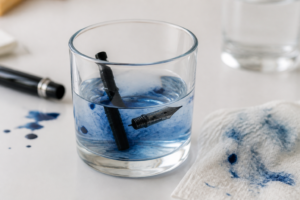
Even so, luxury doesn’t exempt a pen from upkeep — a proper cleaning routine still applies. Budget roughly 15 minutes a month flushing the pen with distilled water, plus a more thorough cleaning twice a year. A pen at this price has earned that attention. Treat a $500 pen the way you’d treat a disposable ballpoint and you’ll cut its working life short for no good reason.
The Fountain Pens Under $1,000 Worth Your Money
What follows are the pens I’d genuinely put my own money behind at this tier, based on time spent actually writing with them rather than reading spec sheets.
Pelikan M800: The Benchmark for a First Luxury Pen
Price range: $490–$650 | Best for: A first serious pen, or the start of a small collection | Nib: Two-tone 18k gold
The Pelikan M800 Fountain Pen M Premium Plume Noir/Bleu is the gateway drug to real luxury pens. It’s been in production since 1956. If you see a pen in someone’s desk drawer at a law firm or publishing house, it’s often an M800. This isn’t accident—it’s earned reputation.
What the money buys: an 18-karat two-tone gold nib with balance that just feels right in the hand. The piston fill mechanism doesn’t wobble or hesitate. The resin barrel — a proprietary blend — reads as premium without ever feeling breakable. Weight lands around 30 grams: substantial enough to feel like an object, light enough that your hand won’t tire. The medium nib carries real character — responsive under pressure, smooth at rest, dependable session after session.
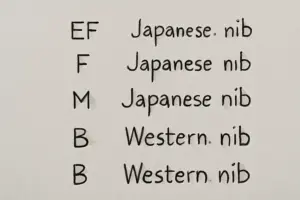
Specific recommendation: Order in Medium if you write normally, or Fine if you prefer a tighter line. US nib sizes tend to run broader than German sizing, so a German “Fine” often feels more like a US “Extra Fine.” The M800 is available in the Extra Fine version and Medium version as well, if you want to test multiple nibs.
Where it falls short: after years of daily use, the cap can develop a faint wobble. It’s purely cosmetic — the writing performance stays flawless — but it’s the kind of thing you’ll notice if you expect German engineering to be perfect at all times. It’s rarely bad, and Pelikan’s service department handles it well if it bothers you enough to send it in. At $500-plus, a loose cap out of the box shouldn’t happen at all, but it happens often enough that I feel obligated to mention it.
Why it tops the list: the M800 gives you luxury without theater. The nib performs the way it should. The materials only get better with age. Reputable retailers stock it widely, and if anything goes sideways, Pelikan’s customer service actually helps. It’s not the rarest name on this list, but it’s the one I trust most to satisfy consistently.
Sailor King of Pen: Nib Precision Taken to Its Limit
Price range: $700–$900 | Best for: Writers obsessed with fine line control; anyone drawn to Japanese craftsmanship | Nib: 21k gold, hand-tuned
Japanese pen makers tend to place nib precision above every other consideration, and the Sailor King of Pen (sold in some markets as King Profit) is that philosophy in physical form. Its 21-karat gold nib is absurdly consistent and fine. What Sailor labels “fine” produces a line thinner than most Western “extra-fine” nibs. Anyone who’s spent years frustrated by skipping or uneven flow will find this pen speaks directly to that frustration.
What the money buys: a near-obsessive standard of nib craftsmanship. Someone examined and adjusted this nib by hand before it ever shipped. The body’s typically urushi lacquer laid over wood or ebonite — a finish that takes weeks to apply correctly. Weight distribution is exact, and at 35-plus grams this is a serious object in the hand. Writing with it feels intentional, almost formal — built for quality first, convenience second.
A specific recommendation: Sailor’s sizing genuinely runs finer than German counterparts — their “Medium” behaves like a German “Fine.” If you prefer a delicate line and write with light, controlled pressure, order Fine or Extra-Fine. Broader options exist for heavier hands or weaker eyesight, though going broad on a Sailor undercuts a lot of what makes owning one worthwhile.
Where it falls short: this is a big, heavy pen, full stop. Small hands or long writing sessions will feel the strain. Sailor does make smaller lines (the 1911 series), but the King is built for prestige and performance, not comfort. Availability is the other issue — stock outside Japan is unpredictable, and you’ll likely eat shipping and import costs. A handful of international retailers carry it, but the selection is thinner than anything German.
Why it earns a spot: if the finest line control obtainable at this price is the goal, this is the answer. Japanese pen-building diverges enough from German tradition to feel like a genuinely different craft, not just a variation. Owning one is a good reminder that “luxury pen” isn’t a single formula.
Montblanc 146: The Luxury Pen Everyone Recognizes
Price range: $650–$750 | Best for: Buyers after prestige and resale — executives, collectors | Nib: 14k gold
The Meisterstück 146 is the one luxury pen even non-collectors recognize on sight. Walk into a boardroom with it and the message reads clearly: serious professional. The design hasn’t changed since 1924. That white star on the black cap is legible from across a room, in any country — and that recognition took Montblanc a full century of deliberate marketing to build.
What the money buys: heritage, mostly. The 14k nib is genuinely good but not meaningfully better than the 18k nib on a Pelikan M800. The plastic body is high quality, though not a dramatic step above Pelikan’s resin. The piston fill works reliably. What you’re really paying $650-plus for is certainty — anyone who sees this pen clocks it instantly as “expensive,” and that carries real value if image is part of your calculation.
A specific recommendation: the 146 sits in the middle of Montblanc’s size range — bigger than the 145, smaller than the 149. Choose Fine or Medium depending on your hand. Skip the extra-broad nibs unless your handwriting runs unusually large; the 146’s whole appeal is refinement, and an oversized nib works against that.
Where it falls short: a large chunk of the price is, quite literally, the star on the cap. Put a 146 head-to-head against a Pelikan M800 in a blind test and the result might surprise you. Counterfeits are a real problem too — convincing ones exist, so buy only from authorized sellers. And if you’re chasing pure writing performance and nothing else, there are better pens for the money.
Why it earns a spot: resale is where Montblanc pulls ahead of most competitors — a well-kept 146 will typically return 60–70% of purchase price five years out, which softens the blow if you upgrade later. The recognition is legitimate, not manufactured. And if pen collecting becomes a habit, a Montblanc is nearly impossible to avoid owning eventually — even if it’s not the sharpest value pick at this price.
Visconti Homo Sapiens: Buying Into Material Innovation
Price range: $500–$700 | Best for: Buyers wanting something visually unusual; collectors chasing difference | Nib: Bronze-age alloy, hand-tuned
Visconti zigs while everyone else zags. The Homo Sapiens is built from a proprietary resin infused with actual basaltic lava — the color reads dark and geological, almost like a piece of stone that happens to write. The barrel has heft and texture that feel deliberately old, as if it predates the rest of your pen drawer. If you want something that looks like nothing else you own, start here.
What the money buys: material innovation that’s more than a marketing line. The lava-infused resin actually changes both the structure and the look of the pen. The nib runs a bronze-age alloy instead of pure gold, giving a writing feel with slightly more feedback — warmer, less glassy than a pure gold nib. The hood-and-blind-cap fill system is unusual and elegant. This is a pen that’s genuinely different, not just dressed up to look that way.
A specific recommendation: order the medium nib to get the full character of the bronze-age alloy — the extra-fines can feel scratchy given the alloy’s composition. Homo Sapiens ships in several finishes, but lava is the one that actually delivers what’s distinctive about this pen; the other versions are more conventional.
Where it falls short: Visconti’s quality control has been genuinely inconsistent across production runs. Some units are flawless. Others arrive with alignment issues or nib trouble. At $600 that’s a hard pill to swallow, so buy from a dealer with a real return policy. The resin is also more fragile than it looks — a hard drop can crack the barrel — and it’s heavier than expected, which makes accidental drops more likely. Don’t toss it loose into a bag.
Why it earns a spot: if standing out is the point, this is the pick. Visconti isn’t competing on the same terms as Pelikan or Montblanc — it’s redefining what a luxury pen can even look like. It’s also the riskiest name on this list given the QC variance, but when a unit comes through clean, it’s genuinely unforgettable.
Aurora 88: The Value Pick of This Tier
Price range: $400–$500 | Best for: Value-minded buyers; the entry door into real luxury | Nib: 14k gold
The Aurora 88 is Italian design and manufacturing with nothing extra bolted on. The celluloid barrel is vivid now and only improves with age. The 14-karat nib writes smooth and responsive. The piston fill is simple and dependable. This is everything a luxury fountain pen needs to deliver, at the lowest entry price on this entire list.
What the money buys: a manufacturing tradition dating back to 1919, with the 88 as Aurora’s flagship expression of it. You’re getting proven design and solid execution without paying Montblanc’s brand tax. The celluloid is the genuine article — colored resin that patinas over time, not black plastic pretending otherwise. This is a pen that gets better, not worse, the longer you keep it.
A specific recommendation: go with Medium or Fine. Aurora’s medium runs closer to a German fine, so size your expectations accordingly. Celluloid comes in black, burgundy, blue, and green — pick whichever you’ll actually want in your hand daily, since the colors differ subtly and the grain in the celluloid is visible at this thickness, making every pen slightly its own.
Where it falls short: nib width choices are narrower than Pelikan’s — mostly Fine, Medium, and Broad. If you want something specialized, a 1.1mm stub for example, German makers offer more range. Customer service is also less accessible than Montblanc’s, especially in North America, so repairs tend to move slower.
Why it earns a spot: this is the most rational luxury purchase at this price. No brand tax inflating the number. None of Visconti’s QC roulette. Just a well-made pen that delivers exactly what a $500 pen ought to deliver. Torn between an Aurora and a Montblanc for your first luxury pen? Take the Aurora — you’ll still have $200-plus left over for a second pen, and there’s a real chance you’ll prefer how it writes anyway.
Buying Safely at This Price Point
Once you’re spending $400-plus, a fountain pen purchase demands some caution. Counterfeits circulate. Returns get complicated. Shipping damage is a real possibility. Here’s how to sidestep the worst outcomes.
Authorized Sellers Versus Secondary Marketplaces
Amazon does carry genuine luxury pens — but third-party sellers on that platform sometimes mix counterfeits in with the real inventory. Check the seller before you check out. For Montblanc and Pelikan, buying straight from the brand’s own site or an authorized retailer (Goulet Pens, JetPens, and similar shops) lowers your risk considerably, since those businesses have real reputational skin in selling authentic product.
For Japanese pens like Sailor, stick with retailers that specialize in that market specifically. Nib Depot and Wajima are both trustworthy. eBay is worth avoiding unless you’re chasing a vintage piece from an established seller with detailed photos and a documented history.
What to Inspect the Moment It Arrives
Open the box and check it right away. The nib should sit centered, not tilted. The cap should seal snugly (though a slight looseness can develop with age and isn’t automatically a defect). Look the body over for cracks or serious flaws. Write with it immediately, using whatever cartridge or converter the retailer included. Any real scratchiness or skipping should go back to the seller within 48 hours — reputable dealers will either tune the nib themselves or take the pen back.
Resale Value and Collectibility
A Montblanc or Pelikan kept in good shape typically resells for 50–70% of its original price. Visconti and Aurora are less predictable on this front. None of it is guaranteed — this is a niche hobby — but it does mean a luxury pen isn’t purely money vanishing into a drawer. If committing $500 to one pen feels uncomfortable, it helps to remember roughly half that amount is usually recoverable down the line.
What Warranties and Service Actually Cover
Most luxury pens carry a warranty somewhere in the 2–5 year range, and Montblanc’s is generously long. The catch is that warranty coverage assumes the pen sits idle rather than getting used, which somewhat defeats owning it. If the pen’s a gift, or you’re genuinely nervous about it, buy retailer insurance. Otherwise the real safeguard is simpler: buy a reputable brand and use the thing normally. A Pelikan M800 treated with basic care will outlast your interest in fancy pens entirely.
If I Had to Pick Just One Luxury Pen
Limited to a single fountain pen under $1,000, I’d land on the Pelikan M800 in medium nib, most likely the black/blue finish. Here’s the reasoning.
The M800 is unsentimentally functional. The nib does its job. The piston mechanism never demands fiddling. The resin only looks better with time. That 18k nib outperforms steel and, in my experience, several 14k competitors on responsiveness. At $490–$650, it’s expensive enough to register as real luxury without being so expensive you’re afraid to actually use it.
The Montblanc 146 is instantly recognizable. The Sailor King is precise beyond reason. The Visconti is striking. But the M800 is honest — none of your money is going toward mythology or a star logo. You’re paying for engineering that Germany figured out sixty-odd years ago and hasn’t stopped getting right since. That’s a fair trade.
That said, this pick is personal, not universal. If the brand itself matters to you — if that star on a Montblanc cap genuinely does something for you — buy the Montblanc without a second thought. You’ll use it more precisely because you love owning it. Want the sharpest nib available at any price in this range? Go Sailor. In the end, the best pen is whichever one actually ends up in your hand daily, not whichever one wins on paper.
Not Quite Ready to Spend This Much?
If $400-plus feels like a leap you’re not ready to take, that’s a completely reasonable place to be — go look at my under-$50 picks instead. Plenty of pens down there write beautifully and won’t cause you any grief if they get knocked around. Spending more never guarantees a better writing experience — what it guarantees is better materials, stronger resale, and the quiet satisfaction of owning something that doesn’t feel disposable. Try a solid $20 or $50 pen first as a test. If you notice yourself reaching for it constantly, thinking about fountain pens more than you probably should, the luxury tier starts to make real sense.
A fountain pen is equal parts tool and small pleasure. The best one you’ll ever own is always the next one you’ll actually reach for.
About This Article

Written by Ellen Ashford. Watch collector, fountain pen enthusiast, and lifelong journaler. Time & Ink is where I explore the craft of analog living — from vintage timepieces and fine stationery to the simple pleasure of putting pen to paper. More about this site.
Verify this against a primary source
Specifics change, and your situation may differ from the one described here. These are the authorities worth checking directly:
- NAWCC — horological reference, archives and research library
- Smithsonian Institution — collection records for historic timepieces and writing instruments