The Drawer Where My Grandfather’s Watch Waited
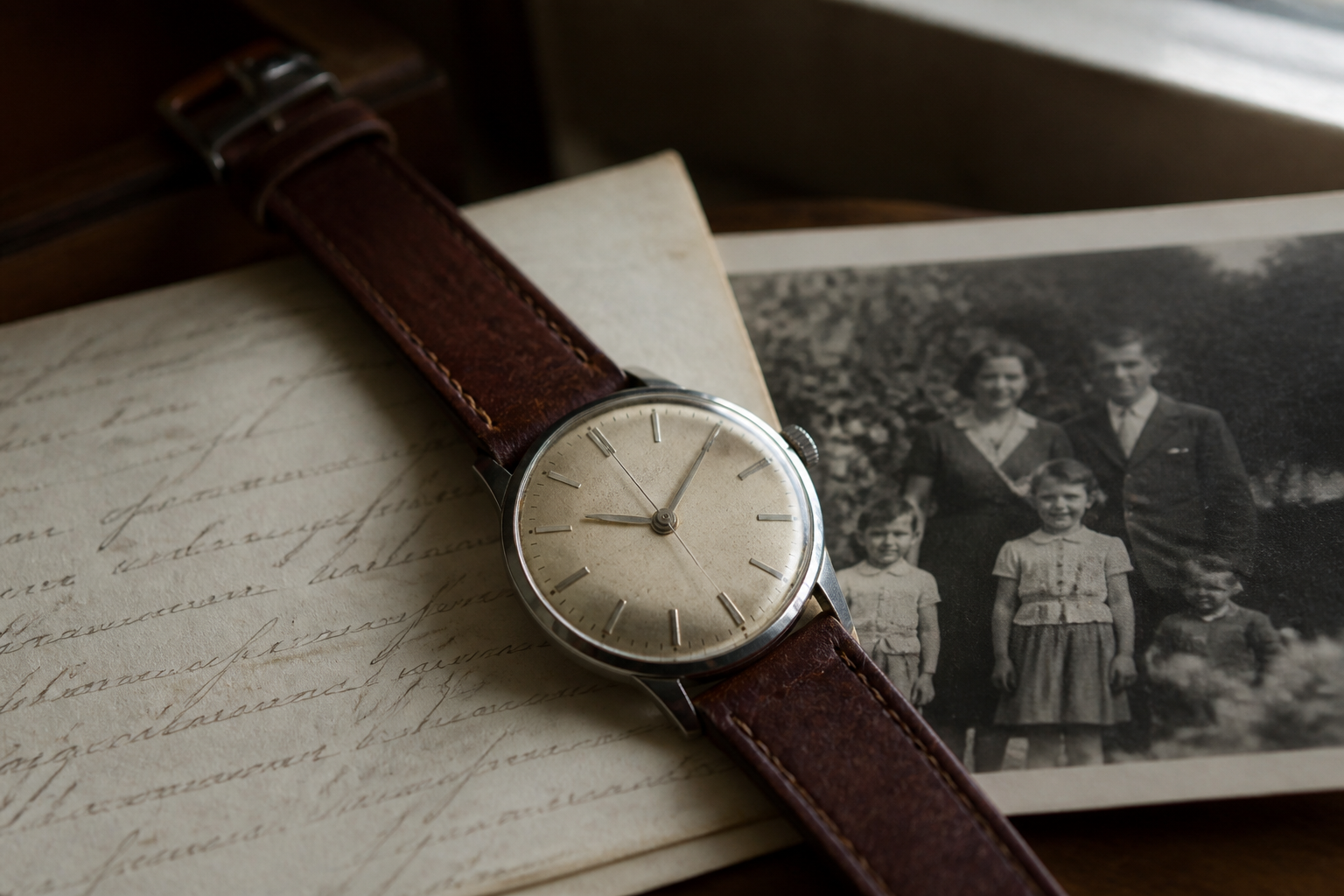
Here’s a piece of conventional wisdom I no longer buy: that locking a sentimental heirloom away in a drawer counts as “taking care of it.” It doesn’t. It’s closer to slow neglect dressed up as caution, and my grandfather’s watch is the proof. It showed up with zero fanfare — my aunt pressed a small zip-lock bag into my hand at a family gathering in 2014, no velvet box, no accompanying note. Inside sat a thin, gold-toned dress watch from the early 1960s, hand-wound, Swiss-made, carrying a signed dial I’ve never managed to pin down to a specific maker, running on what looks like an ETA base caliber typical of that era. It still ticked when I wound it that first day. A hairline scratch cut across the lower left quadrant of the crystal. The original bracelet had vanished decades ago, swapped for a brown leather strap so dried out it had the flex of cardboard. He wore it to work for twenty straight years. Beyond that, I’ve got nothing.
On the open market, it’s worth next to nothing — call it fifty dollars if the movement checks out clean and somebody happens to like the dial. I can say that with confidence after more than a decade of watch collecting, having watched enough humble, unsigned Swiss dress watches from 1960 cross the auction block. And that certainty, oddly enough, is exactly what held me back.
Why I Let It Sit for Eight Years
I never wound it again after that first afternoon. It went into a soft cloth, then a small wooden box on my dresser, then — bit by bit, over the following weeks — further and further toward the back of a drawer. I told myself this was for its own protection. Really it was fear: fear of breaking something one-of-a-kind, fear that a watchmaker chasing a repair might scuff the original dial in the process, and if I’m honest, fear of dropping $200 on something worth $50 and then having to justify that to the more rational version of me.
This, I’ve come to notice, is the standard fate of sentimental objects. We guard them so fiercely against damage that we forget the whole point was ever to use them. Eight years slipped by that way. The watch stayed dark and motionless, its remaining lubricant slowly evaporating and thickening into sludge. I wasn’t preserving a single thing. I was just delaying the inevitable.
What Actually Happens to a Watch That Never Runs
Here’s the piece of knowledge I wish I’d had eight years sooner, and it’s worth passing along if you’ve got something similar tucked away right now. A mechanical watch doesn’t age the way a photograph does — sitting untouched doesn’t harm it through exposure. What it does do is harm it through stillness. The oils packed into a movement are engineered to stay fluid under normal wearing temperatures and the light jostling of daily use. Take that away, and the oils dry out. They creep off the surfaces they’re supposed to be protecting. Eventually they can thicken into something closer to paste — arguably worse than having no lubrication whatsoever.
A watch worn and wound consistently isn’t necessarily headed toward service any faster because of that use — if anything, the reverse can be true. But a watch that’s gone dormant for five years or longer almost certainly needs a look before it goes back into daily rotation, no matter how gently it was tucked away.
Finally Sending It Out for Service
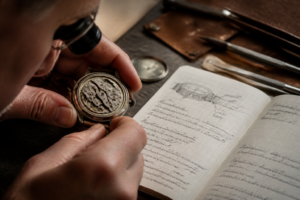
By 2022 I’d handed it over to a watchmaker I’ve relied on for years — a solo operation, no website to speak of, someone I found through a local collectors’ group. He’d already earned my trust years back with a 1968 Omega Seamaster, so this felt like familiar territory. Before he ever popped the caseback, I made two things clear: this watch carries sentimental weight, not financial weight, and I wanted the original dial left alone almost no matter what it cost me in functionality.
That second point matters far more than people tend to give it credit for. Spell it out for whoever’s servicing your piece: the dial is original, and it stays that way. A watchmaker who refinishes a scratched-up dial isn’t being careless — a fresh-looking dial can genuinely raise the price on a watch headed for sale. But on something inherited, that same refinishing job just erases its history. So say it directly: no refinishing, no reprinting, no aggressive cleaning of the dial. Nearly every watchmaker I’ve dealt with will honor that request without pushback.
What Turned Up Once He Cracked It Open
Ten days later the report landed, and it confirmed every suspicion I’d been carrying. The movement was ticking, yes, but badly — running about four minutes fast per day, a real problem for a dress watch that ought to hold within a minute or two under ideal conditions. The oils had dried up entirely in places. The crown gasket, whose entire job is sealing the winding stem against dust and moisture, had gone brittle and split. It was doing essentially nothing at that point.
He also flagged some light wear in the keyless works — the small assembly responsible for winding and setting the hands — which accounted for that faint grittiness I’d felt when adjusting the time. Nothing had failed outright. Nothing needed swapping beyond the gasket and the usual consumables. All told, this turned out to be about as uneventful a service as a watch this old could hope for.
Grand total: $175. And the watch, once again, is worth roughly $50.
Why That Arithmetic Doesn’t Actually Matter
I’ve seen plenty of people run these numbers and then bail on servicing something they actually care about. The logic feels airtight on its face: why pour $175 into a $50 watch? But that framing quietly treats the watch as an investment vehicle, which it has never once been and never will be. Fifty dollars is what a stranger would pay for it. What it’s worth to me isn’t a figure I can put on a spreadsheet — and, practically speaking, that unquantifiable number is the only one that actually decides whether I spend the money.
Servicing doesn’t make a watch like this worth more to anyone else. What it does is give it function back. And function is what lets me actually wear the thing, which is the only thing that turns an object into something meaningful again. Left in a drawer, it’s just an artifact. On my wrist, it’s a watch.
My Current Storage Routine Between Wears
Once the service was done, I changed a few habits around how I treat it when it’s not on my wrist. If you’ve got an heirloom watch you’re not wearing daily, a handful of these points are worth keeping in mind.
- Pick a storage spot with steady temperature and low humidity — attics and basements are basically hostile territory for a mechanical movement. A bedroom drawer works well enough. A proper watch box with a silica gel packet inside is a notch better.
- Skip storing it fully wound. Cranking a hand-wind watch tight before shelving it for a month just leaves the mainspring under strain for no reason. Save the winding for right before you put it on.
- Steer clear of magnets. Speaker cabinets, phone chargers, and magnetic bag flaps can all magnetize a movement, and a magnetized movement runs fast. Give vintage pieces a six-inch buffer from anything magnetic.
- If it’s been dormant for over five years, get it checked before wearing it regularly. Running dry components grinds metal against metal with nothing cushioning the contact — and a service will always cost less than a replacement part, let alone a replacement movement.
Telling Urgent Service Apart From Service You Can Postpone
Not every old watch is screaming for attention right now. If it’s holding time within roughly 30 seconds a day, was last serviced somewhere in the past seven to ten years, and you’re wearing it casually rather than depending on it for precision, waiting a bit longer is usually fine. That said, a few red flags push service from optional to urgent: drifting more than two minutes a day in either direction, stopping cold even after a full wind, a crown that feels gritty or slips while setting the time, or any hint of moisture fogging up under the crystal.
A cracked crystal by itself isn’t a full-blown emergency, but it does mean the watch has lost its barrier against dust and moisture — so get it swapped promptly. A watchmaker can knock that out alongside other work, or handle it on its own for somewhere between $20 and $40 if it’s a simple flat mineral crystal.
What This Watch Means to Me Now, Worn Regularly
These days it mostly comes out on Sundays. It slides slim beneath a cuff and holds time within about 45 seconds a day, which quietly pleases me given it’s 60 years old and worth less than the lunch I’ll eat while wearing it. The dial has developed a patina no relacquering job could ever fake — that cream warmth only comes from decades of extremely gradual oxidation. The scratches on the hands haven’t gone anywhere. The new gasket is invisible, as it should be. Altogether, it looks exactly the way it’s supposed to.
My grandfather passed before I was old enough to ask him a single question about it. I don’t know what he paid, whether it was purchased or given to him, or whether he gave it much thought at all. That absence of information used to sit like a loss. Now it feels more like permission — permission to wear it, to wind it on Sunday mornings, to let it keep gathering its quiet history on my wrist instead of in the dark.
Nothing about this watch taught me anything I hadn’t already understood on paper. What it did was let me actually feel the cost of putting things off. Eight years in a drawer accomplished nothing for anybody. One hundred seventy-five dollars and ten days handed me something I get to wear every single week. That’s a trade I’ll make without a second thought.
About This Article

Written by Ellen Ashford. Watch collector, fountain pen enthusiast, and lifelong journaler. Time & Ink is where I explore the craft of analog living — from vintage timepieces and fine stationery to the simple pleasure of putting pen to paper. More about this site.
Verify this against a primary source
Specifics change, and your situation may differ from the one described here. These are the authorities worth checking directly:
- NAWCC — horological reference, archives and research library
- Smithsonian Institution — collection records for historic timepieces and writing instruments