Ask around in pen collecting circles long enough and you’ll hear two completely contradictory pieces of advice about a pen with cement-hard ink in the feed. Camp one says the pen is done — retire it, harvest it for parts, move on. Camp two says give it an overnight soak in plain water and it’ll almost certainly come back. Camp two is right, and camp one is wrong in a way that costs people money and sentimental pens they didn’t need to lose. I’ve been servicing my own fountain pens at the kitchen table for more than ten years now, and reviving a dried-out one is, hands down, the most practically useful thing that skill set has taught me. It’s spared me from buying replacements I resented spending money on, brought back pens with real family history attached, and taught me more about how a feed actually functions than every article I read on the subject combined.
The pen at the center of today’s walkthrough is, frankly, the most embarrassing case in my own rotation: a medium nib, loaded up with a carbon-based permanent ink — the artist-grade kind — then left sitting untouched for a little over a year. Yes, a full year. By the time I rediscovered it, that ink had cured into a dark, waxy plug lodged somewhere inside the feed, and the nib wouldn’t budge. What follows is exactly how I brought it back to life, stage by stage, along with the specific signs that would have told me it needed a repair person instead of a kitchen sink.
Why Taking the Nib and Section Off the Pen Is Always My First Move
Water doesn’t touch the pen until I’ve taken it apart. On most cartridge-converter pens today, that’s simply a matter of unscrewing barrel from section, pulling the converter or cartridge free, and setting the barrel to the side. What remains is the nib-and-section unit, which is the only part actually holding onto the dried ink. Trying to work on the whole assembled pen is a waste of both time and water, and worse, it hides what’s actually happening inside the feed from view.
The feed itself is the ebonite or plastic piece nestled just under the nib, cut with a series of channels and thin ridges — collector fins — whose job is regulating ink flow through capillary action while also managing air exchange. Once ink hardens inside those fins, the whole mechanism freezes solid. That’s the real target of this whole process: not the ink sitting visibly on the nib’s surface, but the ink buried inside the feed’s internal architecture.
On my neglected pen, I could see the permanent ink had crept up into the channel grooves and set there like a resin. The tines — those two prongs forming the writing point — sat with a slight gap between them, which told me the ink had shrunk as it dried and left no flexibility behind. I set the nib-and-section unit aside and filled a small glass with water straight from the tap at room temperature.
Soaking It Overnight — and Why the Water Temperature Isn’t Negotiable
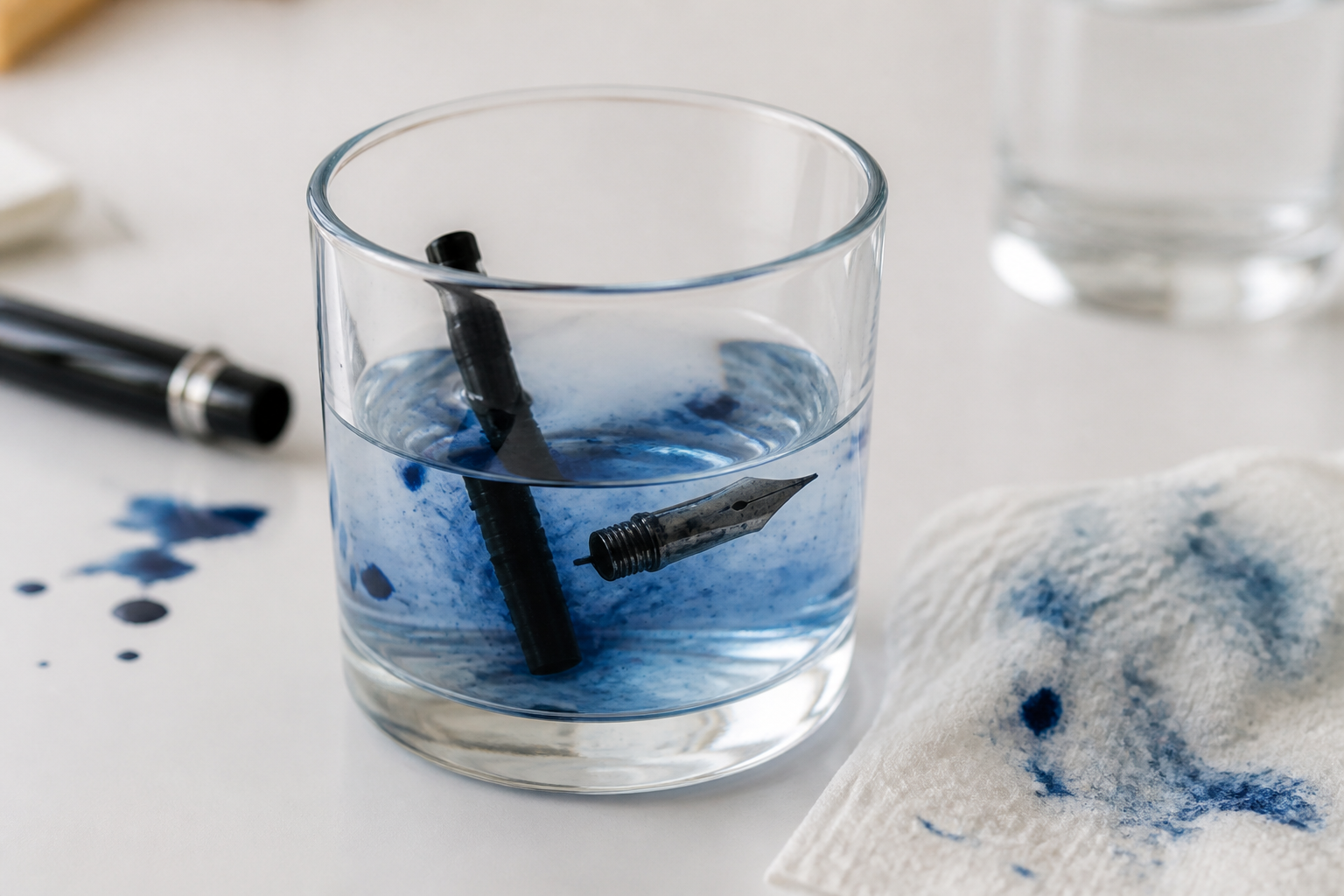
Nib pointed downward, I lower it into roughly an inch and a half of water — just enough to cover the nib and the first quarter inch of the section above it. Then I walk away from it for the night. Eight hours minimum, though I’ll stretch that to twelve if permanent or iron gall ink is involved.
Room temperature, not warm, not hot — this part I won’t budge on. Heat expands materials at different rates depending on what they’re made of. Acrylic section, ebonite feed, steel nib — three different expansion coefficients under the same heat source. Warm water can split a feed, loosen a nib that was only ever friction-fit, or permanently warp an old section. I found this out the expensive way on a celluloid pen I handled carelessly during my second year collecting. A hairline fracture opened right along the feed’s main channel. The pen still wrote, technically, but it was never the same afterward. That particular pen had cost me around $90 at an estate sale and was worth quite a bit more than that. Lesson learned: cold or room temperature, no exceptions.
Come morning, the water in the glass had gone a murky grey-brown from the carbon pigment leaching out. That discoloration is precisely the sign I’m hoping for — proof the pigment had begun letting go of the feed channels.
Flushing It the Next Morning — and Knowing When the Water’s Actually Clear
Once it’s soaked overnight, I carry the nib and section to the sink and let a gentle, steady trickle of room-temperature water run through them, aiming to push the dissolved ink forward through the channels and out the nib slit. I keep this up for roughly two minutes, then hold the section up against a light source and check through the fins of the feed.
What I’m watching for is color in the runoff. Any tint at all means another round. With most dye-based inks — Waterman, Diamine, the bulk of Pilot’s lineup — a single overnight soak followed by a five-minute rinse gets the job done. My permanent-ink pen, on the other hand, needed three separate overnight soaks spread across three days before the water finally ran clear. That’s not a sign of failure — pigment-based and shellac-bound inks simply behave that way.
What I’ve found over the years is that patience at this stage prevents grief down the line. Push a still-seized nib into writing before the feed is genuinely clear and you risk scratching the paper with leftover pigment grit, or worse, scoring the tipping material on the nib itself.
Bringing In a Single Drop of Dish Soap
When a second overnight soak still doesn’t clear the water noticeably, I introduce exactly one drop of plain dish soap into the glass — the kind that falls on its own from an angled bottle, no squeezing required. Dish soap runs mildly alkaline and works as a surfactant, cutting the water’s surface tension so it can actually get into the feed’s internal channels rather than beading around them.
That said, any soap soak gets followed by a serious plain-water rinse afterward — three full minutes under the running tap, minimum. Leftover soap residue in the feed causes feathering and erratic ink flow the next time the pen’s inked up. Residue sitting specifically in the collector fins can trap tiny air bubbles, which translates to a pen that skips at random for weeks afterward.
Reaching for Ammonia — Only as a Last Resort, With Real Warnings Attached
For ink that simply won’t quit — shellac-based formulas especially, since they polymerize as they cure and turn genuinely chemical-resistant — I’ll mix a weak ammonia solution: one part household ammonia to nine parts room-temperature water. Ammonia’s alkalinity breaks down shellac and certain polymers that plain water never will. I limit the soak to thirty minutes max, then flush it out completely.
The cautions here are non-negotiable, and I’m not going to trim them down:
- Skip ammonia entirely on any pen with a natural rubber sac — it eats through rubber fast, and the damage often stays invisible until the sac ruptures under pressure, sometimes weeks down the road.
- Keep ammonia away from aluminum parts too, including certain vintage trim rings and some modern converter components — it corrodes the metal.
- Hot water has no place anywhere in this process, whether you’re mixing the ammonia solution or rinsing it out afterward.
- Do this somewhere with airflow. A 10% ammonia dilution isn’t overwhelming, but it’s unpleasant enough in a closed-up room.
If you can’t confirm whether your pen has rubber sac parts inside, assume it does and act accordingly. Vintage pens from roughly the 1920s through the 1960s — lever-fills, button-fills, vacuum-fills — almost certainly used, or still contain, natural rubber sacs. It isn’t worth the gamble.
Recognizing When a Pen Is Past My Own Skill Level
After my permanent-ink pen had gone through its full three days of soaking, I gave it a close visual once-over before putting it back together. Three specific red flags were on my checklist: cracking anywhere in the feed, tines that had sprung out of alignment, and a section refusing to release its grip on the feed cleanly.
Even a hairline crack in the feed guarantees uneven flow or leaking that cleaning alone will never resolve — that calls for a replacement part, assuming one’s even available. Sprung tines, where the nib’s two prongs have drifted apart or crossed each other, can occasionally be coaxed back into alignment with careful, precise pressure, but I don’t attempt that on any nib I’m attached to — that’s a nibmeister’s territory, running roughly $20 to $50 depending on the pen and the extent of the adjustment. A shellacked section, where the feed’s been bonded in place with shellac instead of simply friction-fit, calls for an entirely different disassembly approach, usually involving gentle heat to soften the bond, and that’s well past a weekend rescue project.
My pen, thankfully, checked out fine on every count. Feed intact, tines aligned properly, and once it had gone through a final rinse and dried for twelve hours, it took a fresh fill of a cooperative dye-based ink without any fuss. The very first line it laid down was smooth, wet, and genuinely satisfying to see.
The Two-Minute Habit That Keeps Me From Doing This Rescue Very Often Anymore
Everything described above — three days of soaking, weighing whether to bring out the ammonia, anxiously inspecting the feed for cracks — was completely preventable. Here’s what I do now, no exceptions: before any pen goes into storage, it gets flushed. Two minutes of room-temperature water through the nib and section alone, until it runs clear. Then it sits nib-down on a folded paper towel for an hour, wicking out whatever moisture’s left, before it goes into the drawer bone dry.
That’s the whole trick. Two minutes at the tap now saves months of soaking later. A pen stored dry and empty can sit untouched for years and still be writing again within ten minutes. A pen stored with ink still drying inside it — permanent, iron gall, anything pigment-based especially — can take days to bring back, and sometimes never fully recovers.
I’ve collected long enough to know I won’t always follow this advice myself. Life gets busy; pens get set down and forgotten. But when that happens, you’ve now got the whole routine in hand: take it apart, soak overnight in room-temperature water, flush the next morning, work up carefully to soap and then ammonia if it’s called for, and recognize the point where it needs someone with better tools than a kitchen sink. Most pens that seem beyond saving really aren’t. They just need time, a bit of patience, and water at the right temperature.
Reviving a Dried Pen: Common Questions
I replaced the cartridge and it still will not write. What now?
The blockage is not in the cartridge — it is in the feed and nib, where ink dried into the channels months ago. A fresh cartridge cannot push through a plugged feed, which is why swapping it changes nothing.
Take the cartridge back out, pull the nib and feed from the section if the pen allows it, and soak the nib and section overnight in cool water with a single drop of dish soap. Flush the next morning until the water runs completely clear, dry it, then re-ink. If the pen does not come apart, soak the whole front end with the nib submerged and the barrel dry.
One thing not to do: squeezing the cartridge to force ink through. It cracks the collar and produces a leak rather than a fix.
What is best to soak old pens in overnight?
Cool or room-temperature water, with one drop of washing-up liquid. That is genuinely it for the overwhelming majority of pens, and it is what I use first every time.
If water alone has not cleared it after a second overnight soak, step up to a pen flush — commercial, or ten parts water to one part household ammonia with a drop of dish soap. Use that on modern acrylic and steel only. Never on vintage celluloid, hard rubber or casein, and never with hot water, which can loosen the shellac holding a nib and feed in place.
How long does a dried-out fountain pen take to revive?
One overnight soak clears most of them. Pens left with permanent, pigmented or iron gall ink can take two or three cycles, changing the water each time. If three soaks and thorough flushing have not restored flow, the problem is mechanical rather than dried ink, and it is time for a nib specialist.
About This Article

Written by Ellen Ashford. Watch collector, fountain pen enthusiast, and lifelong journaler. Time & Ink is where I explore the craft of analog living — from vintage timepieces and fine stationery to the simple pleasure of putting pen to paper. More about this site.
Verify this against a primary source
Specifics change, and your situation may differ from the one described here. These are the authorities worth checking directly:
- NAWCC — horological reference, archives and research library
- Smithsonian Institution — collection records for historic timepieces and writing instruments