Sitting in my pen cup at this very moment is a Pelikan M200 with a faint ghost of iron gall staining near the feed — a scar left by a clog that took three full weeks of soaking to undo. That pen is also the reason strangers write to me more often about clogs than about nibs or ink colors, usually asking some version of the same question: why did my fountain pen quit writing after two weeks in a drawer? I understand the frustration firsthand. Figuring out how to clean a fountain pen and prevent clogs reshaped my entire relationship with this collection. Before I had an actual maintenance rhythm, that M200 nearly became a paperweight, dried solid by an iron gall ink I’d left sitting too long. What followed was three weeks of patient soaking, more than a little irritation, and language I won’t repeat here at my desk.
There’s a myth about fountain pens that refuses to die: that they’re delicate, needy things requiring constant fuss. Cleaned on schedule, the opposite is true — a properly flushed pen will outwrite a ballpoint for reliability. My vintage Pilot Custom 74s and a well-worn Lamy Safari have served as daily writers for years now without so much as a hint of a clog. What separates a pen that behaves from one that doesn’t isn’t luck, it’s routine. What follows is the actual system I use, from the five-minute weekly flush up through the full teardown clean, plus the specific tools that genuinely earn their place on my desk.
What’s Really Behind a Clogged Fountain Pen
Prevention only works once you understand the mechanism you’re up against. Clogs trace back to three culprits: leftover dried ink sitting in the feed’s channels, buildup from pigment or shellac-heavy formulas, and residue left behind when you switch inks without flushing thoroughly first. That feed sitting beneath the nib — plastic on most modern pens, ebonite on some vintage ones — relies on capillary channels finer than 0.5mm to pull ink up to the tipping. It doesn’t take much dried pigment to seal one of those channels shut completely.
Iron gall formulas cause the most damage of any category. Their acidity can eat away at metal parts if you let them sit too long unused. Pigmented inks — Platinum Carbon Black, Sailor Kiwa-Guro, that sort — look gorgeous on paper but will set up like cement inside a pen if left more than a week or two without use. Dye-based inks, the Diamines and Iroshizukus I reach for most, are considerably more forgiving in my experience. Even so, an uncapped pen left unused long enough will eventually give you trouble too.
Temperature plays a role as well. My daily-use pens stay out on the desk, while the rest of the collection lives in a case shielded from direct sun. Warmth speeds up evaporation through the nib, concentrating whatever ink remains and hastening a clog. Once you know these underlying causes, you can size your cleaning schedule to the actual risk level — rather than treating maintenance as something you only think about after a pen has already failed.
The Weekly Flush I Run on Pens I Use Every Day
Take the pens in regular rotation right now — a Pilot Custom 74 with a medium nib and a TWSBI Eco in fine — each gets a quick flush once a week, under five minutes total per pen. Rather than topping off the cartridge or converter the moment it runs low, I hold off and run the pen nib-down under a gentle stream of lukewarm water instead, letting it pass through the feed. I keep that water in the 30–35°C range; anything hotter risks warping an acrylic section or breaking down the seals over time.
With a piston filler like the TWSBI Eco, I draw up and expel plain water three or four cycles, stopping once what comes out runs completely clear — that’s my signal the feed is clean. Cartridge-converter pens get the same treatment after I pull the converter free. None of this takes much effort. What actually stops clogs isn’t any single thorough cleaning — it’s doing this small thing on repeat.
Skip this for three or four weeks running, though, and the trouble compounds fast. I once let a Kaweco Sport loaded with Diamine Ancient Copper sit forgotten on a shelf for about a month. A flush that should have taken five minutes turned into a two-hour soak-and-scrub session. Ancient Copper throws a beautiful sheen, but it carries enough iron content to oxidize over time. The takeaway stuck with me: steady, minor upkeep will always beat an emergency rescue clean.
Deep Cleans: Knowing When One’s Actually Necessary
Three scenarios call for a full deep clean in my book: a major ink-color swap (dark navy to bright orange, say), a pen that’s sat idle past the three-week mark, or a pen writing unevenly despite having plenty of ink on board. When it’s time, I take the pen apart as far as its design permits. A Lamy Safari or AL-Star lets the nib-and-feed unit pull straight out of the section — they’re friction-fit and separate without a fight. A Pilot Metropolitan’s nib unit simply unscrews.
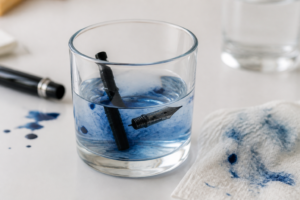
I let the nib and feed soak together in a small glass of room-temperature water, anywhere from 30 minutes to 2 hours depending on how stubborn the residue is. When dried ink refuses to budge — iron gall and pigmented inks especially — I’ll add a drop of Rapido-Eze pen flush, or failing that, a touch of dish soap, to the soak. Once it’s done soaking, a soft cotton cloth handles the wipe-down on the nib itself. Paper towels never touch a nib tip in my process; they’re more abrasive than they look and can wear down the tipping material on finer points over time.
Most of the truly stubborn gunk hides inside the feed’s channels, not on the nib. A gentle back-flush — sending water backward through the feed instead of forward — reaches debris that a standard flush never touches. That’s exactly the gap a proper cleaning tool fills, and it’s how I landed on the specific product that now handles every deep clean in my collection.
The Bulb Syringe That Made Deep Cleaning Actually Predictable
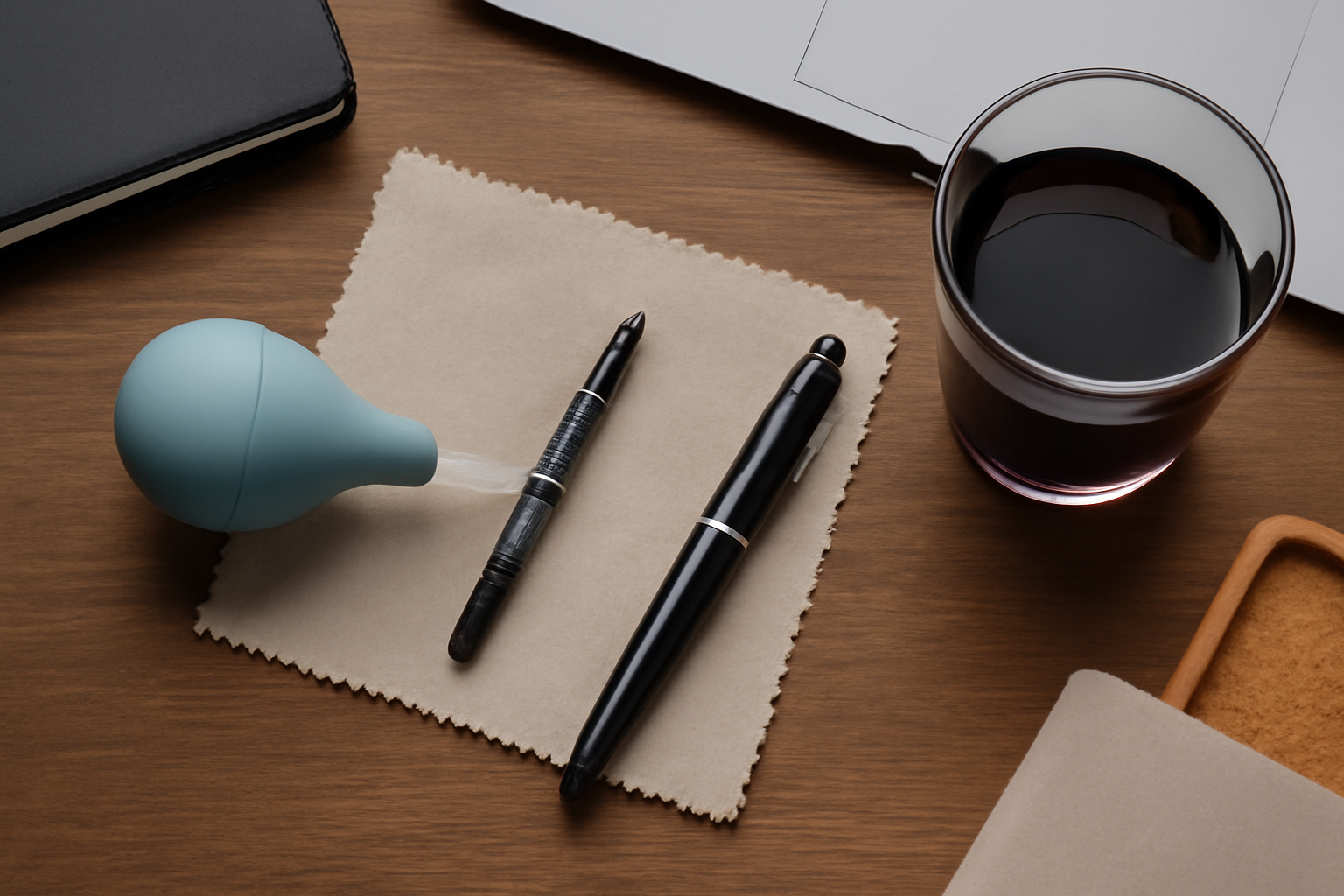
A bulb syringe turns pen cleaning from anxious guesswork into a controlled, repeatable process. Rather than submerging a pen and crossing your fingers, you can aim water precisely at the trouble spot — straight through the feed, around the nib, into the converter itself.
Where It Delivers
- Squeeze pressure is easy to modulate with the soft bulb — enough force to break loose dried ink, but gentle enough to spare a fragile nib or feed from cracking.
- At 2oz, the capacity hits a genuine sweet spot: enough volume to flush several pens on one fill, small enough that a single hand manages it while the other holds the pen steady.
- Buying the pair means one lives permanently at my desk for the weekly flush while its twin rides along in my travel kit — no more skipping maintenance just because I’m away from home.
Where It Falls Short
- This isn’t a substitute for soaking — a pen neglected for months still needs a warm-water bath to loosen dried ink before the syringe can do anything useful.
- In a shallow sink or narrow water cup, the bulb’s size gets in the way, and you’ll likely splash yourself now and then getting the angle right.
I was skeptical that a medical syringe would make any real difference until I used it to rescue a pen I’d already mentally written off as dead. Now I reach for it before every refill. Grab the 2 Pack Ear Syringe 2oz / 60ml Hand Bulb Syringe and keep one within arm’s reach of wherever you write.
About This Article

Written by Ellen Ashford. Watch collector, fountain pen enthusiast, and lifelong journaler. Time & Ink is where I explore the craft of analog living — from vintage timepieces and fine stationery to the simple pleasure of putting pen to paper. More about this site.
Verify this against a primary source
Specifics change, and your situation may differ from the one described here. These are the authorities worth checking directly:
- NAWCC — horological reference, archives and research library
- Smithsonian Institution — collection records for historic timepieces and writing instruments