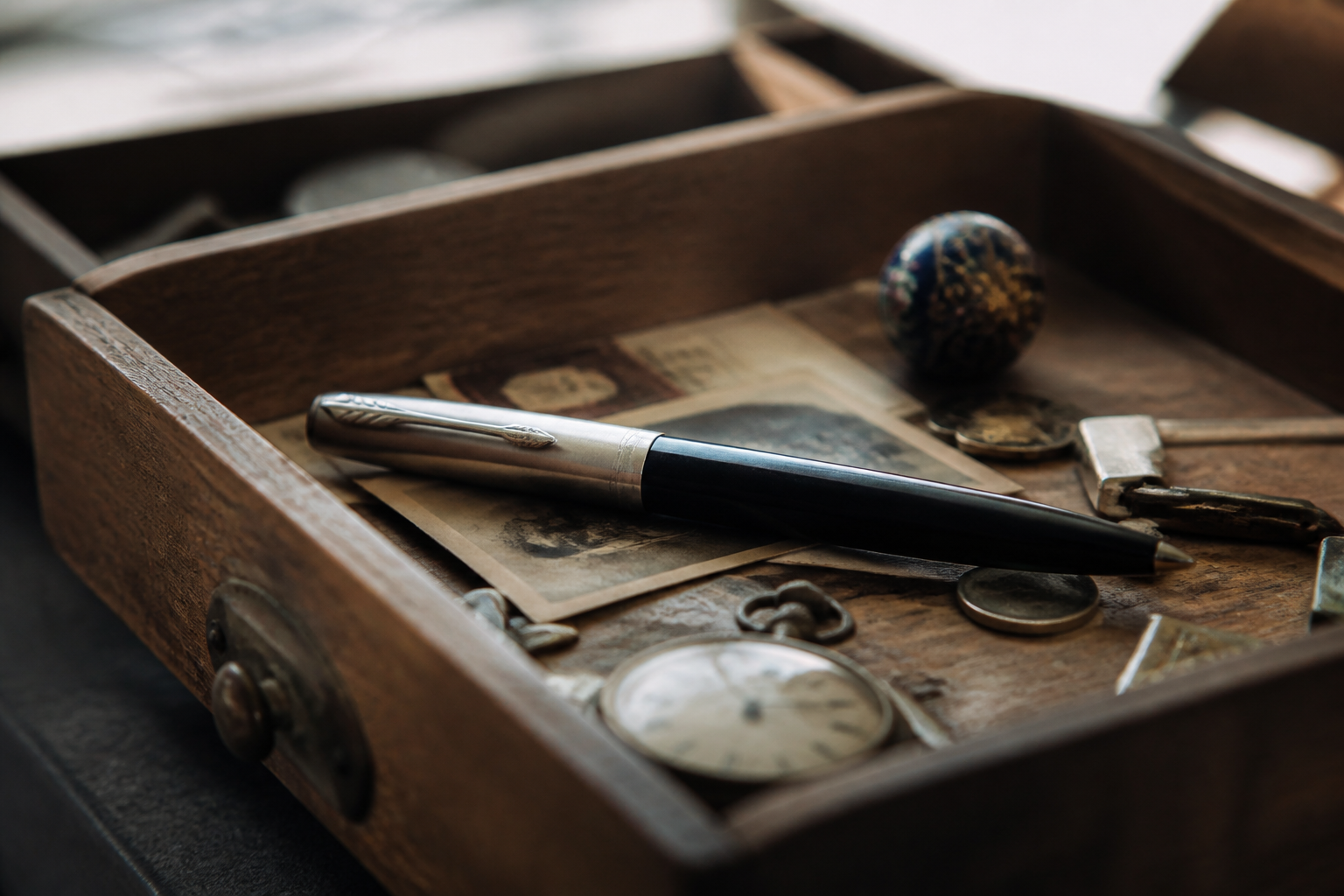
Years back, cataloging a different pen entirely, I wrote in my journal that a “clean” Parker 51 nib meant no hard starts and left it at that — no mention of feed condition, no note on the section threading, nothing about the cap lip. I look at that entry now and wince a little, because the eight-dollar pen sitting in front of me is the reason I learned to look harder before I write anything down. It turned up loose in a flat wooden drawer at a shop in Mineral Point, Wisconsin, the sort of establishment where a case of arrowheads leans against a stack of 1970s Reader’s Digests and a basket of stray salt shakers. I nearly walked past the drawer altogether. It was marked “Pens & Pencils — Make Offer,” and everything inside looked like it — dried-out ballpoints, a couple of mechanical pencils with snapped clips. I nudged a clutch pencil aside without much hope and there it was: that profile, that hood.
The Detail That Gave It Away Instantly
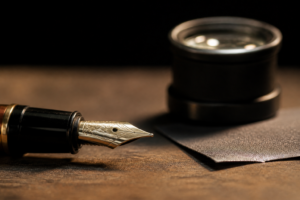
Nothing else on a Parker 51 announces itself quite like the hooded nib, and once your eye learns it, you spot it across a room. Nearly every other fountain pen shows its nib openly — tines, breather hole, engraving, all visible. The 51 tucks nearly the whole thing into a section collar, so only a thin edge of metal peeks out, and from the side the pen almost reads as a capless rollerball. Parker engineered this in the early 1940s to accommodate their Superchrome ink, a formula corrosive enough that it couldn’t touch exposed metal. That ink didn’t survive long-term, but the hood stuck around because people loved how quickly it dried and how instantly it laid down a line.
What I pulled out of that drawer was grimy — dark buildup along the cap seam, a clip oxidized to a flat bronze, a barrel the color of dishwater left standing too long. Still, the silhouette gave it away instantly. I turned it over in my hand: there was the arrow clip, Parker’s signature design pointing up toward the cap top. The threading on the section held firm. No cracks jumped out at me. When I asked the woman behind the counter what she wanted for it, she didn’t look up from her phone. “Whatever the sign says.”
The sign said two dollars. I handed her eight anyway. Somebody had let this thing sit in a drawer long enough for me to find it, and that felt worth a few extra dollars.
Working Out Its Age Before I’d Even Left the Parking Lot
I sat in my car for a solid fifteen minutes, pen in one hand and phone in the other. Pinning down when a Parker 51 was made isn’t difficult once you know the trick. On most pens built after 1948, Parker stamped a small date code into the barrel near the end — a quarter and a year, something like “2/52” for the second quarter of 1952. Mine read “4/52,” the fourth quarter of that year. That puts it right in the Aerometric era.
Why that distinction matters is worth explaining. Parker built the 51 around two main filling systems. The earlier one, running roughly 1941 through 1948, was a vacuum filler — an elegant but fussy mechanism built around a long metal rod you depress to draw ink into the barrel. Gorgeous when they work, but after 70-plus years, the sacs and seals often need real attention. The Aerometric system, arriving in 1948, swaps that out for a softer PVC “Pli-Glass” sac housed inside a metal collector shell, and it holds up remarkably well over time. My own experience says an Aerometric that was cleaned and dried before it went into storage can still flex and fill perfectly decades later. This one did.
A Closer Look at the Barrel Itself
The material Parker used for the barrel says something about age, and for some collectors, about value too. The very earliest 51s were made of celluloid — the same nitrocellulose plastic found in old eyeglass frames and early film stock. Celluloid has a depth and translucency you just don’t get from Lucite; light seems to move around inside it. Around 1948, Parker switched to Lucite, an acrylic resin that’s more stable, resists shrinkage better, and doesn’t off-gas the way celluloid can over time. Mine, from 1952, is Lucite — a deep “Cordovan Brown” that had gone chalky with oxidation on the surface. Underneath that haze, though, the color was still there, rich as ever.
I went looking specifically for cracks along the barrel seam near the section — a known weak point on these pens — and found nothing. The cap lip is actually the more common failure point, and sure enough, mine had a hairline fracture roughly 4mm long. Purely cosmetic, no structural concern. I logged it mentally and kept going.
The Cleanup, Done at My Kitchen Table That Night
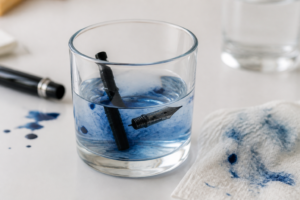
I don’t do rushed cleanups. That evening I filled a small glass with lukewarm — never hot — water and dropped the section and nib assembly in, after separating it from the barrel. Forty-five minutes of soaking later, the water had turned a pale blue-gray, evidence of dried ink still lodged in the feed channels. A Parker 51’s feed is an intricate, multi-finned collector molded from hard black plastic, and old ink can harden into those fins over the course of decades. Slowing down here costs nothing compared to what a wrecked feed would cost.
Once the soak finished, I ran a blunt syringe through the section repeatedly until the water came out clear. Then came the real test — the Aerometric sac. I gave the metal collector shell a light press with one finger, and it compressed and sprang back cleanly, pulling water straight up into the section. That moment caught me off guard. This sac was seventy years old. By rights it shouldn’t have worked at all. But PVC holds onto its plasticizers far better than natural rubber does, and a pen left dry in a drawer for decades fares much better than one that sat filled with ink the whole time.
Where I slipped up was using a final rinse that ran a touch too cold, which left a faint water mark inside the Lucite, visible only when held up to light. It cleared on its own within two days. No harm done, but it’s worth flagging — stick to room temperature water the whole way through.
Bringing the Body Back Without Overdoing It
The Lucite responded well to a gradual micromesh treatment. I moved through 3200, 4000, and 6000 grit, roughly three minutes on each, then finished with a small dab of plastic polish worked in with a microfiber cloth. Cordovan Brown came back almost entirely — deep, warm, with just a hint of translucency when the light hits it right. The clip needed nothing more than a soft cotton cloth; no chemicals near the metal at all. The arrow engraving still held enough definition that a fingernail could trace it.
I left the hairline crack on the cap exactly as it was. Trying to fill a crack in celluloid or Lucite without the right materials and enough hands-on experience tends to make it more noticeable, not less. Had it been structural, I’d have reached for a thin coat of PVA or a plastic-specific adhesive. But cosmetic cracks like this one, to my mind, are simply part of the pen’s history.
The First Time I Actually Wrote With It
The next morning I loaded it with an unremarkable blue-black — nothing showy, nothing designed to trip up a nib I didn’t yet trust. The fine nib put down a line about 0.5mm wide, steady the whole time, no hard starts, no skipping anywhere. Because the hooded design keeps ink from sitting exposed to air, it starts writing instantly even after sitting capped for hours. That’s not a minor detail. Some of my modern pens — ones that cost ten to twenty times what I spent on this Parker 51 — need a shake or two before they’ll flow reliably.
The weight and balance caught me off guard as well. It’s lighter than it looks — about 18 grams capped, around 13 uncapped — and the section is narrow by today’s standards, roughly 10mm at the grip. Anyone with larger hands might find it fatiguing over a long stretch of writing. I don’t. I filled two full pages of notes that morning without once thinking about the pen in my hand, which is really the only test that matters for a writing instrument.
The Real Lesson From This Eight-Dollar Find
I’ve spent far more money on far less pen. A modern fine-nib pen with comparable writing characteristics runs sixty to one hundred and fifty dollars, and plenty of them are genuinely good. But not one of them carries the particular weight of being 72 years old and still fully functional. The fact that the Aerometric sac survived untouched, that the feed cleared with nothing but water, that the nib asked for no adjustment at all — that tells you something about how these were built. Parker didn’t stumble into longevity with the 51. It was built into the material choices from the start.
For anyone poking around antique shops, here’s what’s worth keeping in mind: watch for the hooded nib profile, the downward-pointing arrow clip, and “PARKER” stamped into the barrel. Check the section for cracks. Check under the cap lip. Hold the barrel to the light and hunt for the date code near the blind cap. Aerometric or vacuum filler — either one deserves a closer look. Neither is harmed by a careful water soak.
Because of that eight-dollar morning in Wisconsin, this Parker 51 now sits in daily rotation next to pens that cost twenty times as much — and it holds its own. Some days it outright wins. There’s something quietly worth noting in that: an object designed in 1941 still has plenty to say about what a writing instrument ought to be. I’m glad whoever left it in that drawer did. I’m even gladder I bothered moving that clutch pencil out of the way.
About This Article

Written by Ellen Ashford. Watch collector, fountain pen enthusiast, and lifelong journaler. Time & Ink is where I explore the craft of analog living — from vintage timepieces and fine stationery to the simple pleasure of putting pen to paper. More about this site.
Verify this against a primary source
Specifics change, and your situation may differ from the one described here. These are the authorities worth checking directly:
- NAWCC — horological reference, archives and research library
- Smithsonian Institution — collection records for historic timepieces and writing instruments