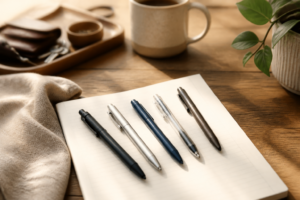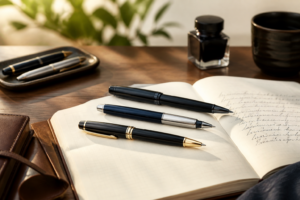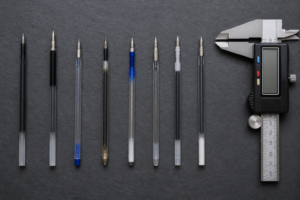
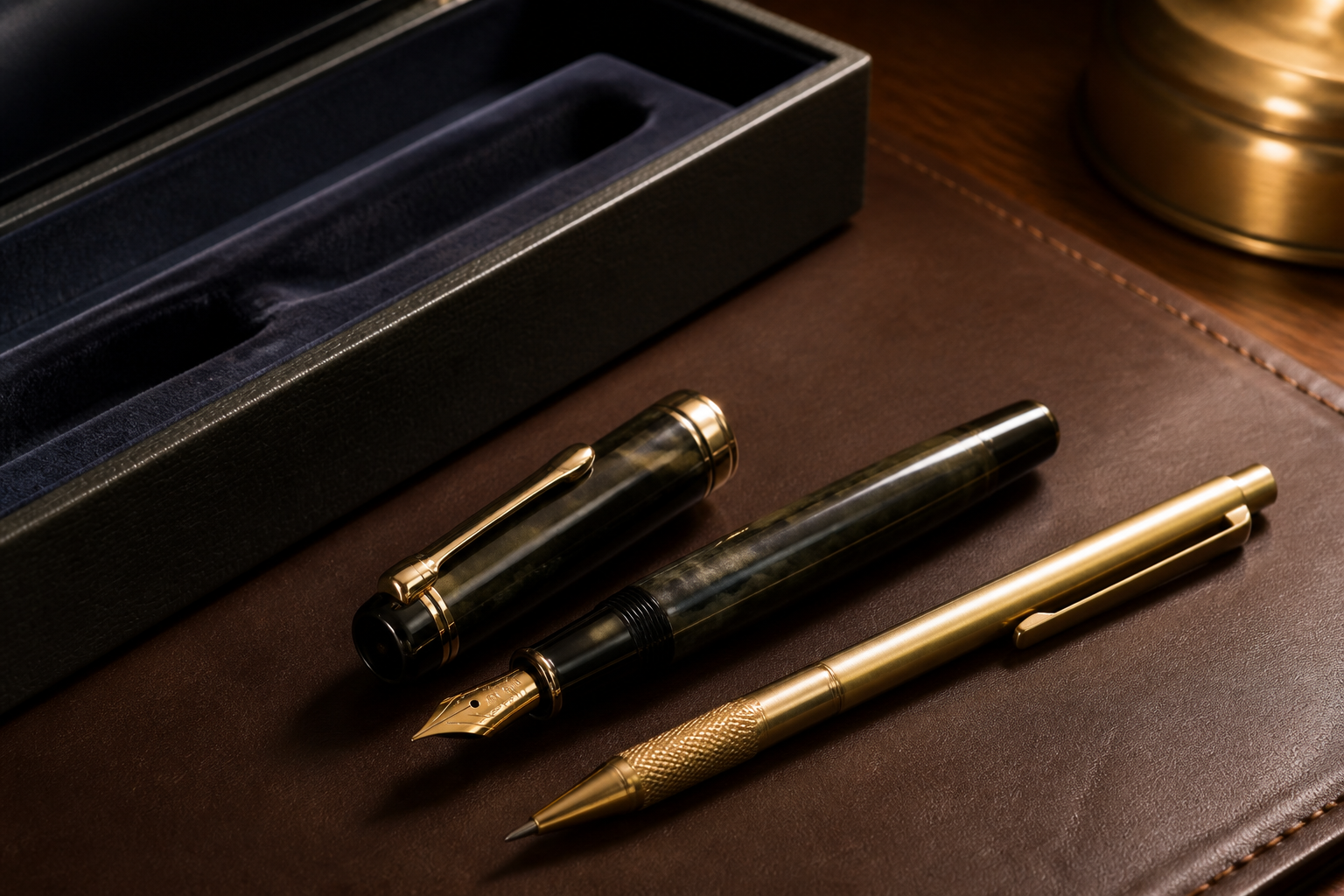
So you’ve got a Lamy 2000 sitting on the desk, or maybe a Pelikan M400 someone gave as a graduation present — and the question nagging at you is what pencil could possibly sit next to it without looking wrong. The fountain pen itself isn’t the problem. Metal barrel, weighted just right, the sort of thing that makes putting words on paper feel like a decision rather than an accident. Then you go looking for something to jot a note with, and what turns up is a giveaway plastic pencil from some hotel conference room. The spell snaps. A pen you paid $400 for shouldn’t have to share a desk with something that undercuts it.
I field this question all the time at Time & Ink. Somebody’s holding a Sailor Pro Gear, or a vintage Cross, or a TWSBI — either it’s theirs or it’s about to be a gift — and they want a mechanical pencil that visually belongs beside it, not a two-dollar throwaway rattling around the same gift box looking out of place.
Ten-plus years of running pencils through their paces — everything from bargain bin sticks under $10 to limited-run imports out of Japan — has taught me that the pairing question deserves more thought than most people give it. Material, proportion, weight, finish: they all pull weight here. Below is how I sort out which mechanical pencil belongs with a luxury fountain pen set, plus the specific models I keep coming back to.
What Actually Makes a Pencil and a Fountain Pen Look Like a Set
This isn’t sentimentality dressed up as design advice. There are four concrete criteria that decide whether a pen and pencil sitting side by side look deliberate or just thrown together.
Getting the Material and Finish to Agree
A fountain pen built from metal calls for a metal-barreled partner. Set a Lamy 2000 — brushed stainless — beside a plastic pencil and the mismatch announces itself instantly. Your eye files them under two different categories before your brain even weighs in.
The same logic applies to resin and lacquer pens — Pelikan, Sailor, Montblanc, that world — which look right next to pencils cut from the same material family. Glossy black resin beside glossy black resin reads as planned. Brass next to brushed steel works. Anodized aluminum beside aluminum works.
The finishes don’t need to match exactly — they just need to be speaking the same material dialect.
Getting Length and Proportion Right
A pencil that reads as noticeably stubbier or thinner than its pen looks like it was grabbed as an afterthought. From what I’ve seen, aim to keep your mechanical pencil within roughly 5mm of the fountain pen’s capped length. The barrel width should read as a smaller sibling of the pen’s — not a toothpick standing next to a baton.
If you’re assembling a matched set for a desk tray or a gift box, this proportion isn’t cosmetic trivia — it’s what your eye is unconsciously checking for before it decides the pair belongs together.
How the Pair Should Feel in the Hand
Pick both up and they should feel like they came from the same family, not like two objects pulled out of unrelated drawers. Pair a featherweight plastic pencil with a dense metal fountain pen and your hand notices the imbalance immediately.
The pencil wants some real heft — enough to register as substantial, but not so much that your hand tires halfway through a long writing session. As a target, I keep both instruments somewhere in the 20–35 gram window.
Clip Design and Metal Color
If pen and pencil are riding in the same pocket or the same leather sleeve, their clips need to get along. A polished chrome clip on one next to a matte gunmetal clip on the other creates a visual clash nobody asked for.
Keep the metal tones consistent — gold with gold, steel with steel. It’s a minor detail on paper, but it’s exactly what separates a curated pairing from two things that just happen to sit near each other.
Five Mechanical Pencils Worth Pairing With a Serious Fountain Pen
Keeping those four criteria in mind, here are the five pencils I reach for again and again when someone asks me this exact question. Each one fits a different budget, look, and use case.
1. Pentel Sharp Kerry (0.7mm) — The Budget Winner
The Pentel Sharp Kerry Mechanical Pencil in 0.7mm, Black Barrel is my go-to recommendation for anyone pairing with a mid-range resin fountain pen like a Lamy Safari, Lamy Al-Star, or Pelikan M200. It costs $15.96, and it feels nearly twice as expensive the moment you pick it up.
What makes this one work is a brass counterweight hidden inside the barrel. That bit of metal gives the Kerry a sense of heft and purpose that its plastic shell doesn’t let on. Capping it feels almost ceremonial, and it protects the tip too — a nice touch for something going into a gift box. The barrel width lines up well with most luxury pens, and the capped length lands right where it needs to for pairing purposes.
Works well alongside: Lamy Safari, Lamy Al-Star, Pelikan M200, Pilot Metropolitan, and most entry-level Japanese pens.
Where it falls short: the exterior is plastic through and through, brass weight or not. Set it beside a fully metal pen like the Lamy 2000 and the material gap will nag at you. Beside a resin pen, though, you’d barely notice.
2. Caran d’Ache 849 — The Swiss-Made Statement
If your goal is a pencil that genuinely matches the price tier of your fountain pen, the Caran d’Ache 849 — sold in 0.7mm or 1.18mm — is the one to buy. Swiss-manufactured, hexagonal aluminum barrel, and priced to match the impression it gives: figure $25–$35 depending on finish and lead size.
That hexagonal barrel shape is instantly recognizable and pairs seamlessly with any premium metal fountain pen — Lamy 2000, Faber-Castell, Cross — or it can stand alone as a gift in its own right. The aluminum has a cool, engineered feel in the hand, and the proportions manage to be elegant without tipping into precious.
Works well alongside: Lamy 2000, Faber-Castell, Cross Century pens, Kaweco Al-Sport, or any modern aluminum-barrel fountain pen.
Where it falls short: leave it uncapped on a desk and that hexagonal barrel will roll straight off. A small annoyance, but worth flagging if you’re building something for daily use rather than a display set.
3. Cross Century II Mechanical Pencil — The Traditional Match
Cross built the Century II mechanical pencil specifically to accompany its fountain pen lineup, and that intent is obvious the moment you pick it up. It’s a slender metal pencil, offered in stainless or plated finishes, running about $30–$40. Own a Cross fountain pen already? This is the pencil that makes sense without much debate.
It also pairs fine with other slim metal fountain pens beyond the Cross lineup. The proportions stay conservative and businesslike. The clip is sturdy enough to match the pen’s presence, and the twist mechanism for advancing lead feels controlled and unhurried.
Works well alongside: Cross fountain pens naturally, plus Kaweco Liliput, Sailor 1911, Pilot Custom 74, or any slim pen under 6.5 inches.
Where it falls short: that twist mechanism reads as old-fashioned next to a modern click-advance pencil. It functions fine — you’ll just notice the lack of immediacy if you’re used to a push-click. For a gift where refined simplicity matters more than mechanical novelty, that’s a non-issue.
4. Rotring 600 — The Premium Tool You Actually Use
The Rotring 600 is solid brass under a knurled grip, offered in 0.5mm or 0.7mm, and it’ll run you $50–$70. Nobody designed this thing to look pretty — it was built to take a beating and keep working.
Oddly enough, it pairs beautifully with steel-nib workhorse fountain pens — TWSBI Eco, Pilot Metropolitan, Kaweco Sport, or anything you’d carry into a meeting and actually write with for hours straight. The look is industrial, no-nonsense. Both instruments seem to say the same thing: I’m here because I get used, not because I look nice sitting still.
It has real heft, the balance is dialed in, and that brass weighting means it’ll outlast a stack of cheaper pencils several times over. In my experience, this is the pick for anyone who wants a matched set that also functions as a daily driver, not just a display piece.
Works well alongside: TWSBI Eco, TWSBI Pro, Pilot Metropolitan, Kaweco Sport, Lamy Safari if you actually use yours, or any pen where toughness matters more than showroom polish.
Where it falls short: it runs heavier and colder-feeling than most people want from a gift pencil. If this is going into an anniversary or graduation set, make sure the recipient is someone who’ll actually put it to work. For a shelf piece or occasional use, the Rotring can feel like overkill.
5. Matching the Pencil Brand to a Platinum or Pilot Fountain Pen — The Japanese Precision Route
Pairing with — or gifting alongside — a Japanese fountain pen such as a Sailor Pro Gear, Pilot Custom, or Platinum 3776 opens up another option: buy the pencil from the same brand as the pen. Both Pilot and Platinum make mechanical pencils engineered to line up precisely with their own fountain pens in material, finish, and proportion.
Sourcing these in the U.S. usually means going through an import seller, and they’re not always easy to find. Expect to pay somewhere between $20 and $50 depending on the model. What you get in return is a set that’s genuinely coordinated — the kind of thing that signals real attention to detail.
Works well alongside: Sailor Pro Gear, Sailor 1911, Pilot Custom 74, Pilot Custom 823, Platinum 3776, Platinum Plaisir, or anything else from those three brands.
Where it falls short: availability and shipping timelines. If you need this soon, an import order probably won’t get there in time. And if the fountain pen itself is a surprise gift, the extra hassle of sourcing a matched import pencil may not be worth it.
Sorting Choices by Budget and by Occasion
What you pair should track both what you’re willing to spend and what the occasion calls for. Here’s the breakdown I actually use:
Under $20 — The Sensible Gift Pick
The Pentel Sharp Kerry in 0.7mm is the only recommendation in this tier that doesn’t feel cheap sitting next to a luxury fountain pen. If you’re adding a pencil to a fountain pen gift without breaking the budget, this is it.
The Kerry also works excellently if you’re unsure about lead size preferences. The 0.5mm version in blue is equally solid and offers a finer line for precision writing—check my lead size guide if you’re torn between 0.5mm and 0.7mm.
$20–$40 — The Solid Middle Tier
Both the Caran d’Ache 849 and the Cross Century II sit in this range, and both are genuinely well-made pencils, not just fancier plastic. If your fountain pen cost somewhere between $150 and $300, a pencil at this price point feels proportional rather than showing off.
This is also the price band where I’d lean on material matching to decide: aluminum for a Lamy 2000, resin for a Pelikan, and so on.
$50 and Up — The Set You’ll Actually Carry Daily
This is Rotring 600 territory, along with the brand-matched Japanese imports. This price range is for someone assembling a set they intend to actually use hard every day — not a pairing meant to sit behind glass.
From what I’ve seen, this is also the point where pencil quality starts closing the gap with fountain pen quality. You’re no longer buying a decorative accessory — you’re buying a real writing instrument.
The Pairings I’d Actually Build Myself
After running dozens of combinations against each other, here’s how I’d assemble two specific sets depending on what they’re for:
For Gift-Giving (Anniversary, Graduation, Special Occasion)
Pair a Pelikan M200 fountain pen with the Pentel Sharp Kerry in 0.7mm, Black. Both have glossy resin barrels. Both are proportional and elegant. The total cost is roughly $50–$70 depending on the fountain pen finish.
Set side by side in a gift box, this pairing looks deliberate — neither piece steals attention from the other. The Kerry’s capped design guards the lead and gives it a bit of ceremony when it’s opened. If you’re not sure whether the recipient will fall in love with fountain pens right away, the Kerry is a forgiving choice that doesn’t push them into a writing habit they’re not ready for.
On the other hand, if the fountain pen itself is a bigger investment — a $300-plus Sailor Pro Gear, say — the pencil budget should scale up to match. Reach for a brand-matched Sailor pencil, or go with the Rotring 600 instead. That combination says “this is a real tool kit,” rather than “here’s a nice pen and whatever pencil happened to be nearby.”
For Everyday Personal Use
What I actually carry: a Lamy 2000 fountain pen (0.6mm fine nib) alongside a Caran d’Ache 849 mechanical pencil (0.7mm). Both have metal barrels. Both weigh in around 25 grams. Both were clearly built to be used hard and hold up under it.
They live together in the same leather case. The look is unified without tipping into forced coordination. Pull the set out for a meeting or on a trip and it reads as intentional and put-together. Sit down at my desk to sketch something out or mark up a document, and the pencil feels like the natural extension of the pen.
Both get used nearly every day, and three years in, they’ve each picked up exactly the wear you’d expect — the honest kind, evidence of use rather than neglect or abuse. If you’re building a set meant to actually get picked up, this is the bar I’d hold it to.
Picking a Default Lead Size
When in doubt, 0.5mm HB is the safest default for a gift. It’s fine enough for most people’s handwriting, common enough that refills are never hard to find, and dark enough to read comfortably. For a deeper dive into this choice, see my full lead size guide.
That said, if you know the recipient writes large and round, 0.7mm will treat them better. If they sketch, or their handwriting runs small and precise, 0.5mm is the one that’ll make them happy.
Where This Leaves You
Pairing a mechanical pencil with a luxury fountain pen set isn’t about spending big. It’s about the pencil looking and feeling like it genuinely belongs there. Match materials when you can. Take proportion and weight seriously. Pick a pencil you’ll actually reach for, not one that just looks nice sitting still.
Whether that means dropping a $16 Pentel Sharp Kerry into a Pelikan graduation gift or putting together a $400-plus everyday set anchored by a Rotring 600, the pairing itself carries weight. Get it right and the pencil makes the fountain pen look even better. Get it wrong and it drags the whole set down.
Curious about the full lineup of mechanical pencils I actually use across different budgets and occasions? Take a look at the pencils I reach for daily. Every one of them has a backstory and a reason it’s still in rotation. Some are indulgences. Some are just tools. All of them hold their own next to the right fountain pen.
About This Article

Written by Ellen Ashford. Watch collector, fountain pen enthusiast, and lifelong journaler. Time & Ink is where I explore the craft of analog living — from vintage timepieces and fine stationery to the simple pleasure of putting pen to paper. More about this site.
Verify this against a primary source
Specifics change, and your situation may differ from the one described here. These are the authorities worth checking directly:
- NAWCC — horological reference, archives and research library
- Smithsonian Institution — collection records for historic timepieces and writing instruments