It comes up on every pen forum eventually: someone has a scratchy nib, someone else suggests a dab of Brasso, and the thread splits into people who have done it happily and people who are horrified. Since the advice keeps circulating, it is worth answering properly rather than just recoiling.
The short answer
No — not on the tipping, and not on a plated nib. Brasso is a metal polish combining ammonia with an uncontrolled abrasive, and neither ingredient belongs anywhere near a fountain pen nib. The abrasive is far too coarse and inconsistent for a tipping ball roughly a third of a millimetre across, and the ammonia attacks plating and can creep into the feed. Use micromesh or mylar abrasive film instead: same job, controlled grit, reversible mistakes.
What Brasso Actually Is
Brasso is a household metal polish designed for brass and copper on a scale of square inches: door handles, instrument bells, ornaments. It works by combining a mild ammonia solution with a fine abrasive suspended in solvent. On a doorknob that combination is excellent. The whole design assumes a large, forgiving, uniform surface.
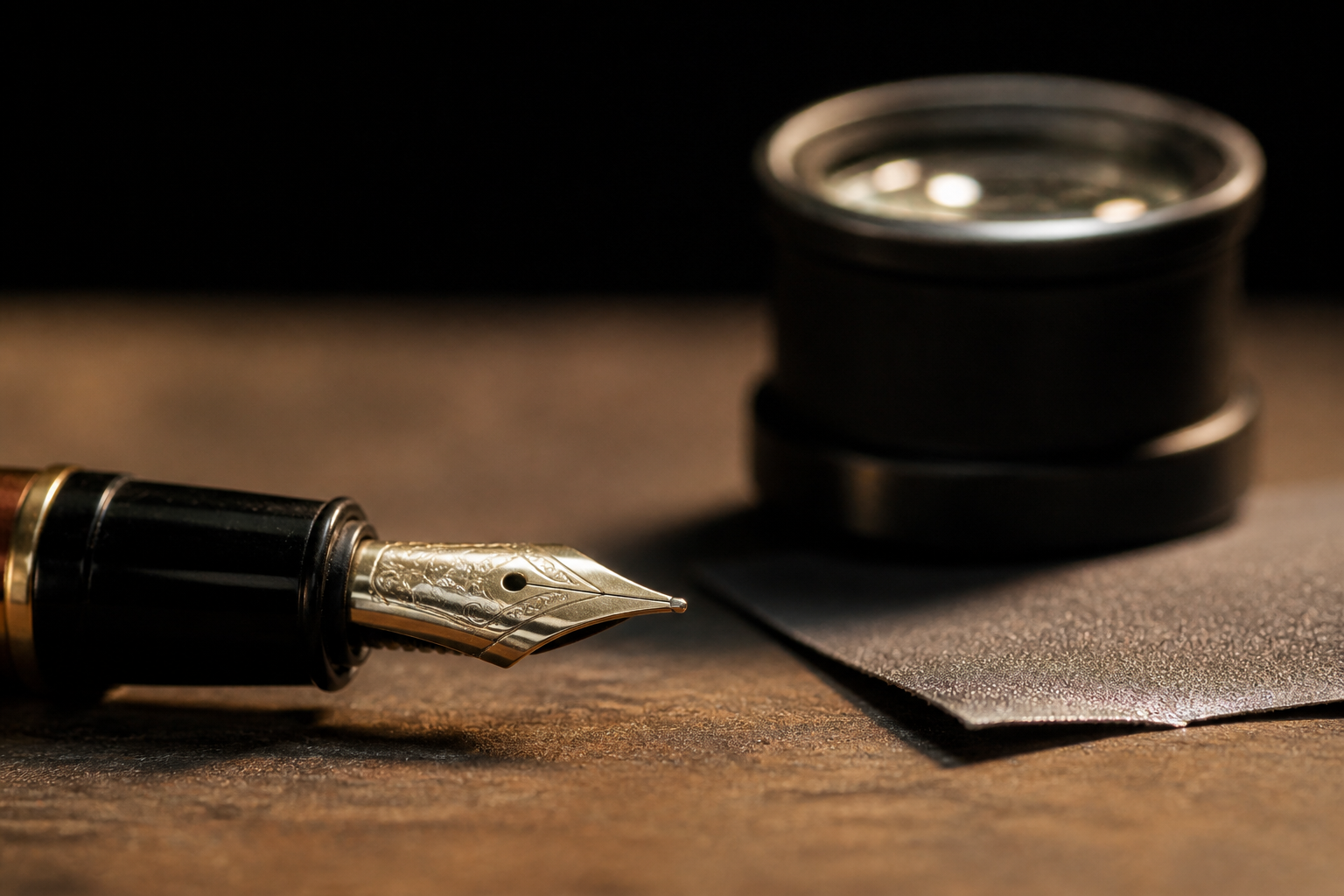
A fountain pen nib is the opposite of that in every respect. The part that touches paper is a tipping ball of hard alloy, historically osmium-iridium family metals, typically somewhere around 0.3 to 0.5 mm across depending on the width. You are trying to remove a few microns from a very specific area of a very small, very hard sphere, without changing its geometry.
The Four Specific Problems
1. The grit is uncontrolled
When you smooth a nib properly you choose a grit, work briefly, inspect under magnification, and step to a finer grit. That progression is the entire technique. Brasso gives you one unspecified grit that varies between formulations and, as the solvent evaporates on your cloth, changes while you work. You cannot step down from it because you never knew where you started.
2. Ammonia and plating do not mix
Most steel nibs and a good many gold ones carry plating — chrome, rhodium, gold wash over steel. Ammonia dulls and lifts these finishes, and once plating has gone patchy on a nib there is no fixing it short of replating. This is the damage I see most often from Brasso, and it usually shows up days later rather than immediately.
3. It gets into the feed
A nib is not a sealed object. Polish residue and solvent wick along the slit and into the feed channels, exactly where you least want an ammonia-bearing paste with abrasive particles in it. Flushing afterwards helps and does not fully solve it, and on a pen with an ebonite feed the ammonia is a genuine risk to the feed material itself.
4. You cannot see what you are doing
Smoothing works because you can inspect. A loupe tells you whether you have taken material off the correct facet of the tipping or rounded it asymmetrically, and asymmetric rounding is what turns a scratchy nib into a nib that skips on upstrokes and never comes back. Working with an opaque paste on a cloth, you find out at the end.
What to Use Instead
Scroll the table sideways to see every column →
| Tool | What it is for | Notes |
|---|---|---|
| Micromesh, 6000–12000 grit | The actual smoothing | Start at 8000 or finer. Anything coarser removes tipping faster than a beginner can judge. |
| Mylar abrasive film | Final polishing, and cleaning the slit | The 0.3 micron sheets are the gentlest useful abrasive. Hard to do real damage with one. |
| Brass sheet shims | Tine alignment | Most “scratchy” nibs are misaligned rather than rough. Fix alignment first and you often need no abrasive at all. |
| 10x loupe | Diagnosis and inspection | The single most important item on this list. Do not smooth what you have not looked at. |
| Plain paper, figure-eights | Micro-smoothing | Writing figure-eights on ordinary paper for a minute settles a lot of minor roughness for free. |
The method itself, in order: diagnose under the loupe, correct tine alignment, and only then, if it is still rough, touch it to micromesh under water for a few light passes, inspecting between each. That sequence is covered properly in my guide to nib tuning at home.
The Case Where Brasso Is Fine
Fairness demands this: Brasso on a pen body is a different question with a different answer. Polishing a scratched metal cap band or a brass barrel with Brasso is exactly what the product is for, and people do it with good results. Keep it off the nib, off the feed, away from any plated trim you want to keep, and never near celluloid or vintage plastics, which react badly to the solvent.
So the answer is not that Brasso is useless around pens. It is that it is a body polish being recommended for a nib job, by people who mostly got away with it.
If You Have Already Used It
- Flush thoroughly, immediately. Cool water, a drop of dish soap, repeated until the water runs clean and there is no polish residue in the slit.
- Inspect the tipping under a loupe. Look for a flat spot or an asymmetric shape rather than a rounded ball.
- Write with it before deciding anything. Plenty of Brasso jobs turn out fine. Panic-sanding a nib that is now smooth would be the actual mistake.
- If it skips on upstrokes, the tipping geometry has changed and it needs a nibmeister. That is a repair, not a home fix.
Frequently Asked Questions
Can you smooth a fountain pen nib with Brasso?
You can, and people do, but it is the wrong tool and the risks are avoidable. Brasso combines ammonia with an uncontrolled abrasive: the ammonia attacks nib plating and can reach the feed, and the grit is too coarse and too variable for a tipping ball a third of a millimetre across. Micromesh or mylar film does the same job with grit you choose and mistakes you can see coming.
Will Brasso damage a gold nib?
The gold itself is fairly resistant, but most gold nibs carry rhodium or two-tone plating that ammonia will dull or lift, and the tipping is not gold — it is a hard alloy whose shape is what matters. The risk on a gold nib is the same as on steel, and the pen is usually worth more.
What is the safest way to fix a scratchy nib at home?
Check tine alignment under a loupe first, because misalignment causes most scratchiness and needs no abrasive at all. If it is genuinely rough after that, a few light passes on 8000–12000 grit micromesh under running water, inspecting between passes, will settle almost anything. Go slowly; removed tipping does not come back.
About This Article

Written by Ellen Ashford. Watch collector, fountain pen enthusiast, and lifelong journaler. Time & Ink is where I explore the craft of analog living — from vintage timepieces and fine stationery to the simple pleasure of putting pen to paper. More about this site.
Verify this against a primary source
Specifics change, and your situation may differ from the one described here. These are the authorities worth checking directly:
- NAWCC — horological reference, archives and research library
- Smithsonian Institution — collection records for historic timepieces and writing instruments