You’ve read my first pen refill compatibility guide, and you know the basics: Parker-style refills, G2-style refills, Schmidt upgrades, Zebra F-series. You’re armed with the knowledge that a Jotter refill fits a Lamy Safari ballpoint, and that most Japanese gel pens swap with each other. But you’re standing in your desk right now holding a refill stamped “PB 2221” or “Flexi 07,” or you’re trying to slot a Frixion erasable refill into a multi-pen body that isn’t Pilot, and nothing in that first guide covers your specific pen refill compatibility question. This post picks up where that one left off, tackling the refill formats, shoulder profiles, and brand-pair mysteries that don’t fit neatly into Parker or G2 categories.
Looking for the chart?
The side-by-side format table and the direct does-this-fit-that answers now live on the main pen refill compatibility chart — the full compatibility chart lives there. This post covers the formats that fall outside those standards.
The truth is, the pen refill world extends far beyond those two dominant standards. Some refills are too short, others have a shoulder profile that blocks a swap that looks plausible on paper, and a few formats (like submarine-style ballpoints) were never standardized at all. I’ve spent the last decade testing pens across every price point and format, and I’ve encountered plenty of refills that left me measuring, cross-checking, and sometimes making peace with the fact that the answer wasn’t “yes” or “no”—it was “measure your specific pen and check the manufacturer’s parts page.”
This guide is for everyone who already knows the common formats and still didn’t find an answer. Let’s solve the ones that have caused me the most head-scratching moments, and show you the measuring method that works when the internet doesn’t have your exact refill code.
The Refill Formats My First Guide Didn’t Cover
After Parker-style and G2-style, the next most common mystery refills are the ones that exist in smaller bodies: mini ballpoints, slim pocket pens, and keychain attachments. These use formats that look just different enough to trip you up.
D1 Mini Ballpoint Refill Format
The D1 is a short, slim ballpoint refill about 67mm in length—roughly half the size of a Parker-style refill. Cross makes the most famous D1 pen with their Tech2 series. You’ll also find D1 refills in slim keychain ballpoints, multi-tool pen inserts (like Leatherman and Gerber pens), and some T-Point style pens.
Here’s the direct answer: a D1 refill is not interchangeable with Parker-style or G2-style refills, even though a Cross Tech2 pen might *look* like it could take a standard refill. The length difference alone rules it out. A full-size Parker refill will be too long for the barrel and won’t fit properly.
How to identify one: D1 refills are short and narrow. They have a compact barrel and often a rounded or slightly tapered tip housing. The refill itself is noticeably thinner than a standard ballpoint, and if you hold it next to a Jotter refill, the size difference is immediate.
The upside? D1 refills are easy to find from Cross, Fisher Space Pen, and third-party makers like Kaweco. If you own a Cross Tech2 or similar slim pen, sticking with genuine D1 replacements is the easiest path. Trying to force a standard-size refill into a D1 pen will either jam or fail to retract.
Submarine-Style Refill
“Submarine” is slang for a refill shape, not a formal standard. These refills taper at both ends, creating a torpedo-like profile. They’re common in inexpensive gift ballpoints and promotional pens—the kind you might find in a hotel lobby or corporate give-away.
The honest answer: submarine refill compatibility has no one universal standard. These are usually generic or private-label formats. One brand’s submarine refill won’t necessarily fit another brand’s submarine pen, even if they look similar in length and shape.
What you actually need to do: measure the specific refill against the specific pen. Check the length, the outer diameter at the widest point, and the tip housing shape. Compare those measurements to the pen manufacturer’s parts list (if one exists). In my experience, submarine pens are often cheaply made enough that the manufacturer doesn’t publish specs—in which case, the safest move is to buy a refill from the same brand that made the pen.
Submarine refills are the wild card of pen compatibility. Treat them as unique until proven otherwise.
Why “Shoulder” Shape Breaks Refill Swaps That Look Like They Should Work
You’ve probably experienced this: the refill length matches, the diameter looks close, but it won’t seat properly in the pen. The tip housing doesn’t line up, or the refill sits too high or too low. The culprit is often the “shoulder.”
A refill’s shoulder is the stepped-down section near the tip where the barrel narrows before the tip housing begins. Think of it like the neck of a bottle. The shape and position of this shoulder are invisible in photos and almost never mentioned in product listings. However, they are critical to fit.
Euro-format gel refills (common in European promotional pens, desk pens, and some luxury brands) have a distinct shoulder profile. Japanese G2-style gel refills have a different shoulder. A refill that’s the right overall length and diameter can still fail to seat because its shoulder doesn’t match the pen’s internal geometry.
In my experience, this is the most common reason a swap fails silently. The refill slides in partway, feels stuck, or clicks but won’t retract smoothly. The pen is fine. The refill is fine. But the shoulder geometry is incompatible.
Euro-format gel refills are typically used in pens from German and European manufacturers. If you’re trying to swap a Japanese G2-style refill into a German Faber-Castell or Staedtler pen, shoulder incompatibility is the most likely reason it won’t work, even if length and diameter seem compatible.
The fix? Stick to refills designed for that specific pen family, or measure the shoulder profile (the exact diameter at the stepped-down point and the length of the taper) against a known-good refill for that pen before you buy. This is where the manufacturers’ parts pages become invaluable.
Specific Brand-Pair Questions, Answered Directly
These are the exact pens and refills people email me about. Here are the straight answers, without hedging.
Lamy Safari Ballpoint (M16) vs Parker Jotter Refill
No, a Parker-style refill does not fit a Lamy Safari ballpoint body.
Lamy uses a proprietary format called M16. It’s a different length, different diameter, and uses different threading than Parker-style refills. The M16 is also different from Lamy’s fountain pen cartridges and their gel refills. It’s ballpoint-specific.
The only solution is a genuine Lamy M16 ballpoint refill. The good news? Lamy manufactures them in multiple ink colors (black, blue, red, green), and they sell a “giant” M16 refill with more ink capacity. Third-party makers like Kaweco also produce M16-compatible refills.
I tested this years ago out of stubbornness—I had a Lamy Safari ballpoint and a Parker Jotter refill sitting on my desk, and every online forum seemed to suggest they might work. They don’t. The moment you try to insert a Jotter refill, the diameter is wrong and it won’t even slide in far enough to confirm length incompatibility.
Zebra F-Series vs Pilot/Pentel G2-Style Refills
No, standard Pilot or Pentel G2-style refills do not fit Zebra F-301, F-402, or F-701 bodies.
Zebra uses the JK format (JK-0.7 or JK-1.0, depending on line width). These are not interchangeable with G2-style refills despite similar ballpoint mechanics. My first guide covers this in detail if you need the specifics on what does work with Zebra.
If you own a Zebra F-series and want to upgrade the refill, stick with Zebra JK format refills or confirmed Zebra-compatible third-party alternatives.
Frixion Multi-Pen Refill—What Else It Fits
Pilot’s Frixion erasable refill is a dedicated format for Pilot’s own Frixion multi-pen bodies. This is where people get hopeful and disappointed.
Frixion refills generally do not drop into other brands’ multi-pen bodies (Zebra, Uni-ball, Staedtler). The length and click-mechanism differences are too pronounced. Some Pilot single-refill Frixion pens (like the Pilot Frixion Ball 4) share the same cartridge format across Pilot’s own product line, so you can use refills designed for one Pilot Frixion pen in another Pilot Frixion pen. But cross-brand success is rare and unverified compared to the well-documented Parker/G2 swaps.
If you want erasable refills in multiple colors, Pilot offers Frixion refill packs in 0.38mm and standard sizes. But don’t expect them to work in a Uni-ball Jetstream or a Zebra multi-pen. For testing fit and experimenting with different line widths, the Pilot FriXion Ball Slim 038 refill set is a good reference collection to keep on hand.
Schmidt Refill in a Waldmann Pen
Yes, generally Schmidt refills work in Waldmann ballpoint pens.
Waldmann’s ballpoint pens are built around the Parker-style refill standard. Schmidt’s P8126 (a Parker-compatible upgrade refill) is one of the most common upgrade swaps Waldmann owners make for a smoother or longer-lasting writing experience.
That said, confirm against your specific Waldmann model. Some limited editions or vintage models vary in barrel diameter or length, so measure before ordering if the pen is unusual or rare.
Refill Codes Like “PB 2221” or “Flexi 07″—What Do They Actually Mean?
You find a refill stamped with “PB 2221” or “Flexi 07” and search for what pen it fits. You find nothing. That’s because these codes are usually a manufacturer’s internal SKU or a private-label refill number, not a universal format name.
These codes do not tell you which pens are compatible. They’re inventory labels, nothing more. The reliable way to identify what pen a refill fits is the same measuring method as always: length, outer diameter, and tip housing shape, cross-checked against the pen manufacturer’s own replacement-parts page (if one exists) rather than guessing from the code.
If you have a refill with a code like this, search for the exact code plus “refill compatibility” or “pen” to see if the manufacturer publishes a parts list. If nothing comes up, you’re back to measuring and comparing against known-good refills for similar pens from that brand.
When There’s No Clean Answer—The Measuring Method
Several of these formats (submarine, Euro-format, cross-brand Frixion) don’t have one universal answer the way Parker versus G2 does. That’s frustrating, but it’s also honest. The pen industry has no central standards body for refill compatibility outside of a few dominant families.
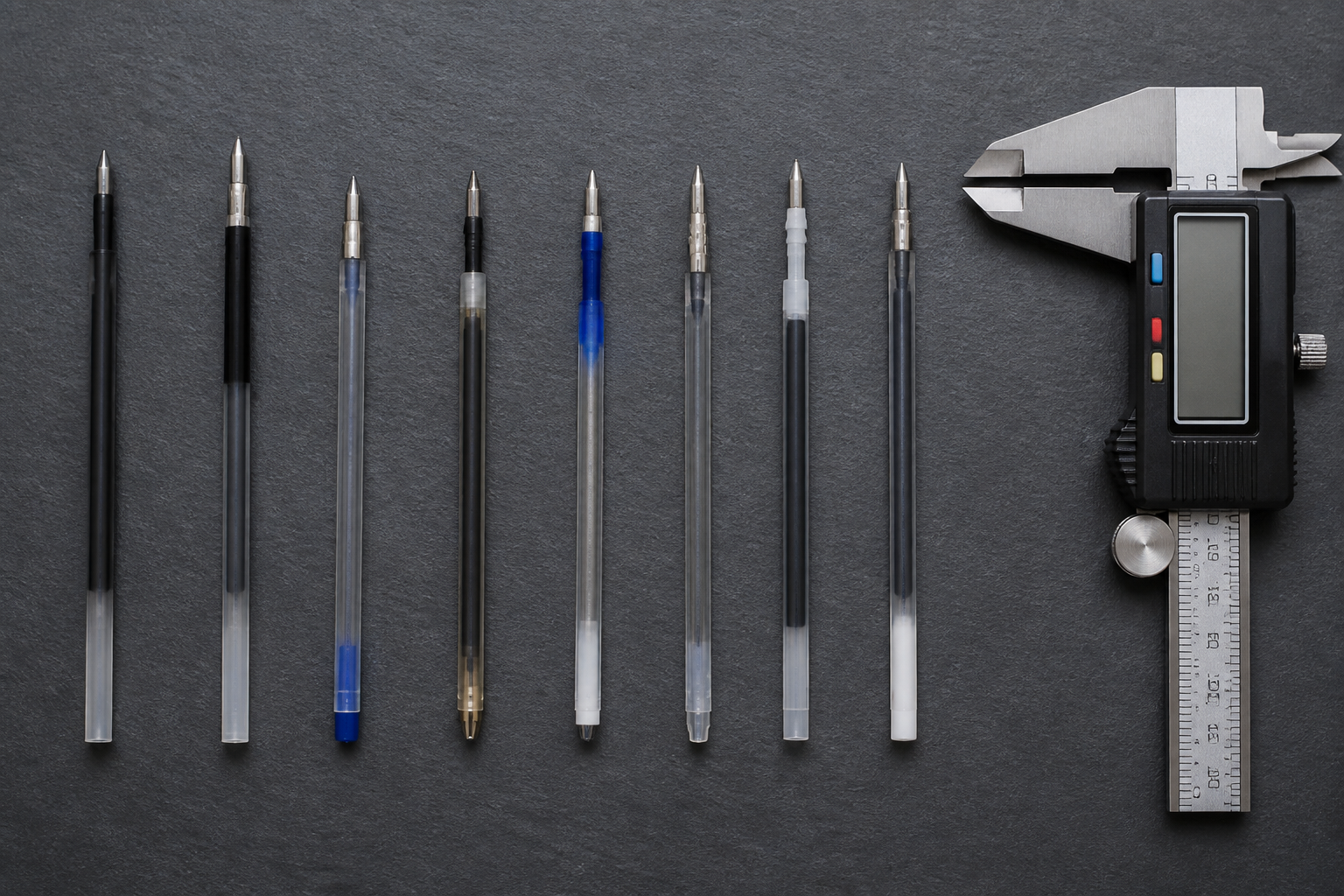
When the internet doesn’t have your exact answer, measure. You need three numbers:
- Length of the refill (tip to the end of the barrel)
- Outer diameter of the refill body (the widest part)
- The shape and position of the shoulder (the stepped-down section near the tip)
Write these down. Then find a refill you know works in your pen, measure it the same way, and compare. If your mystery refill matches on all three counts, there’s a high probability it will work. If any measurement is off—especially the shoulder—don’t force it.
This method has never failed me in a decade of testing pens. It’s slower than trusting a compatibility chart, but it works for the pen mysteries that don’t fit any chart at all.
Wrapping Up: The Refills That Fall Outside the Standards
The pen refill world divides neatly into a few dominant formats (Parker, G2, Zebra, Schmidt) and a long tail of everything else. If your pen or refill is in that tail, you now know the formats to check for—D1 minis, submarines, Euro-format shoulders, Lamy M16, Frixion—and you know the measuring method that works when a format doesn’t have a published standard.
Start with your specific pen or refill code. Check the manufacturer’s parts page. Measure against a known-good refill. If nothing matches, come back to my first pen refill compatibility guide and work through the core formats there. Ninety percent of the time, your pen will fit one of those established standards once you know which one to look for.
About This Article

Written by Ellen Ashford. Watch collector, fountain pen enthusiast, and lifelong journaler. Time & Ink is where I explore the craft of analog living — from vintage timepieces and fine stationery to the simple pleasure of putting pen to paper. More about this site.
Verify this against a primary source
Specifics change, and your situation may differ from the one described here. These are the authorities worth checking directly:
- NAWCC — horological reference, archives and research library
- Smithsonian Institution — collection records for historic timepieces and writing instruments