The Pen That Skipped at the Worst Possible Moment
I was signing a watch purchase agreement in a dealer’s back room in 2017 — a Tudor Black Bay I’d been chasing for eight months — and the ballpoint handed to me skipped clean across my signature, leaving a ghostly scratch instead of ink. I scribbled furiously in the margin. Nothing. The dealer produced another pen. I signed, flushed with embarrassment, and spent the drive home thinking about why that happened and how I could fix a skipping ballpoint pen the next time one gave up on me mid-stroke. That single moment sent me down a rabbit hole I’ve never fully climbed out of. I’ve since learned that most ballpoint failures follow a short, predictable decision tree — and that replacing the refill is almost always the lazy answer, not the correct one.
What’s Actually Happening Inside a Skipping Ballpoint
Before I walk through fixes, it helps to understand the mechanism. A ballpoint works by rolling a tungsten carbide ball — typically between 0.5 mm and 1.2 mm in diameter depending on the tip grade — through a viscous oil-based paste. That paste is much thicker than fountain pen ink by design. It doesn’t wick or flow under gravity; it transfers only when the ball physically rotates against paper. That means anything interrupting the ball’s rotation or the paste’s viscosity will cause a skip.
There are essentially four culprits, and I now diagnose them in order from easiest to hardest to fix.
Culprit One: Dried Paste at the Ball
This is the most common cause and the one I see most often with pens that have been left uncapped, stored in a drawer for six months, or carried in a warm jacket pocket through a long summer. The paste at the very tip oxidizes and stiffens. The ball can still turn, but it’s dragging through semi-dried material that won’t transfer cleanly. The skip feels stuttery rather than completely dry — you’ll get intermittent ink, sometimes a blob, then nothing.
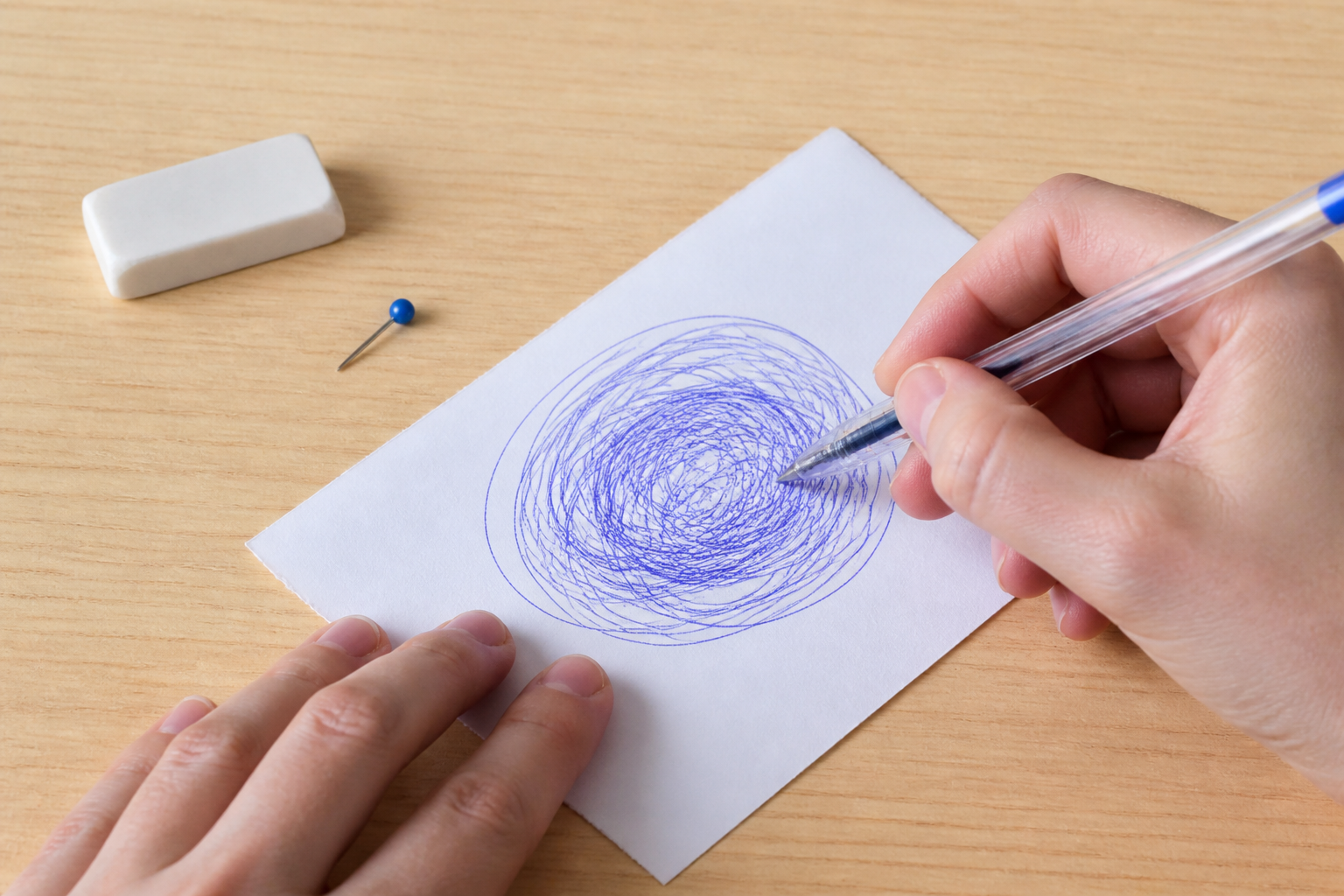
My fix takes about four seconds. I find a rubber surface — the sole of a nearby shoe works perfectly, or the eraser on a pencil — and scribble fast circles on it for three or four strokes. The rubber grips the ball and spins it aggressively, breaking the stiffened paste free. Alternatively, I hold the tip near a lighter flame for half a second, no closer than an inch. The mild heat softens the paste almost instantly. That said, I hold the flame briefly and keep it moving. I melted one Parker-style refill casing in 2019 by lingering too long — a three-dollar refill lost, which stung more than it should have.
Culprit Two: Lint Packed Into the Tip
This one took me an embarrassingly long time to identify. I carry a slim ballpoint in a bag that also holds a microfiber watch cloth, and for about a year I had a pen that skipped on the first two strokes of every writing session. I blamed the refill. I replaced it twice. Finally, in good light, I looked at the tip under a loupe and saw a tiny grey mat of compressed fiber sitting right against the ball.
The fix is low-tech. First, wipe the tip firmly on scrap paper — printer paper is rough enough to pull surface lint free. If that doesn’t clear it, take a sewing pin and gently pick the debris from around the ball socket. I work at a low angle, never pushing the pin directly into the tip, because the ball seat — the small brass or steel cup the ball rests in — is easy to deform. A deformed ball seat is one of the two problems on this list with no good fix. So I’m careful.
How I Fix Skipping Ballpoint Pen Problems With an Air Gap
The third culprit is an air gap inside the refill tube, and it’s the most satisfying one to fix. Oil-based paste is denser than air, obviously, but if a pen is stored point-up for a long period — or dropped hard on a hard floor — a bubble can migrate down through the paste column and park itself right behind the ball. When you write, the ball draws on the air pocket instead of paste, and the pen writes dry for anywhere from two to fifteen seconds before paste flows back.
I discovered this fix by accident. I was swinging a refill idly between two fingers and noticed it started writing immediately afterward when it had been skipping before. The physics are simple: you’re applying centrifugal force to push the denser paste back toward the tip and the lighter air toward the back end of the tube.
The Sock Centrifuge, Step by Step
Drop the refill into a clean sock — or hold the pen firmly if it’s a one-piece design. Extend your arm fully. Swing it in 10 to 15 fast circles, tip-outward, like a slow-motion lasso. The whole process takes under 30 seconds. In my experience, this works on roughly 70 percent of air-gap skips. The remaining 30 percent are usually cases where the paste has also partially dried, so I follow up with the rubber-scribble trick immediately after.
A word on the mistake I mentioned earlier: I once attempted this fix with the pen still assembled — a Zebra F-701, full metal body — and swung it hard enough that it slipped from my grip and hit a tile floor, cracking the clip and denting the barrel. The pen still writes, but it looks like it survived something. A refill inside a sock has no such risk. Disassemble when possible.
Culprit Four: Ball-Seat Wear You Cannot Fix
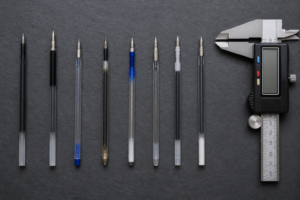
The ball rides in a small precision cup. On quality refills, the tolerances between ball diameter and seat diameter are held to within a few microns. On cheaper refills — and many refills under a dollar per unit are made with looser tolerances — the seat wears unevenly after sustained use. The ball begins to wobble slightly rather than rolling clean, and paste deposits unevenly. You’ll see this as thick blobs alternating with skips, rather than consistent flow.
No trick fixes a worn ball seat. I’ve tried, including one ill-advised attempt involving a tiny drop of superglue that ruined both the refill and fifteen minutes of my afternoon. This is the one situation where replacement is genuinely the right answer — not a lazy default. Specifically, this is also when it’s worth noting that paste quality and ball-seat precision are exactly where cheap pens cut costs. I have a handful of refills I trust after a decade of testing, and they all share one trait: consistent first-stroke flow, even after sitting unused for four or five months.
Why Cheap Pens Skip More — and What I Do About It
The oil-based paste in a ballpoint refill is essentially a mix of dye, fatty acids, and a resin carrier. Higher-quality formulations stay viscous across a wider temperature range. They resist the oxidation that causes tip-drying. However, a budget refill uses a paste with fewer stabilizers, and it starts to skin over within hours of being uncapped — sometimes even through a loose-fitting cap.
I’m not recommending you spend money on specific products here. What I will say is that I’ve tested refills across price points from about fifteen cents to around five dollars per unit, and the performance gap is real and consistent. The pens I reach for daily share a common trait: they write on the first stroke, every morning, without warm-up.
Storage Habits That Prevent the Problem Entirely
Half of the skips I’ve diagnosed over the years were preventable. The three rules I follow now, after learning them the slow way:
- Store point-down. I keep all ballpoints in a cup on my desk, tips facing the floor. Gravity holds paste against the ball. Air stays at the back of the tube, where it belongs.
- Cap clicker pens inside bags. A retracted tip dragging through a bag lining is the number-one source of lint contamination. I retract every click pen before it goes into a pocket or bag, without exception.
- Keep paste pens out of hot cars. Oil-based paste thins dramatically above about 40°C. In a parked car in summer, a refill can heat to 60°C or beyond. The paste runs forward, floods the tip, and then re-solidifies into a semi-dried crust as the car cools. That cycle, repeated a few times, produces exactly the kind of tip-blocking that needs the pin treatment.
When I Don’t Attempt Any of This
I should be honest about limits. These fixes work on standard ballpoint refills — the kind you can pull from the barrel, hold in your hand, and examine. They do not apply to multi-function pens with complex internal mechanisms where forcing rotation or heating the tip risks damaging plastic cam tracks or spring assemblies. For those, I disassemble to the refill level first, and only then apply any heat or mechanical fix.
Vintage ballpoints — anything with an original refill from the 1950s or 1960s — get no heat and no pin from me, ever. The paste chemistry from that era is irreplaceable, and a skip in a vintage pen is far more likely to be a ball-seat issue or a paste chemistry failure than simple drying. Those belong with a specialist, not in my repair tray.
As a result, my general rule is this: if the pen is worth less than ten dollars and the fix takes under two minutes, I try it. If the pen is irreplaceable, I consult someone who knows more than I do. That boundary has saved me from several expensive mistakes — and from the particular misery of destroying something that deserved better than my impatience.
The Right Way to Fix Skipping Ballpoint Pens, Start to Finish
To put it plainly: diagnose before you discard. Scribble on rubber for dried paste. Wipe and pin for lint. Centrifuge in a sock for air gaps. Accept the limits when ball-seat wear is the actual problem. Store point-down, cap clickers, and keep the pen out of heat. I’ve been running through this sequence for about six years now, and the number of refills I’ve thrown away prematurely has dropped to nearly zero. That saves money, obviously, but more than that, it keeps pens in rotation that I actually like writing with — which was the point of collecting them in the first place.
About This Article

Written by Ellen Ashford. Watch collector, fountain pen enthusiast, and lifelong journaler. Time & Ink is where I explore the craft of analog living — from vintage timepieces and fine stationery to the simple pleasure of putting pen to paper. More about this site.
Verify this against a primary source
Specifics change, and your situation may differ from the one described here. These are the authorities worth checking directly:
- NAWCC — horological reference, archives and research library
- Smithsonian Institution — collection records for historic timepieces and writing instruments