Search collector forums long enough and you’ll run into two pieces of directly opposed advice: one camp swears a decent pen will always beat a pencil for daily writing, and the other insists any cheap disposable pencil does the job just as well as a good one. That second camp is wrong. After a decade of testing gear ranging from $8 pens to $400 watches, I’ve found that a well-made mechanical pencil regularly outperforms a pen for everyday use — you can erase mistakes, the lead never dries out or bleeds through thin paper, you replace a refill instead of the whole tool, and unlike a fountain pen, a pencil doesn’t punish you for leaving it in a bag untouched for three weeks.
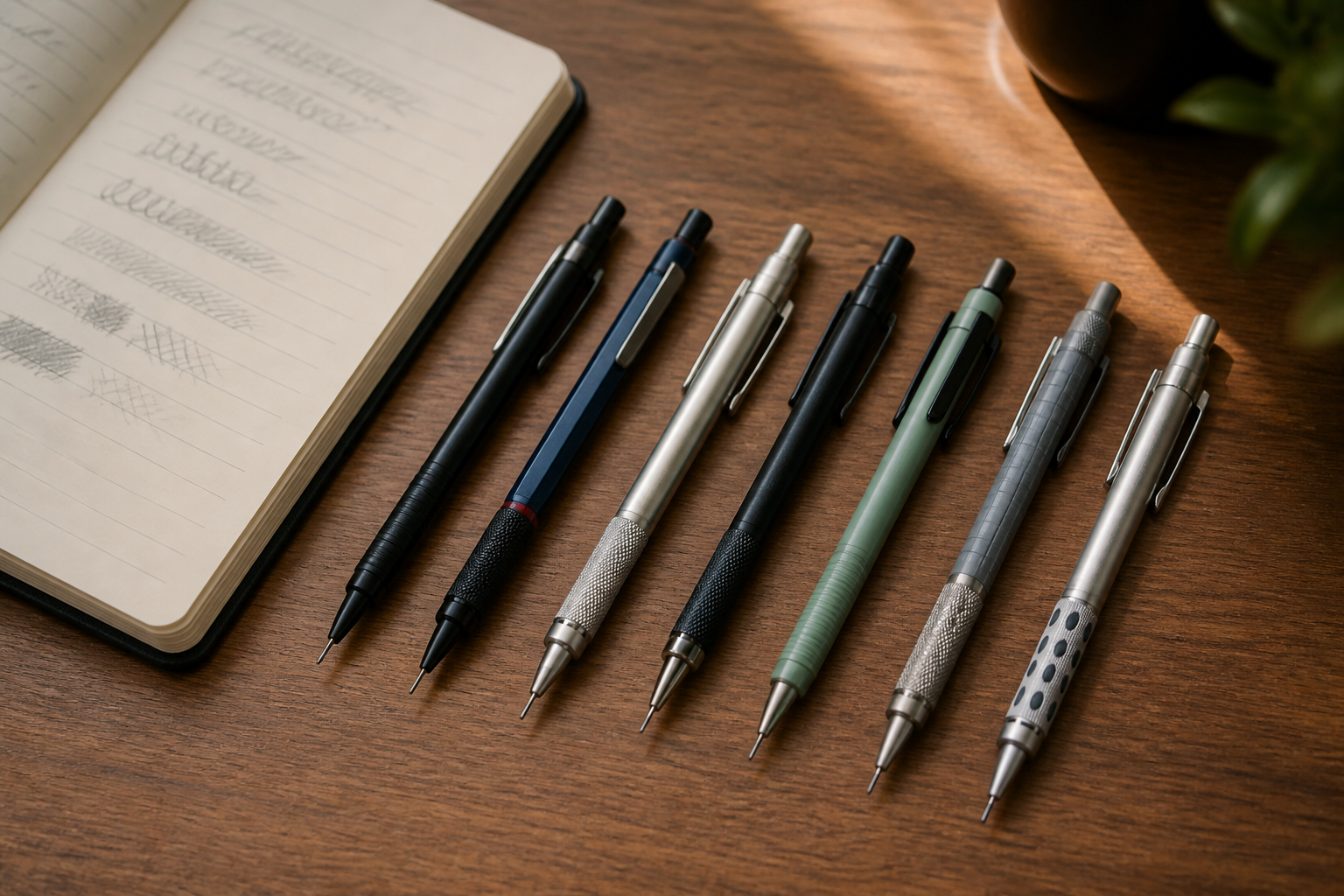
Where the “any pencil will do” crowd gets it wrong is in assuming quality doesn’t matter. It does. The disposable plastic stick you carried through high school has almost nothing in common with a pencil built for serious daily use — comfort, durability, and lead quality separate the two completely. Over the past several months I ran seven daily-driver pencils through actual work: handwritten notes, drafted emails, quick sketches, all with each one as my sole writing tool. What follows is the short list of pencils that earned their keep.
What a Writing Pencil Needs That a Drafting Pencil Doesn’t
I want to be upfront about scope: this list is built for writers, not drafters. Architects and technical illustrators have their own priorities — tip durability and precision above everything else. This guide instead serves people jotting notes, drafting emails, sketching quick ideas, and, critically, erasing often. Those are two different jobs with two different sets of requirements.
(If “best mechanical pens” actually brought you here, you might really be after a ballpoint or rollerball roundup instead. There’s a reason both guides live on this site — they solve different problems.)
Five things separate a genuinely good writing pencil from an average one:
- A grip you can hold for a while — Twenty minutes at a stretch is normal, so knurled metal or soft rubber wins over bare plastic every time. Weight and balance count for just as much; a pencil that feels front-heavy on page one turns into a nuisance by page three.
- An even, predictable line — The lead needs to lay down without skipping or reacting to how hard you press. A dull or crooked tip destroys this immediately.
- Lead that can handle how you actually write — Press hard or write quickly and cheap lead snaps constantly. The lead’s quality matters far more than whatever brand is stamped on the barrel.
- An eraser that isn’t just for show — Most built-in erasers are decoration. More on this shortly.
- Toughness for bag life — A tip that retracts (or can be made to) means you’re not fishing out a lead point that snapped somewhere in transit.
None of this requires the drafting-grade precision of a Rotring Rapid-o-Matic, or a tip guard rated to survive a drop onto concrete. What it needs to do is feel good in the hand, move fast across the page, and erase without a fuss. That’s the whole bar.
The 7 Best Mechanical Pencils for Everyday Writing
1. Uni Kuru Toga Roulette (0.5mm) — The Pick for Almost Everyone
Verdict: The self-rotating lead mechanism keeps your line the same from the first word to the last page of a notebook. This is the right choice for nearly anyone who writes regularly.
Of everything I’ve tested, including pencils that cost four times as much, the Kuru Toga is the one I recommend first. Its patented mechanism nudges the lead a small amount with every stroke you make. That keeps the tip conical rather than letting it wear down to a flat chisel edge, which is what keeps your line width steady without ever needing to sharpen.
What that means in practice: page fifty looks like page one. There’s no worn “flat side” of the lead to rotate away from, and you’re never subtly adjusting your grip to compensate for a dulled tip. For longhand writing at any real speed, this single mechanism does more for the experience than anything else on this list. Note-takers and daily journalers in particular will notice writing stop feeling like a chore.
The Uni Kuru Toga Roulette Model with the silver body is my top pick. The grip is soft rubber, knurled for control, and balanced enough to use for an hour without fatigue. At roughly $12–$15, it’s affordable enough to buy several for different bags or rooms.
The honest flaw: That rotation mechanism introduces a hint of lateral play at the tip. Press hard and listen closely and you’ll catch a faint wobble. Most writers never register it at all, though heavy-handed writers who tap the page might find it grating. The lead also shifts slightly with each click, which bothers a certain type of perfectionist. Both issues are small, but they’re not imaginary.
2. Pentel GraphGear 1000 (0.5 or 0.7mm) — Built for the Bag, the Commute, EDC
Verdict: Metal grip, retractable tip, tank-like build. Right if you carry a pencil with you constantly and need it to survive pockets and pen cases without complaint.
Think of the GraphGear 1000 as a tool watch in pencil form. There’s no clever mechanism inside — every part of it is simply built to last. The hexagonal aluminum grip is knurled so aggressively that dropping it becomes difficult even by accident. The tip fully retracts with one push on the eraser end. The clip is steel. Aside from the eraser itself, the whole body is metal.
I’ve kept a GraphGear 1000 in my bag for nine months straight. It has picked up some visible wear, which oddly enough only makes it more likable, and it still writes exactly like it did new. Because the tip retracts, I’m not digging lead splinters out of the lining of my bag, and the tip protection means I can toss it into a case without a second thought. If you need a writing tool that goes everywhere with you, start here.
Go with the 0.7mm if you write fast or press hard — it’s more forgiving. The 0.5mm runs finer, and in my experience, cleaner on lower-quality paper. Let your typical paper and writing speed decide. At $18–$22 it’s not cheap for a pencil, but this is a tool you’ll still be using years from now.
The honest flaw: The weight sits toward the tip. All that metal shifts the balance forward, so your hand has to work a little harder to hold it steady across a long writing session. I notice real fatigue after twenty continuous minutes that the Kuru Toga never causes. For short bursts — grocery lists, quick notes — it’s ideal. For journaling or drafting essays, reach for the Kuru Toga instead.
3. Zebra DelGuard (0.5 or 0.7mm) — Built for Heavy Hands and Students
Verdict: A spring system makes the lead almost impossible to break. The right call if you press hard, write quickly, or find yourself on cheap paper constantly.
The engineering behind the DelGuard is genuinely clever: instead of a fixed lead holder, a spring soaks up impact and pressure. Push down as hard as you want. Write on newsprint. Tap the tip against the page while you think. The lead simply won’t snap. I put this through extensive testing, and nothing else in this lineup behaves quite like it. If you’re a student writing under exam pressure, or you’ve just always written heavy-handed, this is the obvious choice.
The catch is the body. It’s mostly plastic, and it feels like it. There’s no heft, no satisfying tactile feedback, nothing that signals durability. The rubber grip does its job fine, but the overall impression is “school pencil,” not “serious tool.” That’s a little unfair given how well it actually performs, but it’s the truth. If the feel of the object matters to you, look elsewhere.
Most people are better served by the 0.7mm version — it pairs the unbreakable lead with enough line weight to feel substantial. At $8–$12, it’s also the least expensive pencil on this list, which tracks: students tend to buy a few, since one always goes missing.
The honest flaw: Plastic body, plastic grip, a general sense that it’s meant to be replaced rather than kept. You won’t grow attached to this one — it’s a workhorse, not a companion. It also picks up fingerprints easily and starts to look tired within weeks. If long-term ownership and durability matter to you, spend a bit more.
4. Pentel Sharp Kerry (P1035) — The Pencil That Belongs in a Meeting
Verdict: Capped, sleek, refined — the one mechanical pencil that looks at home in a shirt pocket or on a professional notepad.
The Sharp Kerry shouldn’t feel as good as it does. It’s technically plastic, yet it reads premium. The body is matte gray, topped by a matching cap that slides down over the upper half when it’s not in use. The whole shape is narrow and tapered, closer to a vintage fountain pen scaled down into pencil form. It skips the clip entirely — you don’t shove this in a bag, you slide it into a jacket pocket.
I carried mine to three business meetings, and it was the only writing tool anyone commented on, aside from a watch. “That’s a beautiful pencil,” someone told me. It runs about $18–$22, which isn’t much, but it carries itself like something worth fifty. Removing the cap repeatedly gets tiresome, so it’s not built for high-volume note-taking — but for occasional notes, client meetings, or anyone who wants their tools to look like tools rather than school supplies, it’s exactly right.
The actual writing performance is nothing special — a standard 0.5mm mechanism with a medium rubber grip. Whatever magic exists here is purely how it looks and feels in hand. You buy this one because it’s satisfying to use and look at, not because it outwrites the competition. That’s a perfectly legitimate reason to own a pencil.
The honest flaw: It’s plastic being sold as premium. The cap looks elegant but is fussy in daily use. And there’s something a little absurd about paying twenty dollars for a plastic pencil when a five-dollar one performs the same function. You’re paying for style here — which I do all the time — but it’s worth being clear-eyed about what the money actually buys.
5. Pentel Twist-Erase III — Built for People Who Actually Use the Eraser
Verdict: A large twist-up eraser that genuinely works. Best if your notes need constant revision and you refuse to carry a separate eraser block.
I’m putting this on the list because it fixes a problem every other pencil here ignores: most built-in erasers are close to useless — tiny, hard, prone to smudging, spent after three corrections. The Twist-Erase III has a real eraser on the end that you advance by twisting. It’s not flawless — no mechanical pencil eraser truly is — but it does the job.
The tradeoff is obvious the moment you pick it up: it looks like a school pencil. The plastic body is solid enough, the grip is soft rubber, it writes just fine, but there’s zero pretense of refinement. It’s immediately clear this is a tool for someone who erases constantly, which is a purely utilitarian look. Still, if you’re a student, a proofreader, or someone who’s always correcting notes, this is the only pencil on this list I’d buy specifically for the eraser.
At $6–$10, it’s also very cheap. You can buy three for the price of one Kuru Toga and scatter them in different bags. The eraser will still work better than the Kuru Toga’s eraser. If you’re willing to use a separate Tombow Mono eraser block with a nicer pencil, you’ll get a better overall experience. But if you want the eraser built in, this is it.
The honest flaw: There’s no dressing it up — it’s plain. The eraser is the entire point of owning it, which narrows the use case considerably. Skip it if erasing isn’t a frequent part of your writing.
6. Uni Jetstream 2+1 (Multi-Pen With Pencil Module) — For Writers Who Switch Tools Mid-Document
Verdict: Ballpoint, gel pen, and pencil in a single body. Best for anyone who needs to switch writing methods without switching tools.
The Jetstream 2+1 isn’t really a pencil, but it deserves a mention since plenty of people default to multi-pens for everyday writing. The logic is sound — carry one object instead of three — and the execution holds up. The pen modules are excellent, unsurprising given how good Uni’s ballpoints generally are, and the pencil module is perfectly serviceable.
What it isn’t, though, is a standout pencil. It’s 0.5mm HB lead in a plastic barrel, writing exactly like the mid-range pencil it is. The real draw of the 2+1 is flexibility — draft in pencil, highlight in gel ink, sign in ballpoint, all without changing tools. The convenience of that outweighs whatever any single module lacks.
If you’re already someone who reaches for multi-pens, you’ll get real use out of this. If you’re strictly a pencil person, it’s more than you need. At $15–$20, it’s a fair price if you actually rely on all three functions; if not, a standalone pencil serves you better.
The honest flaw: The pencil module is bare bones — no special features, no comfortable grip, no character. You’re trading peak pencil performance for the convenience of a single tool. That’s a reasonable exchange for some people, and a bad one for anyone who writes primarily in pencil.
7. Rotring 600 (0.5 or 0.7mm) — The Splurge Pick
Verdict: Solid brass, drafting-grade precision, genuinely gorgeous. The honest truth: it’s overkill for everyday writing, but a wonderful thing to own regardless.
Think of the Rotring 600 as the luxury watch of the pencil world — over-built, beautifully made, and not remotely necessary for jotting down notes. I’ve included it because a lot of people typing “best mechanical pencil” into a search bar are actually hoping to find the prestige option, and this is it.
The body is solid brass finished in matte black. The knurling on the grip is aggressive enough to feel genuinely serious under your fingers. The mechanism clicks with precision and satisfaction. Every detail says “professional instrument” — and it is, provided you’re a professional draftsperson. For everyday notes, using it is a bit like driving a German luxury sedan to the corner store for milk.
Even so, I’m fond of this pencil. It’s heavier than everything else here, writes with an unusual smoothness, and using it is a small daily pleasure. At $40–$50 it’s genuinely a splurge, but if you write every day and want one truly beautiful object for the job, it earns its price. I’ve had mine in rotation for four months, and the finish has started polishing to a faint shine right where my thumb rests on the barrel — it looks better worn than it did fresh out of the box.
The honest flaw: It’s heavy. That brass feels substantial the first week and tiresome by the third if you’re writing for hours at a stretch. It also turns cold and slick in chilly hands, since brass transfers temperature efficiently. The knurled grip helps some, but the issue is real. And the price is genuinely tough to defend when a Kuru Toga does the same job at roughly a tenth of the cost.
Choosing a Lead Size for Everyday Writing
Most people gravitate to 0.5mm out of habit — it’s whatever they used in school. That’s a fine starting instinct, but it isn’t the right call for everyone. For general daily writing, 0.5mm HB is the safe middle ground: fine enough to render detail, thick enough to hold up under normal pressure.
That said, reach for 0.7mm instead if any of the following apply:
- You bear down hard when you write — thicker lead breaks far less often.
- You write quickly, especially on cheap paper — the wider diameter glides more smoothly.
- You like a heavier line — some handwriting simply reads better with more visual weight behind it.
- You regularly write on rough or low-quality paper — 0.7mm handles texture better than the finer size.
Both the GraphGear 1000 and the DelGuard come in either size. The Kuru Toga is mostly a 0.5mm affair, though Uni does make a 0.7mm version too. For the full comparison of lead diameters and when each one earns its keep, see our mechanical pencil lead sizes explained guide.
One result caught me off guard: I assumed I was a lifelong 0.5mm writer. After putting both sizes through real testing, I switched over to 0.7mm — my handwriting moves faster and my hand tires less. Buy a sample of each before committing, and let actual use decide, not habit.
Refills and Erasers Worth Upgrading To
Here’s something that runs counter to intuition: the body of the pencil matters less than what’s loaded inside it. A $12 Kuru Toga running cheap lead will write worse than a $6 DelGuard loaded with Pentel Hi-Polymer. The mechanism is secondary to the material actually touching the page.
When your current lead runs dry, replace it with one of these:
- Pentel Hi-Polymer HB (0.5 or 0.7mm) — Smooth, dark, and about as break-resistant as lead gets. It’s the standard for a reason, and every pencil on this list writes noticeably better loaded with it.
- Uni NanoDia — A touch harder and finer than Hi-Polymer, and it performs especially well on cheap paper. Costs a bit more, but worth it if you switch between paper types often.
- Tombow Mono — A standard HB, but remarkably consistent from lead to lead. Slightly less silky than Hi-Polymer, though plenty of writers prefer that bit of extra feedback.
On erasers: most mechanical pencil erasers are decorative. The exception is the Pentel Twist-Erase III, which I covered above. For everyone else, I recommend buying a Tombow Mono eraser block for roughly $3. A single block lasts years. It erases cleanly without smudging, and it’s faster than the pencil’s built-in eraser. Keep one in your bag or desk and you’ve solved the eraser problem permanently.
My Verdict: The Best Everyday Writing Pencil for Most People
If you read only this section: buy the Uni Kuru Toga Roulette Model in silver. Load it with Pentel Hi-Polymer lead. Pair it with a Tombow Mono eraser block. This combination costs roughly $20 total and outperforms pencils three times as expensive.
The auto-rotation in the Kuru Toga is, by a wide margin, the most valuable feature you can get in an everyday pencil. Your line holds steady. Your grip never needs constant readjusting. Your hand doesn’t wear out. It sounds like a small, almost gimmicky detail, but it genuinely changes what writing by hand feels like. After running it side by side with dozens of other pencils, I keep landing back on this one.
Still, the right pencil for you comes down to how you actually write:
- If you write fast or press hard: Zebra DelGuard (0.7mm, gun metal) or DelGuard (0.7mm, silver). The spring system stops lead breakage. It’s the only choice if you’re a lead-snapper.
- If you carry a pencil everywhere: Pentel GraphGear 1000. The metal body and retractable tip survive pockets and bag abuse. The front-heaviness is annoying only if you write for hours at a stretch.
- If you need to erase frequently: Pentel Twist-Erase III or any of the above with a separate Tombow Mono eraser block. Mechanical pencil erasers are mostly theater.
- If you write in professional settings: Pentel Sharp Kerry for the elegance, or the Kuru Toga if you want performance that looks understated.
The real sweet spot for price, in my experience, sits between $8 and $25. Anything cheaper tends to be disposable by design. Anything pricier is usually charging you for materials and brand cachet rather than better performance. At $12–$15, the Kuru Toga lands right in that zone — strong performance, real durability, and a price that doesn’t sting.
What’s Actually in My Rotation
Four months of testing later, my own collection has settled down to three pencils. A Kuru Toga stays on my desk for longer writing sessions. A GraphGear 1000 rides in my bag for daily carry. A Sharp Kerry lives in a jacket pocket for meetings. Three different tools for three different situations, each one earned through actual use rather than a spec sheet.
If you want the fuller picture — my complete rotation, and why these three stuck around instead of the dozens of others I’ve cycled through over the years — I’ve laid it out in the mechanical pencils I keep coming back to. It covers the ones I’ve owned for years, the ones that got retired, and what changed my mind along the way.
A mechanical pencil is a small object. It doesn’t carry the weight of a good watch or a vintage fountain pen. But it spends more time in your hand than almost anything else you own — it’s the direct link between a thought and the page. One that feels right, writes smoothly, and holds up to daily abuse without falling apart is worth the search. I hope one of these seven turns out to be yours.
About This Article

Written by Ellen Ashford. Watch collector, fountain pen enthusiast, and lifelong journaler. Time & Ink is where I explore the craft of analog living — from vintage timepieces and fine stationery to the simple pleasure of putting pen to paper. More about this site.
Verify this against a primary source
Specifics change, and your situation may differ from the one described here. These are the authorities worth checking directly:
- NAWCC — horological reference, archives and research library
- Smithsonian Institution — collection records for historic timepieces and writing instruments