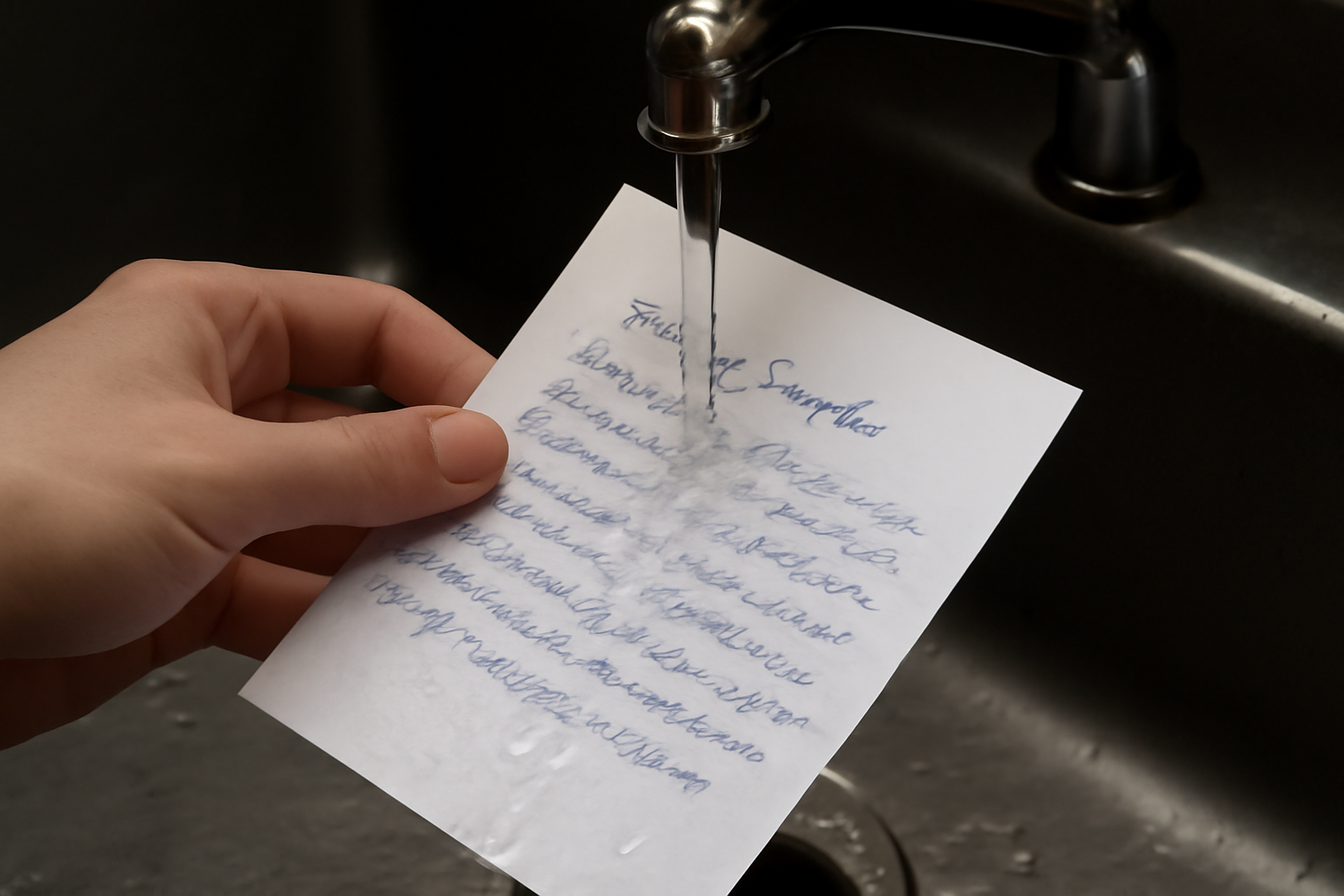
Every January, when I sit down to break in a fresh notebook, I’m reminded of a mistake that cost me an entire page of research notes: I once assumed that any fountain pen ink would simply become waterproof if given enough drying time. That assumption turned out to be badly, expensively wrong. I’d filled a page with tasting notes at a watch auction preview using an ink I believed was “durable.” A glass of water tipped over. The page dissolved into streaks and blotches. Every note vanished. That ink had zero water resistance, and I’d never bothered to check beforehand.
The damage went beyond bruised pride. It sent me down a months-long rabbit hole of testing nearly every ink in reach — swatching samples, dousing them with water, dragging wet fingertips across dried lines, and lining up the results to compare. A decade into collecting both old watches and fine writing instruments, I now rank water resistance right up there with flow, dry time, and shading when I judge an ink. It’s a bigger factor than most people give it credit for, particularly once your pen sees use beyond the occasional journal entry.
What follows is everything I’ve verified through actual use: the traits that make an ink genuinely water-resistant, which formulas deliver that without wrecking your pens, and where Pilot Iroshizuku’s lineup fits into the picture honestly — flaws included.
What “Waterproof” Really Means for Fountain Pen Ink
People throw around the word “waterproof” pretty carelessly in this hobby, and that carelessness leads to real problems. A truly waterproof ink, in the strict sense, would show no color migration whatsoever even submerged indefinitely. Practically speaking, almost nothing sold to fountain pen users clears that bar. What we’re actually discussing is a range — water-soluble dye inks sit at one end, and pigment or iron gall formulas that resist water strongly sit at the other.
Dye-based inks dominate the market. They dissolve readily in water, write smoothly, and treat nibs and feeds kindly. Their downside: almost no resistance to water at all. Iron gall inks rely on a chemical reaction — usually iron sulfate paired with tannic acid — that binds the ink into the paper fibers as it oxidizes over time. That bond genuinely holds up against water. Pigment inks work differently, suspending solid particles in a liquid carrier; those particles wedge into the paper and refuse to wash away. Each category carries its own compromises in flow, upkeep, and how gently it treats a nib.
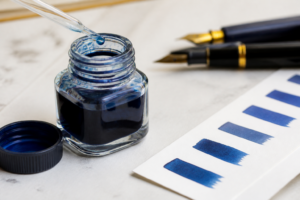
Grasping that spectrum matters because a “waterproof” claim printed on a bottle tells you almost nothing useful on its own. I test every new ink myself: write a line, give it 24 hours to cure, then drag a wet finger across it and drip water directly onto it. The outcomes differ wildly even between two inks from the same manufacturer. That test costs me three minutes and has spared me from grabbing the wrong bottle at the wrong moment more times than I can tally.
What Iron Gall Ink Taught Me About Nib Damage
I found this out the hard way while nursing a vintage Pelikan 400N back to working order. Iron gall ink genuinely resists water — it’s about as permanent as fountain pen ink gets. But it’s also mildly corrosive. Just how acidic depends on the specific formula, and leaving it sitting in a pen unflushed for more than a week risks staining the feed, eating into a steel nib, or, in bad cases, ruining a rubber sac in an older pen.
Bringing that Pelikan back took three weeks of flushing with a diluted ammonia solution. I’d left a popular iron gall ink sitting in the pen for roughly three weeks while traveling. When I got back, the nib had visible oxidation on it. Cleaning restored the writing performance, but the feed kept a faint stain that never fully lifted. What I took from that: iron gall ink shines in pens you flush every week, or in steel-nibbed pens meant for daily grinding. It’s a bad match for vintage pens, prized gold nibs, or anything that sits idle for long stretches.
In a workhorse pen — say, a TWSBI 580AL with a steel medium nib, roughly $60 — iron gall ink can be a smart pick as long as you stay disciplined about cleaning it out. But in a $300 vintage Sailor King of Pen or a flex-nibbed Nakaya, I’d rather use a gentler, still water-resistant formula than gamble with corrosion.
The Traits a Waterproof Ink Needs Without Wrecking Your Pen
The waterproof inks worth recommending to most collectors manage a narrow balance: real water resistance without demanding brutal maintenance routines. When I’m sizing up a candidate, I check it against four specific criteria.
- Resistance to actual water contact: after blotting a direct water drop, I expect at least 80% of the line to stay legible — a figure I’ve confirmed myself rather than lifted from a product page.
- Safety for nib and feed: plain water should flush it out cleanly after a reasonable stretch of use — I use two weeks as my cutoff for inks in daily rotation.
- Steady, reliable flow: an ink that dries up in the feed or hesitates on the first stroke isn’t worth its water resistance. I want a clean start every time.
- Getting along with common papers: on standard stock — Rhodia No. 16 at 80 g/m², Leuchtturm1917, Clairefontaine — it shouldn’t feather badly or bleed through.
Finding all four together is tougher than it sounds. Plenty of highly water-resistant inks lean pigment-based, and those demand rigorous weekly flushing to avoid clogging in fine points — anything under 0.4 mm is especially vulnerable. From what I’ve seen, medium and broad nibs tolerate water-resistant inks far more gracefully than fine or extra-fine ones do. If a fine nib is your daily driver, put reliable flow and easy flushing ahead of maximum water resistance when you’re weighing options.
The Blue Ink That Outlasted My Own Carelessness
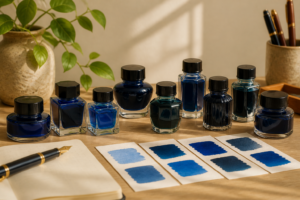
After that water disaster at the auction preview, I went looking for an ink that wouldn’t let me down the next time someone got clumsy near my notebook. Pilot Iroshizuku Kon-peki turned out to be honestly waterproof, and it didn’t cost me any of the flow or color depth I’ve come to expect from a good fountain pen ink.
Where it delivers
- Water beads right off the line instead of feathering into a smear — I’ve run this test repeatedly, and it holds across paper weights of every kind I’ve tried.
- That rich blue tone holds its saturation and never drifts toward gray or brown the way some “waterproof” inks tend to once dry.
- It glides through fine and medium nibs without the hesitant starts or flow stutters that trip up a lot of waterproof formulas.
Where it falls short
- It needs a full 24 hours to cure before the water resistance kicks in — write and splash it right away and you’ll regret it.
- The bottle’s cap is notoriously stubborn — good news for keeping evaporation at bay, bad news when you’re rushing and your fingers won’t cooperate.
I was still skeptical the first time I deliberately dripped water onto a Kon-peki test swatch—part of me expected to see it dissolve like my auction notes did. It didn’t. Pilot Iroshizuku Kon-peki Deep Azure Blue
About This Article

Written by Ellen Ashford. Watch collector, fountain pen enthusiast, and lifelong journaler. Time & Ink is where I explore the craft of analog living — from vintage timepieces and fine stationery to the simple pleasure of putting pen to paper. More about this site.
Verify this against a primary source
Specifics change, and your situation may differ from the one described here. These are the authorities worth checking directly:
- NAWCC — horological reference, archives and research library
- Smithsonian Institution — collection records for historic timepieces and writing instruments