Caliber 1012 — that’s the movement stamped inside my 1970 Omega Seamaster, a bi-directional automatic I’d just brought home and wasn’t wearing often enough to keep alive on its own. Seven years back, staring at that number in a repair manual, I decided the fix was obvious: buy a winder, keep the rotor spinning, problem solved. So I ordered a $25 Amazon unit, brushed aluminum shell, a listing that bragged about its “premium Japanese motor.”
Two months in, the motor developed a stutter. Three rotations, a five-second pause, three more — over and over. The Seamaster started shedding seven minutes a week. I pulled it, set it on the dresser, wound it once by hand, and it held time better sitting motionless than it ever had inside that box.
That’s the lesson underneath everything in this watch winder review: owning an automatic doesn’t automatically mean you need a winder. Some collectors do benefit — genuinely. What follows is who those collectors are, which units actually earn their keep, and why so many $15-to-$40 boxes let you down eventually.
What’s Actually Happening Inside a Watch Winder
Start with the basics. An automatic winds itself off the motion of your wrist — a weighted rotor inside the movement spins as you move, and that spinning banks energy into the mainspring, which is what keeps the watch running.
Take the watch off, and the mainspring begins unwinding on its own. Depending on the caliber, it’ll run dry somewhere between 24 and 72 hours. A winder’s whole job is to fake wrist motion — it rotates the case, which keeps the rotor turning, which keeps the mainspring topped off.
Here’s the part most first-time buyers miss entirely: automatics don’t all wind the same way. Get that wrong and you’re buying the wrong winder for the watch you own.
TPD — Turns Per Day, and Why It’s the Number That Matters
Every automatic movement has a rotation quota it needs met daily to stay fully wound — that’s TPD, turns per day. Most modern calibers want somewhere between 650 and 1,000 TPD to reach a full wind without punishing the mainspring.
A decent winder gives you control over that number. My Wolf Cub, five years in my rotation now, lets me set anywhere from 650 to 1,000 TPD. The cheap ones don’t bother — they spin at whatever fixed, unregulated speed the motor happens to run, which might mean 400 TPD one day and 1,200 the next depending on how the motor’s holding up.
People love to repeat the myth that you can “overwind” an automatic and snap the mainspring. That’s not quite right. There’s a slip mechanism built in specifically to prevent that — the spring simply stops taking energy once it’s full. What actually happens with cheap winders is different: irregular, high-speed rotation wears down the rotor bearings prematurely. In the budget units I’ve run, that wear starts showing up somewhere around the 12-to-18-month mark.
Direction Matters: Clockwise, Counter, or Both
Rotor direction gets underestimated constantly. Different calibers have a preferred winding direction. Rolex movements lean clockwise. The ETA 2824 — sitting inside a huge share of affordable automatics — winds equally well in either direction. Seiko’s NH35 and NH36 share that same bi-directional preference.
A winder locked to a single direction will still keep your watch running, just less efficiently — think of it as pushing a swing with one arm instead of two. Stretch that inefficiency over months and your watch can actually lose more accuracy sitting in the winder than it would just being worn three days a week.
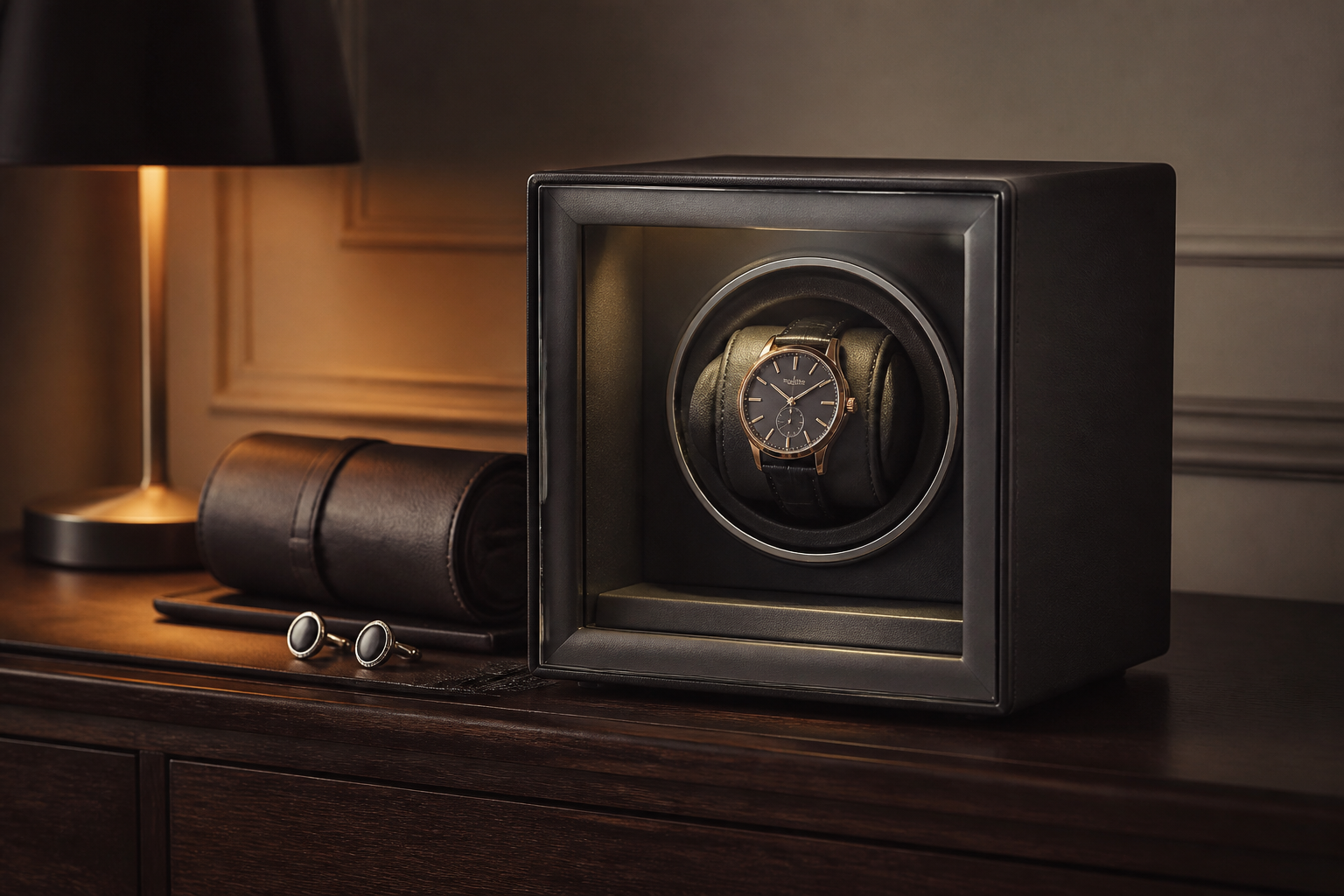
The good winders — Wolf Cub included — give you CW, CCW, and bi-directional settings. The unit I’m recommending here, the Automatic Single Watch Winder Box with Japanese Quiet Motor in Black Carbon Fiber Leather, covers all three, which matters far more in daily use than it looks like on a spec sheet.
Quiet Motors vs. That AC Hum
You’re going to be living alongside this thing for weeks at a stretch. Put it on a nightstand with a loud motor and you will notice, every single night. I ran a Barrington single winder for a while — well built, $120 — and its AC motor buzzed audibly straight through a wood dresser, which is not what you want in a quiet bedroom at 11 p.m.
Battery or DC-driven units run noticeably quieter. The Wolf Cub is AC-powered but its Japanese motor is genuinely silent. The featured product here specifically advertises a Japanese quiet motor, and for anything going near a bedroom, that’s not a minor detail — it’s the deciding factor.
Weighing the Pros and Cons of a Watch Winder
Where a Winder Earns Its Place
You’re rotating three or more automatics. A multi-slot winder, or a few single units side by side, keeps every piece ready to grab without hand-winding each one before you strap it on. This is the case a winder was actually built for.
You’ve got a complication that’s a chore to reset. Perpetual calendars, annual calendars, moonphases — letting these run down means a trip to a watchmaker to walk the date and moon disk back into place. My Tudor Glamour with its annual calendar lives in a winder for exactly this reason and no other.
It’s simply more pleasant. Sure, hand-winding costs you maybe 20 seconds. But if part of the enjoyment is opening a watch box each morning and having everything already ticking, a winder buys you that small ritual pleasure.
Your watch burns through its reserve fast. Certain vintage and budget automatics go dead in 24 hours flat. A winder keeps them alive without you resetting hands and date every time you pick it up.
Where a Winder Falls Flat
One automatic, worn regularly. Twenty seconds of hand-winding, that’s it — I’m not exaggerating. If it’s the same watch on your wrist most days, a winder is money spent solving a problem you didn’t have.
A bad winder is worse than no winder. On the budget units I’ve tested, an inconsistent motor pushed my watches to gain or lose 10 to 20 seconds a week. Compare that to a $15 automatic just sitting powered-down — it drifts roughly zero seconds a day because it simply isn’t running. An unreliable winder, by contrast, keeps the watch active at the wrong TPD and manufactures small timekeeping errors constantly.
Cheap motors don’t last. My $25 Amazon winder made it two months before it started stuttering. Even the better-regarded budget units, in the $30–$60 bracket, typically die within 12 to 18 months. Work out the math and that’s roughly $40 a year to “maintain” a watch that never needed maintaining in the first place.
Room and noise are real constraints. Dresser space isn’t infinite for everyone, and in a small bedroom, an AC motor’s hum can turn genuinely annoying fast. Units with quiet motors — the featured one included — sidestep this, but only the good ones.
Multi-watch boxes concentrate risk. A quad or double winder usually runs off one shared motor. Let that motor fail and all four watches stop at once. Single winders keep failures contained to a single piece.
So — Do You Actually Need One?
Let’s cut to it, since this is really the question the whole review exists to answer. It comes down entirely to how many automatics you own and how you actually wear them.
One Automatic in the Collection
Don’t buy one. Give it 20 seconds of hand-winding before you put it on, or just wear it three-plus times a week and let physics handle the rest. You’ll keep perfect time and pocket $100–$300. This is the most common situation collectors find themselves in, and it’s exactly where a winder is wasted money.
Two or Three Automatics in Rotation
Here’s where a single good winder ($130–$160) starts justifying itself. If you’re swapping watches every two or three days, a winder removes the hand-winding step entirely and every piece stays accurate whenever you reach for it. The Wolf Cub, or the featured Automatic Single Watch Winder Box, both sit comfortably in this bracket and pay for themselves in convenience.
Five-Plus Automatics
Now a multi-unit winder, or a small fleet of single units, makes real sense — you’re saving genuine time and keeping every piece running true. Still, my preference remains individual single winders over shared multi-watch boxes. A quad winder’s single shared motor means one failure takes down four watches at once, not one.
Winders I’ve Actually Tested, Ranked Honestly
Over ten-plus years I’ve run cheap units into the ground, lived with mid-range boxes, and handled the luxury stuff too. Here’s the tier breakdown, unvarnished.
Under $30: Steer Clear
That $25 no-name Amazon winder is basically the textbook example of why cheap fails. Loud, erratic motor, dead in two months flat. I’ve since tried a handful of other sub-$30 boxes, and the outcome repeats: quick failure, and along the way they cause more timekeeping trouble than they fix. The rotor bearings are low-grade and wear out fast, and the motor spins at one fixed speed that never lines up with any specific watch’s ideal TPD range.
$80–$150: The Sweet Spot
This bracket is where the real value sits. The Automatic Single Watch Winder Box with Japanese Quiet Motor lands here and is, in my experience, the best dollar-for-dollar option available. That Japanese quiet motor lives up to the name. It handles multiple rotation directions, gives you adjustable TPD, and the black carbon fiber leather case doesn’t look out of place on any dresser.
My Wolf Cub single winder ($150) has run five years without a single hiccup. Silent motor, excellent build, and precise TPD control across the full 650-to-1,000 range. If I were shopping today at this price point, I’d be choosing between this Wolf Cub and the featured product — performance-wise, they’re essentially neck and neck.
The Mcbazel Single Watch Winder in crocodile-pattern finish ($100–$130) is a legitimate mid-tier alternative. AC and battery power, several rotation modes, quiet running. I put one through 18 months of regular use and it held up without complaint. The design isn’t as polished as Wolf’s, but functionally it holds its own.
$150–$300: Paying for Polish, Not Performance
Barrington, Rapport London, and the higher Wolf lineups occupy this bracket. Nicer cases, more refined looks, motors that are marginally better — but the actual performance gap over mid-tier units is small. Unless the luxury presentation is what you’re after, mid-tier options do nearly the same job.
$300 and Up: More Than You Need
Orbita, Buben & Zorweg, and top-shelf Rapport pieces are genuinely gorgeous objects. But a $500 winder doesn’t wind a watch one bit better than a $150 unit does. This tier is for people who consider the winder itself a collectible, not just a tool. If this is your first winder purchase, skip it entirely.
Warning Signs to Watch For Before You Buy
Before you hit purchase, run through these red flags. Each one points to a unit that either won’t last or could actually mess with your watch’s accuracy.
TPD isn’t adjustable. A fixed-speed motor is a gamble. Your watch needs a specific range, generally 650–1,000 TPD — if the winder can’t be tuned to it, walk away.
Only one rotation direction. Fine for a Rolex, a poor match for bi-directional movements like the ETA 2824 or Seiko NH35. The better mid-tier and up units all offer multiple directions.
No stated motor lifespan. Reputable makers — Wolf, Rapport, Orbita — will quote 5 to 10 years. Cheap brands stay quiet on this because the honest answer is 12 to 18 months, if that.
Loud at night. Dig through reviews specifically for bedside experiences. AC motors hum differently depending on your home’s wiring, so don’t skip this research. Listings that explicitly call out “quiet” usually deliver on it.
Empty marketing language. “Premium” and “advanced” tell you nothing concrete. Look instead for specifics — Japanese motor, silent operation, adjustable TPD, a stated warranty period.
One motor running multiple watches. A quad winder built around a single motor is a single point of failure for four watches at once. Separate units spread that risk out.
The Winder That Finally Let My Inherited Watch Rest Easy
Inherit or own a nice automatic you don’t wear every day, and you’re stuck with a real dilemma: let it wind down and drift, or find a winder that actually does its job without looking like a gadget parked on your desk. After a string of cheap Amazon boxes that rattled themselves to death, this one is the first that actually solved it.
What works
- The Japanese quiet motor lives up to its billing — no ticking or whirring interrupting a journaling session, a world away from the $25 unit that sounded like a miniature alarm clock.
- The black carbon fiber leather finish reads as deliberate on a shelf or desk, not like you’re stashing watch gear under a piece of plastic.
- Steady bi-directional rotation keeps automatics wound without overdoing it, so inherited or collector pieces are actually on time the moment you reach for them.
What doesn’t
- It only holds one watch, so if your collection is growing, plan on buying more than one unit or rotating which piece gets the treatment.
- The power cord runs short, so you’re picking one permanent spot on a desk or shelf rather than moving it wherever you like.
I almost sent this back after the first week because I wasn’t convinced one winder was worth the counter space—until I realized my Omega had been keeping perfect time for the first time in years, and I stopped second-guessing whether I was neglecting my inheritance. Automatic Single Watch Winder Box with Japanese Quiet Motor, Rotating Watch Case in Black Carbon Fiber Leather
About This Article

Written by Ellen Ashford. Watch collector, fountain pen enthusiast, and lifelong journaler. Time & Ink is where I explore the craft of analog living — from vintage timepieces and fine stationery to the simple pleasure of putting pen to paper. More about this site.
Verify this against a primary source
Specifics change, and your situation may differ from the one described here. These are the authorities worth checking directly:
- NAWCC — horological reference, archives and research library
- Smithsonian Institution — collection records for historic timepieces and writing instruments