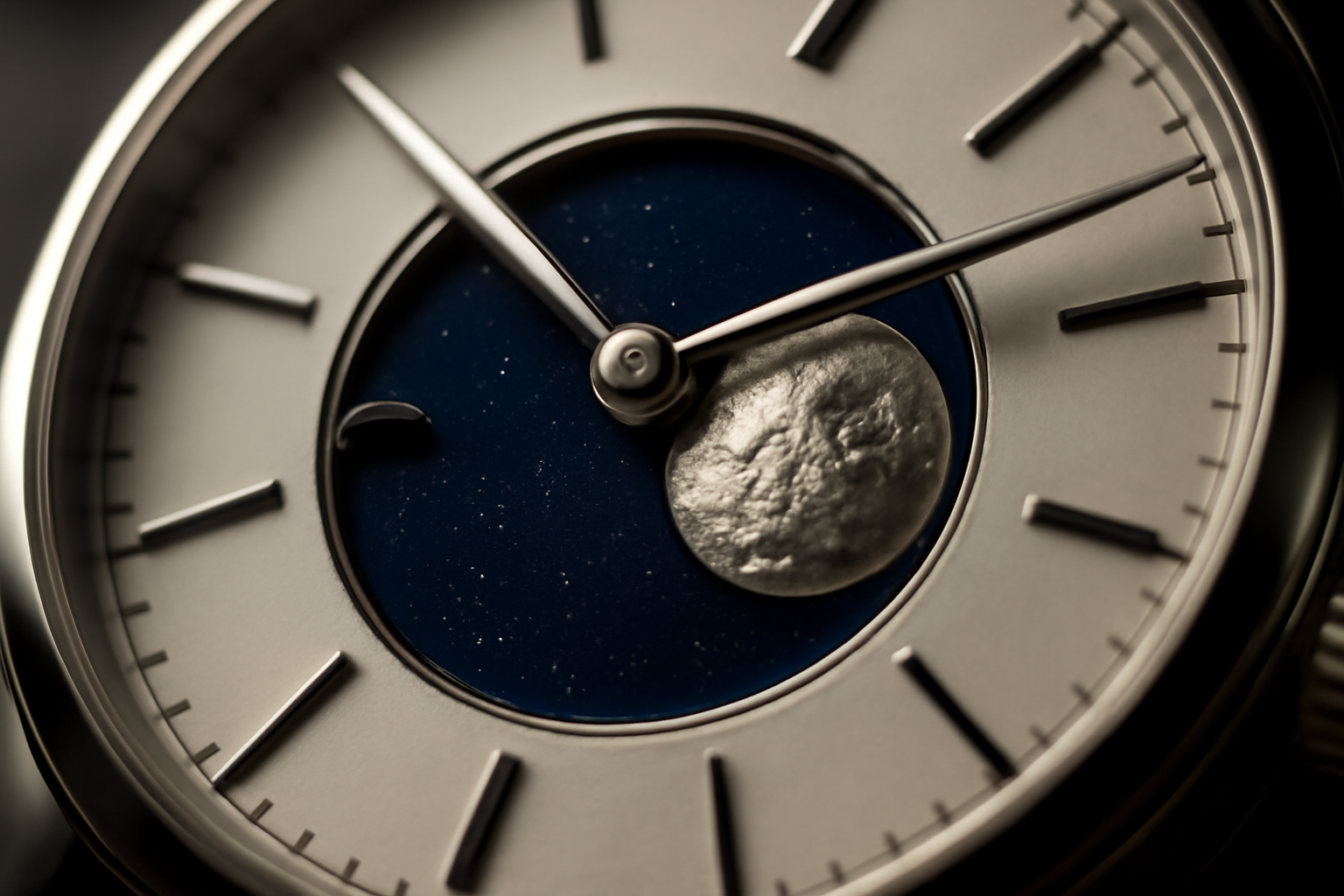
I once logged a moonphase purchase in my collecting journal as “practical” — a word I had to cross out three months later when I actually tried using the thing to track anything. That entry was for a $310 dress watch I bought at an antique mall outside Salem, convinced its little crescent disc would somehow earn its keep beyond looking pretty. It never did, not in the way I’d imagined. What it taught me is that a moonphase complication and a moonphase’s usefulness are almost entirely unrelated questions, and conflating them is the single most common mistake I see collectors make — myself included, apparently, for at least one embarrassing quarter of a year.
Here’s what I’ve settled on after all that: most people asking about the moonphase complication are asking the wrong question entirely. They want to know “is it accurate,” when the question that actually matters is “does it mean something to me.” Those two lines of inquiry lead to completely different places. So I want to lay out what a moonphase mechanism actually does, how the mechanics work, what genuinely separates a $200 example from a $20,000 one, and whether any of it earns a spot on your wrist.
What’s Actually Happening Inside a Moonphase Complication
A moonphase mechanism follows the lunar cycle — roughly 29 days, 12 hours, 44 minutes, and 2.9 seconds, if you want the number precise — and shows the moon’s current phase somewhere on the dial. The usual method is a rotating disc printed with two moons, visible through a small cutout window. As that disc turns, the moon appears to swell and shrink in something close to real time. It’s mechanical engineering wearing the disguise of poetry, and I mean that as a compliment.
Most budget moonphase movements rely on a 59-tooth gear to drive that lunar disc, and this introduces a small, unavoidable error — roughly one day of drift every 2.7 years. Doesn’t sound like much until you do the math over a decade of wear, at which point your moon has wandered nearly four days off schedule. Higher-tier calibers solve for this. Patek Philippe’s caliber 240 Q, as one example, narrows that error to a single day every 122 years. Nobody actually needs that level of precision — you appreciate it the way you appreciate a well-turned phrase, philosophically rather than functionally.
From what I’ve handled over the years, the thing that separates a moonphase worth owning from one that’s just a gimmick is the craftsmanship in the aperture and disc themselves. The cheap versions use flat, printed discs with no depth to them. Better executions — IWC’s Portofino Moonphase comes to mind, as does the Frederique Constant Slimline Moonphase around the $1,200 mark — use hand-guilloché dial work and polished disc surfaces that reflect light differently depending on whether you’re checking it at noon or midnight. That’s where the actual value sits, in the tactile and visual layers, not on the spec sheet.
How the Moonphase Complication Changes Across Price Brackets
I’ve lived with moonphase watches across a fairly wide price range, and the differences between them are real, though they don’t always show up where you’d expect. At the low end, Seiko’s SNE435 runs a solar quartz movement with a moonphase display for around $180. That moon indicator is purely decorative — it doesn’t advance along with the actual lunar cycle the way a mechanical version does. Even so, the dial is legitimately attractive, and the watch sits well on a leather strap.
Real mechanical moonphase territory generally begins somewhere between $500 and $800. Orient’s Star Classic Moon Phase, built around the caliber 982, retails near $550. It runs the standard 59-tooth gear, meaning you’ll be correcting it by hand every few years. Still, the build quality is honest and there’s real depth to how the moon reads on the dial. I’ve had mine on my wrist for two full years now without ever feeling shortchanged.
Cross $1,500 and the moonphase complication starts earning its price through finishing rather than function. Nomos Glashütte’s Orion Neomatik Worldtimer lands near $3,200 and shows in-house movement finishing right through the caseback — the bridge beveling, specifically, is done by hand. At that tier, you’re no longer buying a lunar tracker; you’re buying an object built to reward sustained attention. Those are fundamentally different transactions, even if the outcome on paper looks similar.
Where Your Money Actually Goes as Prices Climb
- Below $500: mostly decorative, frequently quartz-driven — attractive to look at, but no genuine lunar tracking underneath
- $500–$1,500: mechanical moonphase built on the 59-tooth gear — functional, but you’ll need to correct it periodically
- $1,500–$5,000: better gear trains, improved finishing, sapphire casebacks, and in-house movements starting to show up
- $5,000 and up: high-precision moonphase tracking (122-plus year error margins), hand-finished movements, real horological substance
Does a Moonphase Serve Any Real Purpose?
I’ll just say it plainly: if you actually need lunar phase information for practical reasons — fishing trips, garden timing, night photography — pull out your phone. No mechanical moonphase watch, at any price point, functions as a genuine utility tool. That’s not a knock against it; it’s just clarity. This complication occupies the same territory a fountain pen occupies next to a ballpoint. A Pelikan M800 with a broad nib doesn’t put ink on paper any faster than a Bic does. What it does is turn the act of writing into something you actually notice.
Still, there are legitimate use cases worth mentioning. Sailors and surfers who already have a watch on their wrist anyway tell me a moonphase adds a useful layer of tidal awareness they wouldn’t otherwise think about. Astrophotography folks have mentioned enjoying a glance at wrist-level moon status while scouting a shoot. For my own part, owning a moonphase watch has made me pay more attention to the sky generally — I know that sounds like a soft claim, but it’s held up over years of wear. There’s something about analog tools that sharpens attention in a way digital shortcuts don’t.
The strongest argument for owning one, though, has nothing to do with utility and everything to do with feeling. A watch communicates something about how you want to experience time passing. A moonphase says you’re conscious of a bigger rhythm running underneath your day. I happen to find that compelling. You might find it a little much. Both reactions are entirely reasonable — the real work is figuring out honestly which camp you fall into before you hand over $800.
A Costly Lesson in Setting and Maintaining a Moonphase
Here’s where I went wrong early on: I left my Orient moonphase untouched in the watch box for three weeks while I rotated other pieces into wear. By the time I picked it back up, the moon display wasn’t off by a day — it was badly, obviously wrong. I figured I’d just mash the corrector and cycle it forward quickly to catch up. That assumption cost me. I pushed the corrector fast, felt a bit of resistance partway through, ignored that feeling, and kept going anyway. The disc popped right off its detent mechanism.
The fix ran $95 at my local watchmaker’s bench. The embarrassment cost quite a bit more than that. Moonphase correctors are only meant to be pressed during specific safe windows in the movement’s cycle — generally between 6:00 AM and 6:00 PM, when the moonphase gear isn’t mid-advance. Correct it at the wrong moment and you risk damaging the gear train, particularly on movements under $1,000 where tolerances run tight. Since then, every moonphase watch I bring home gets a date with its instruction manual before I touch a single pusher.
There’s another piece to this: setting a moonphase correctly means knowing the precise date within the lunar cycle, not just eyeballing whether tonight’s moon looks full. I check the U.S. Naval Observatory’s lunar data tool before resetting any complication now — takes about three minutes and spares you the trouble of ending up six days off within the first month. Precision habits matter with mechanical tools generally, whether you’re correcting a watch complication or priming a stubborn vintage Pelikan piston filler before loading it with iron gall ink.
Keeping a Moonphase Honest With a Watch Winder
Once you own that moonphase watch — bought or inherited, doesn’t matter which — you’ll notice fairly quickly that automatic movements wind down the moment they sit still on a nightstand. A decent watch winder keeps things running, and that keeps your moonphase display synced to the actual lunar cycle instead of quietly drifting off into its own invented timeline.
Where it earns its keep
- Keeps automatic movements wound without overrunning them, so you’re not stuck resetting the moonphase every single time you put the watch on
- Runs quietly enough to live on a desk or shelf without turning into background noise in your workspace
- Small enough footprint that it doesn’t require its own cabinet — it slots in comfortably among your journals and coffee cup
Where it falls short
- Adds one more object competing for shelf space and an outlet in a workspace that’s probably already crowded
- Only makes sense if you’re actually wearing the watch on a regular basis — for a display-only piece, the winder’s just for show
I almost skipped buying one entirely, convinced the manual winding ritual was part of the moonphase’s charm—until I realized I’d set the phase wrong three times in a month out of pure embarrassment. The Mcbazel Single Watch Winder made that friction disappear.
About This Article

Written by Ellen Ashford. Watch collector, fountain pen enthusiast, and lifelong journaler. Time & Ink is where I explore the craft of analog living — from vintage timepieces and fine stationery to the simple pleasure of putting pen to paper. More about this site.
Verify this against a primary source
Specifics change, and your situation may differ from the one described here. These are the authorities worth checking directly:
- NAWCC — horological reference, archives and research library
- Smithsonian Institution — collection records for historic timepieces and writing instruments