
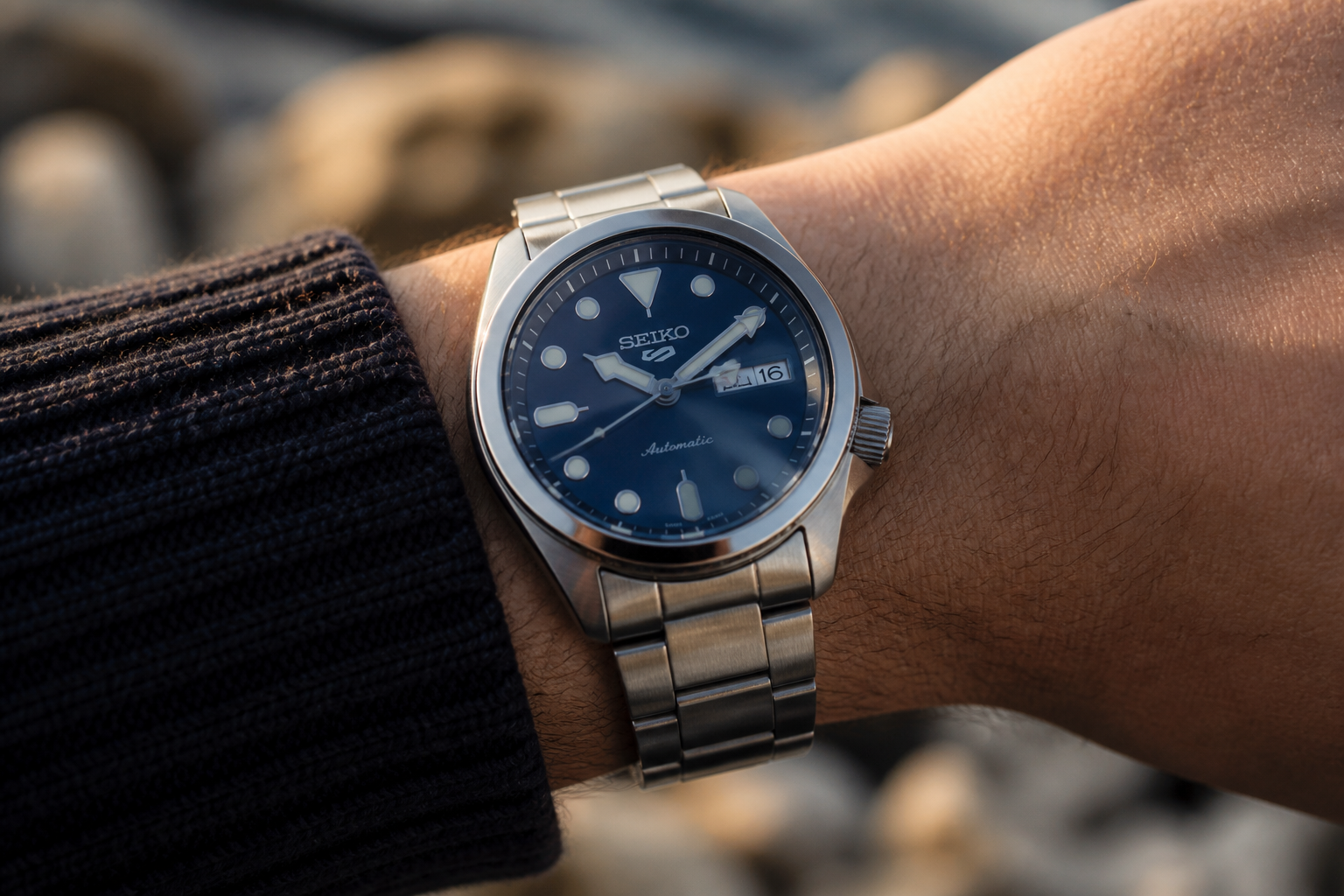
Seiko 5 Review: The Watch I’ve Bought Seven Times and Keep Coming Back To
I own seven Seiko 5 watches. Not as a collector’s flex—I genuinely wear most of them. The SNK805 sits on my desk right now, case brushed to a soft matte from years of field work. The SRPD55 with its ocean-blue dial came off my wrist twenty minutes ago. This isn’t accidental accumulation. It’s the mark of a watch that solves a real problem: where do you find an automatic movement, genuine Swiss-adjacent engineering, and total peace of mind for under $150?
After a decade testing everything from $15 Seiko quartz models to vintage Omega movements, I’ve learned that value in watches isn’t about lowest price. It’s about what you get per dollar. The Seiko 5 lineup has changed dramatically in the last five years, but the core promise remains: mechanical reliability at a price that doesn’t require justification to your partner.
Here’s what I wish I’d known before buying that first SNK805 in 2015, and what I’ve learned from the six that followed.
Which Seiko 5 Models Actually Exist (The Lineup Is Genuinely Confusing)
Seiko 5 is less a single watch and more a brand promise: automatic movement, date window, 100+ meter water resistance, a metal bracelet, and quality control that doesn’t embarrass you. The problem is that promise got stretched across dozens of model lines, and retailers conflate them wildly.
The SNK series—my first love—came in at $50–60 new. The SNK805, SNK809, and SNK807 dominated the field watch category for over a decade. These use the 7S26 caliber, a no-nonsense automatic movement. They’re 37mm and feather-light, perfect for smaller wrists. Unfortunately, Seiko discontinued the line around 2018. You’ll find them now for $70–90 on Amazon, and prices won’t drop further.
The SRPD series replaced it. At 42.5mm with a 13.4mm thickness, these are bigger. They use either the NH35A caliber (in newer models) or the 4R35/4R36 (mid-tier variants). The SRPD55, SRPD57, SRPD65, and SRPD87 retail between $110–150 and represent Seiko’s current automatic Seiko 5 strategy. Specifically, I’d avoid conflating these with the SNKL series, which is pure quartz and has zero business wearing the “5” badge—it’s an anomaly in the lineup.
Price history matters here. The SNK series was cheap because Seiko wanted market penetration. The SRPD series costs more because manufacturing moved, specs improved, and the market learned what these watches were worth. That’s not inflation—it’s honest repricing.
Seiko 5 Accuracy: What to Realistically Expect
This is where people’s expectations crash against reality. A $4,000 Rolex Submariner is regulated to COSC standards (−3 to +2 seconds per day maximum). Your $130 Seiko 5 is not. It won’t be. And that’s okay if you understand what you’re actually getting.
Real-World Seiko 5 Accuracy Numbers
I test accuracy the way most people actually experience it: against time.is over 24-hour periods, worn normally. My SRPD65 (NH35A caliber) typically runs +8 to +12 seconds per day. The SRPD55 gains about +14 seconds over the same period. My old SNK805? It was all over: some weeks +18 seconds, others +22 seconds.
Seiko’s official spec is ±25 seconds per day for the 7S26 caliber (SNK series) and ±10–15 seconds per day for the NH35A (SRPD series). In practice, most examples cluster around ±15 seconds per day. That’s not a flaw—it’s typical for a movement costing Seiko roughly $15 to produce.
However, there’s a critical difference between the older 7S26 (found in SNK models) and the modern NH35A (SRPD series). The 7S26 does not hack—meaning the seconds hand won’t stop when you pull the crown. It also doesn’t hand-wind. For daily wear, this means you’re either shaking the watch or wearing it to wind it. The NH35A hacks and hand-winds, which changes the experience entirely. I didn’t understand this when I bought my second SNK805. After a day in my desk drawer, I’d lose four minutes and spend five minutes getting it back to correct time.
Regulation is possible if you’re willing to open the case back (requires a case opener, roughly $10). Seiko movements are relatively accessible to DIY adjustment. A professional service runs $80–150, which defeats the economic argument. Most owners simply accept the ±15-second range and move on.
That acceptance is the real skill here. Once you stop chasing precision and recognize that losing a minute per week is fine for a watch that costs less than two nice pens, the Seiko 5 becomes liberating. It’s tool-accurate, not chronometer-accurate.
Build Quality at This Price: What’s Good and What’s Not
The dial on my SRPD57 is clean. Applied indices, clean printing, a day/date window that’s not perfectly aligned but honest. You’re not getting dial finish that commands compliments at parties. What you get is something that looks professional and holds up.
The crystal is mineral glass, which Seiko doesn’t hide. It scratches. I have a light scratch on my SRPD55 from a carelessly placed coffee cup. Sapphire crystal upgrades exist—the Sternkreuz MSF costs about $30 and transforms the watch. It’s worth it if you’re keeping the watch five years or longer. For watches bought as beaters, skip it.
The case finishing is competent mixed brushing and polishing. The SRPD series cases (42.5mm x 13.4mm) feel solid but not heavy. Lug width is 22mm, which opens up the aftermarket strap ecosystem considerably. The SNK cases (37mm x 11mm) use 18mm lugs and feel more refined proportionally, especially on smaller wrists—though they’re now harder to find.
Here’s the honest complaint: the SRPD bracelets rattle. The stamped end links and hollow mid-links create a hollow sound when you move your wrist. This isn’t a defect—it’s a cost-cutting measure present in nearly every SRPD shipped. The factory bracelet is adequate but loose. A $12 aftermarket bracelet (often from brands like Strapcode) eliminates the rattle entirely and upgrades the wearing experience noticeably.
The crown needs a mention: if it’s not pushed fully into 3 o’clock, water can seep past the seal. The SRPD65 is rated 100m (10 bar), which means splash-resistant and safe for snorkeling. The older SNK models at 30m (3 bar) are essentially splash-resistant—comfortable for daily wear, not for swimming. Always verify the spec before buying if water resistance matters to you.
One more thing: the rotor (the oscillating weight that winds the movement) creates an audible ticking in most Seiko automatics. It’s not a rattle or a grinding sound—it’s normal. I mention this because someone always asks if their watch is broken.
The Best Seiko 5 Models Right Now
If you’re buying new, you’re choosing from the SRPD series. These modern models use either the NH35A (newer variants) or the 4R35/4R36 (older variants still in stock). Both hack and hand-wind. Both typically run ±15 seconds per day. The 4R35/4R36 offers an additional level of functionality for watches with GMT complications, but for standard field and sports models, the NH35A is the standard.
The Watch That Finally Stopped Me From Buying “Nicer” Alternatives
When you keep returning to the same watch model year after year, it’s because it does something most expensive alternatives can’t: it gets out of your way. The SRPD65 is the version I reach for when I want the Seiko 5 formula perfected—the dial that reads cleanly in low studio light, the case size that feels right on smaller wrists, the movement that simply works.
What works
- The dial has enough breathing room to feel premium without the visual clutter that makes cheaper watches look fussy—text is legible, lume catches light predictably, the date window doesn’t dominate the face.
- Day-to-day wearability is genuine; the bracelet doesn’t rattle, the case back doesn’t dig into desk edges during writing sessions, and a scratch at month three doesn’t feel like a catastrophe because the brushed finish hides evidence of actual use.
- The 4R36 automatic movement is transparent about what it is—accurate enough for a working artist’s schedule, not finicky about positioning, and genuinely durable across multiple years of rotation.
What doesn’t
- No hacking seconds hand or manual wind option—minor friction when you’re someone who syncs watches obsessively, but honestly, a limitation that keeps you from overthinking it.
- The applied indices are real enough to admire, but they’re not hand-finished, so if you’re comparing side-by-side with a watch triple the price, you notice the difference immediately.
I almost didn’t buy the SRPD65 a second time—the temptation to “upgrade” to something Swiss-made or with a visible escapement always creeps in when you have disposable income. But the moment I fastened it and picked up a pen, I remembered: this watch was designed for people who actually work, not people who collect.
About This Article

Written by Ellen Ashford. Watch collector, fountain pen enthusiast, and lifelong journaler. Time & Ink is where I explore the craft of analog living — from vintage timepieces and fine stationery to the simple pleasure of putting pen to paper. More about this site.
Verify this against a primary source
Specifics change, and your situation may differ from the one described here. These are the authorities worth checking directly:
- NAWCC — horological reference, archives and research library
- Smithsonian Institution — collection records for historic timepieces and writing instruments