The first time I tried opening a watch caseback, I did it wrong — and I have the scratched brass to prove it. The watch was a Seiko 5, a beat-up automatic I’d paid six dollars for at a church rummage sale in 2014, already knowing it ran but not caring much either way. I wanted to see inside. I’d been collecting for maybe eight months at that point, reading everything I could find, and the one thing every forum post agreed on was this: if you want to understand movements, you have to look at them. So on a slow Tuesday afternoon in November, with a case knife I’d borrowed from the kitchen and absolutely no idea what I was doing, I pushed the blade into the wrong spot and learned my first real lesson about opening a watch caseback for the first time.
Where I Went Wrong First
I pushed the knife into the flat side of the caseback, away from the notch. This is the instinctive thing to do. It’s also wrong. The blade skated sideways across the stainless steel and left a shallow gouge about four millimeters long, right at the four-o’clock position. The caseback didn’t open. My stomach dropped a little. It wasn’t a precious watch — six dollars, already mentioned — but there’s something specifically deflating about damaging a thing you were trying to respect.
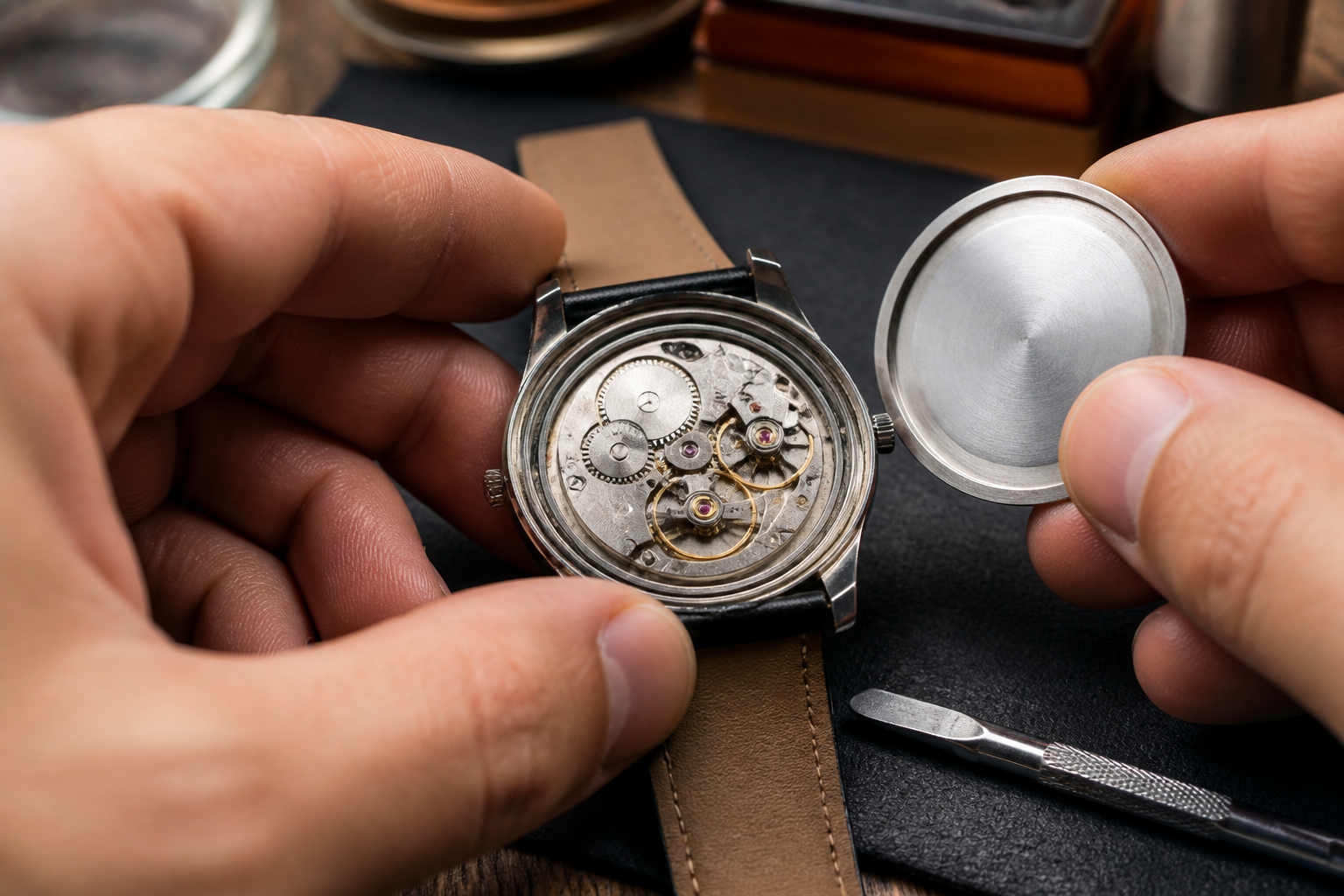
I put the knife down and looked more carefully. That’s when I noticed the small machined notch, just a slight interruption in the caseback’s otherwise smooth lip. That notch exists specifically so you don’t have to force the blade. You seat it there, angle it slightly downward, and apply slow, even pressure with a gentle rocking motion. The caseback popped off in under ten seconds. It genuinely felt like the watch had been waiting for me to pay attention.
What I Found Inside — and What I Learned to Name
I don’t have a precise way to describe that first sight. Small is the obvious word, but small doesn’t cover it. The movement filled the case so completely, so deliberately, that it looked designed in the way that circuit boards look designed — every component earning its space. The Seiko 5 runs a 7S26 caliber, a 21-jewel automatic beating at 21,600 vibrations per hour. None of that meant anything to me in November 2014. What I saw was a rotor — a weighted semicircle of metal that swings freely — and beneath it, just barely visible at the edge, something that flickered.
That flickering thing was the balance wheel. It oscillates back and forth, regulated by a coiled spring so fine it looks like a strand of silver hair. That spring is called the hairspring, or technically the spiral spring in some horological literature, and it is without question the most delicate object I have ever been physically close to. It governs how fast or slow the watch runs. Deformed by a fingertip, it would render the watch useless. I learned its name that afternoon. I did not touch it. I did not breathe heavily in its direction. Some lessons arrive cleanly.
The train bridge — the flat plate visible across much of the movement — sits above the gear train that transfers energy from the mainspring to the escapement. The jewels are the red synthetic rubies set into the metal, reducing friction at the pivot points. In my experience, once you know what you’re looking at, a movement starts telling you things: whether it’s been serviced, whether the lubrication has dried out and turned dark, whether something is obviously out of place.
Why I Kept My Hands to Myself
I had read enough to know that fingers were forbidden territory near an open movement. The reasons are two, and both are serious. First, the oils from your skin. Human finger oil is surprisingly acidic and will migrate into places you cannot see, attracting dust and eventually degrading lubricants that cost a watchmaker real time and money to apply correctly. Second, the mechanical fragility. The balance wheel’s staff — the tiny axle it rotates on — can snap under almost no pressure at all. The hairspring can be bent by a puff of air from the wrong angle. Watching is the activity. Touching is the damage.
I also kept the caseback open for less than three minutes. Dust is not a paranoid concern; it’s a real one. A single dust particle lodged under the balance wheel can cause irregular timekeeping or stop the watch entirely. That Tuesday afternoon was not a clean-room environment. It was my kitchen table, and I’d been cooking earlier. I looked, I named what I could, I took one photograph with my phone, and then I pressed the caseback back on until I heard it click. That click is one of my favorite sounds in collecting.
What Opening That Caseback Changed for Me
Something shifted after that afternoon. Not dramatically — I didn’t suddenly become a watchmaker or even want to be one. However, I started seeing watches differently when I handled them at markets and estate sales. The outside of a watch tells you some things: condition, originality of the dial, whether the hands have been redone. The movement tells you others. Specifically, it tells you whether the watch has been cared for, whether someone has been inside it before you, and whether the service it probably needs is a routine cleaning or something more complicated.
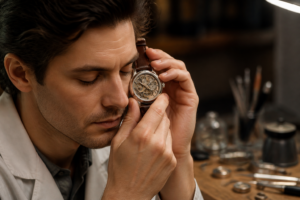
I started carrying a small loupe — 10x, nothing elaborate — and asking sellers politely whether I could open the caseback before deciding. Most said yes. The first time I used this at a flea market, I turned down a $40 Omega that looked beautiful on the outside because the movement showed dark, dried lubricant and what appeared to be a replaced wheel that didn’t match the caliber. I have no idea if my read was correct. That said, it felt like the right call. The point isn’t expertise; the point is informed caution.
How I Started Photographing Movements
The photography came almost by accident. That first phone shot of the 7S26 was blurry and badly lit, but I looked at it for longer than I looked at most things that week. As a result, I started trying to take better ones — macro lens attachments, a small ring light, learning to hold the watch at an angle that caught the finishing on the bridges without blowing out the highlights. Movement photography is its own discipline. The best images I’ve taken show beveling and anglage on movements worth far less than the photographs suggest. There’s real satisfaction in that.
I now have a folder of about 340 movement photographs going back to that 2014 Seiko. They include a 1960s Omega 565, a Longines 30L I found at an estate sale for $55 because the case was ugly, and a handful of ETA 2824-2 calibers from various watches that came through my hands over the years. The folder is personal history. It’s also reference material. When I’m uncertain about something I’m looking at in the field, I check against what I’ve documented before.
Where Opening a Caseback Ends — and Where a Watchmaker Begins
I want to be clear about something, because I think this matters for anyone drawn toward opening a watch caseback for the first time on their own. Looking is beginner-safe. Touching is not. The line between those two things is not arbitrary. It is drawn by the reality that watch movements are precision instruments that can be permanently damaged by someone who doesn’t know what they’re doing — which is almost everyone, including me, when we first start out.
Here’s where I draw the boundary for myself, after a decade of handling watches:
- Opening a snap caseback on a budget automatic to observe the movement: yes, cautiously, on something you can afford to learn on.
- Removing or adjusting any component inside: no, not without training and proper tools.
- Attempting to oil a movement, regulate the balance, or replace a part: absolutely not — this is watchmaker territory.
- Opening a screw-down caseback: requires the correct case wrench for that specific diameter; use the wrong tool and you damage the caseback irreparably.
The scratch on that six-dollar Seiko is still there. I could have polished it out, but I didn’t. It’s the first lesson I paid for with my own carelessness, and that feels worth keeping. The watch runs, by the way. I timed it last year — gaining about twelve seconds per day, which for a 7S26 is practically as-built. Ten years on, and that rummage-sale runner still keeps time. Some things are built to outlast their owners’ mistakes.
If you’ve never looked inside a movement, find something cheap and automatic, be honest about what you don’t know, and open the caseback for the first time with patience. Look at everything. Name what you can. Close it in under three minutes. That’s enough. It is genuinely enough to change how you see every watch you hold afterward.
About This Article

Written by Ellen Ashford. Watch collector, fountain pen enthusiast, and lifelong journaler. Time & Ink is where I explore the craft of analog living — from vintage timepieces and fine stationery to the simple pleasure of putting pen to paper. More about this site.
Verify this against a primary source
Specifics change, and your situation may differ from the one described here. These are the authorities worth checking directly:
- NAWCC — horological reference, archives and research library
- Smithsonian Institution — collection records for historic timepieces and writing instruments