
What Happens Before the Caseback Ever Comes Off
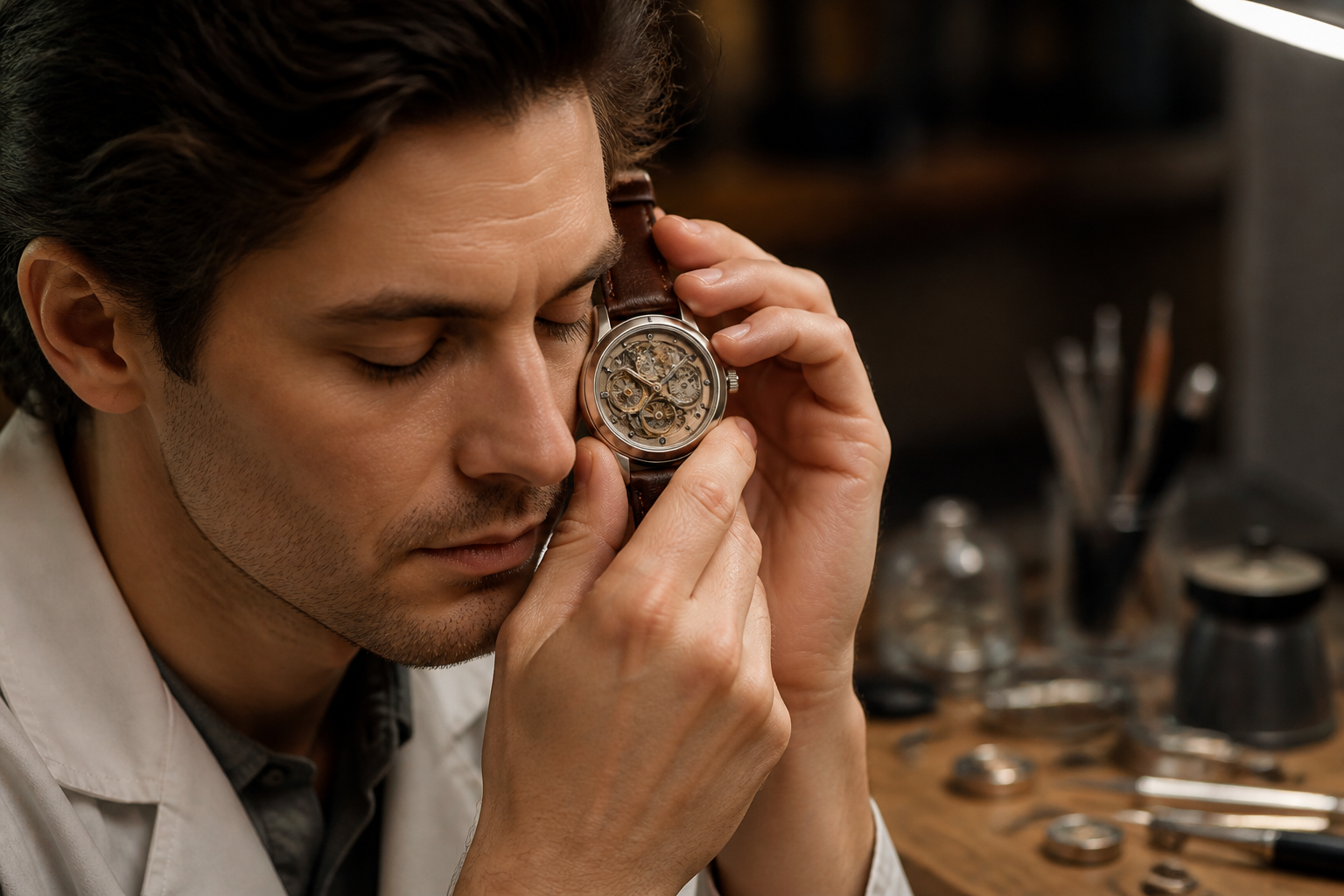
Almost every new collector assumes a watch’s ticking is just ambient noise — something you eventually stop hearing altogether. That assumption is backwards. The very first thing I do with any watch I don’t already know is bring it to my ear and shut my eyes. It’s the oldest form of diagnosis available, and it requires nothing: no app, no tools, no caseback removed. Just sound. I built this habit slowly, across roughly four years of buying watches I had no way to fully vet before the money changed hands — estate sales, flea market folding tables, the occasional nerve-wracking eBay gamble. My ear is quicker than any instrument I own, and unlike a timegrapher app or a loupe, it’s always in my pocket. Still, it has boundaries I only discovered by getting things wrong, and I won’t pretend otherwise here.
What follows is the actual sequence — what I listen for, in what order, and what those sounds have either spared me from or cost me across the years.
The Opening Note: What Beat Rate Reveals
The very first thing a watch reveals is its beat rate. This is measured in beats per hour, or bph, and every single “tick” your ear catches is one beat. The great majority of mechanical movements run at 18,000, 21,600, or 28,800 bph. A smaller category of high-frequency calibers reach 36,000 bph, though I own precious few of those.
At 18,000 bph, that works out to five ticks every second. Vintage calibers from the 1950s and 60s tend to sit here. The rhythm is unhurried, deliberate, close to meditative, with a distinct gap between beats. It carries an almost regal quality — a grandfather clock shrunk down to wrist size. Whenever a watch from that period lands in my hands, this is precisely the sound I expect.
At 21,600 bph, you’re hearing six ticks per second — the middle territory, common from the late 1960s into the 1980s. It’s noticeably brisker than the vintage tempo but still resolvable; concentrate and you can still count each individual beat.
At 28,800 bph, eight ticks per second blur together into what I’d describe as a smooth, continuous hum rather than a series of distinct clicks. This is where modern production lives — ETA 2824, Sellita SW200, a great many Rolex calibers. Compared to a lazy 18,000 bph vintage piece, it sounds almost restless. Neither tempo is superior to the other. They’re simply two different conversations.
Quartz sits in a category of its own and announces itself instantly: a single crisp click per second, machine-precise, with none of the warmth or drift of a mechanical beat. Confirming mechanical versus quartz in that first instant tells me exactly how to proceed.
A $210 Verdict Reached by Ear: The Omega Seamaster
At an estate sale in northern Vermont three years back, I handed over $210 for an early-1960s Omega Seamaster. The seller was certain of the brand and uncertain of everything else — namely, whether it ran at all. I put it to my ear for perhaps thirty seconds before I made up my mind.
What came through was an 18,000 bph beat — unhurried, period-correct, exactly what that era should sound like. That part was encouraging. But the rhythm wasn’t quite level. Every third or fourth tick carried a faint lurch, a subtle gallop, as if the movement briefly stumbled. I knew that sound. It typically means one of two things: the watch needs regulating, or the balance wheel picked up magnetism somewhere along the way. Magnetization ranks among the most common ailments in vintage pieces — and among the cheapest to correct.
I bought it anyway. My watchmaker demagnetized and regulated it for $65. It now keeps time within plus-three seconds a day. All told, $275 bought me a caliber 550 Omega Seamaster that, in that condition, would fetch well beyond that on the open market. I’d made the call with my ear before I’d even bothered confirming the reference number.