Four time zones deep into a single work trip, doing arithmetic on hotel lobby carpet, and the watch on my wrist could tell me exactly one thing: the time in the city I’d left three days earlier. I miscalculated call times twice that week and showed up mentally twelve hours removed from everyone I was supposed to meet, which is how a perfectly beautiful dress watch convinced me it was no longer good enough. What followed was a genuine fixation — not a passing curiosity — with how GMT watches actually handle real movement between time zones. On paper, a GMT complication reads like a niche technical flex. Lived with day to day, it turns out to be one of the most quietly useful things a watch can offer someone who moves between cities and continents for real.
People assume GMT watches exist for airline pilots or globetrotters with passports stamped seventeen times over — I hear this constantly, and it’s simply wrong. If you take calls with colleagues overseas, travel for work even a handful of times a year, or have family scattered across the map, a GMT watch justifies itself on your wrist every single day, not just on the trips that make it into a highlight reel. After roughly a decade of collecting and living with everything from affordable Seikos to vintage Rolex movements, I want to lay out what actually matters when shopping for one, what to steer clear of, and which specific watches I’d point you toward based on wearing them, not reading about them.
What a GMT Complication Is Actually Doing on Your Wrist
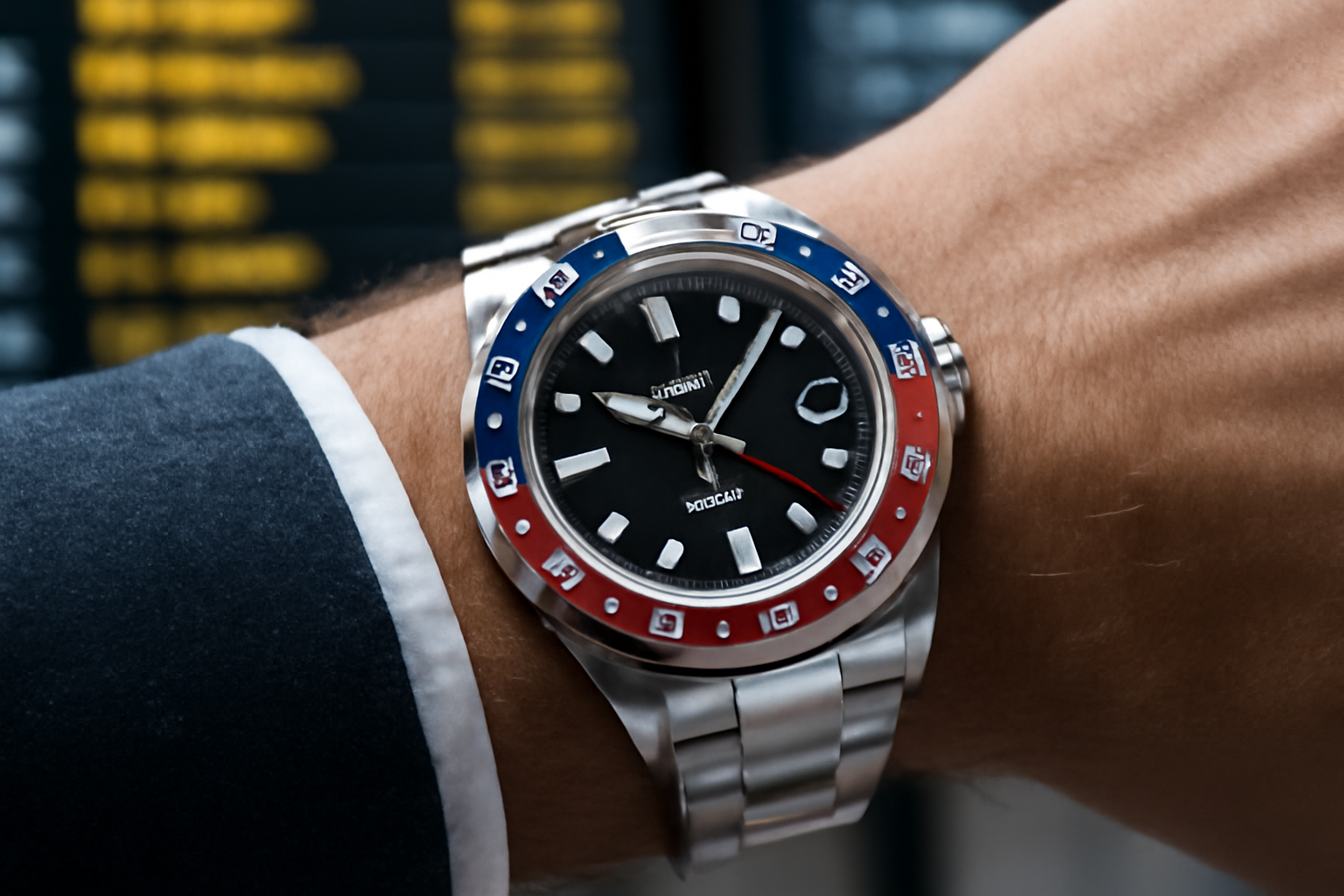
Mechanically, a GMT function bolts a fourth hand onto what would otherwise be a standard three-hand watch. That hand generally makes one complete rotation every 24 hours rather than every 12, and paired with a 24-hour bezel or chapter ring, it gives you a second time zone at a glance instead of a calculation. The name itself traces back to Greenwich Mean Time, adopted as the universal reference point back when Pan Am pilots in the 1950s needed to track home time alongside wherever they’d actually landed. Rolex built the GMT-Master in 1955, running caliber 6542, for exactly that job.
Worth knowing that there are really two flavors of this complication. Collectors call the first a “true GMT,” or independently-settable GMT — the local hour hand moves on its own without dragging the minute hand or GMT hand along with it. Rolex’s GMT-Master II, with caliber 3285, works this way. The second flavor jumps the local hand in one-hour increments in step with the GMT hand, usually nicknamed a “flyer GMT.” Both have their uses, but the independent-setting version is far more practical if you’re actually crossing time zones often, since you’re never disturbing the accuracy of a watch that’s already running correctly.
Making Sense of a GMT Dial Without the Mental Math
I’ll admit this stumped me longer than I’d like to admit. The 24-hour hand tracks your reference zone — usually UTC or wherever home is — against a 24-hour scale, while the ordinary 12-hour hands handle local time wherever you happen to be standing. Land in Tokyo after flying out of New York, and all you do is push the hour hand forward; nothing else needs touching. The 24-hour hand just keeps quietly ticking away at your home reference, and your minute hand never loses a beat of accuracy in the process.
That same 24-hour bezel also settles the AM/PM question for your reference zone, which matters more often than you’d guess. Knowing it’s 2 PM in London while you’re sitting in a San Francisco coffee shop at 6 AM heads off a lot of missed calls and mildly humiliating apologies. In my own experience, one trip of actually reading the GMT hand for real is enough to make the whole system click — give it about two days before you stop reaching for your phone to do time zone math by hand.
Some watches — the Seiko SSK009, the “Pepsi” colorway in the Prospex line, around $450 — handle this with a rotating inner bezel instead of a printed chapter ring. Others, like the roughly $2,700 Tudor Black Bay GMT, rely on a bidirectional ceramic bezel. The hardware differs, but you’re reading it the same way regardless. What actually changes from watch to watch is how you set that GMT bezel and whether the 24-hour hand can move independently of the main time display, or is stuck tagging along with it.
Four GMT Watches I’ve Actually Worn Across Time Zones
Over the past several years I’ve put four different GMT watches through real use, not showroom handling. My starting point was the Grand Seiko SBGM221, the Blue Lagoon spring drive GMT, priced around $3,200. The spring drive caliber 9R66 inside it is genuinely remarkable — I’ve clocked it holding to within ±0.5 seconds a day in ordinary wear. That said, Grand Seiko sits at a price most people aren’t in a position to start at, so my honest advice to anyone new to this is to begin further down the ladder and work your way up.
The Seiko SNE537 solar GMT runs about $250 and is built around the V172 solar movement. I wore it daily for three months during a stretch of heavy domestic travel, and it held to roughly 15 seconds of drift a month — genuinely impressive given the price tag. At 41mm, the case sits comfortably enough to disappear under a shirt cuff. The bezel action, though, felt noticeably looser than what you get on the Tudor Black Bay GMT, which snaps through a satisfying 24-click bezel and runs the MT5652 movement, holding to roughly +/-4 seconds a day — performance that’s essentially COSC-grade in practice.
Purely on value, the Orient Sun and Moon GMT, around $230, earns a mention. I wore it side by side against the Seiko SNE537 for three weeks straight. Orient’s in-house caliber F6T24 runs a touch less precisely ��� plan on roughly ±10 seconds a day — but the dial finishing is genuinely gorgeous for what you’re paying. If you weigh looks as heavily as timekeeping precision, Orient deserves a serious look.
The Checklist I Actually Use When Shopping for a Travel GMT
Between airports, meetings, and long layovers spent wearing these things, I’ve settled on a short checklist I run through before recommending anything to anyone. None of these are arbitrary preferences — each one exists because a watch I owned made me miss it the hard way.
- An hour hand that sets independently: Adjust local time without touching the running accuracy of the watch. For anyone traveling often, this isn’t optional.
- A 24-hour scale you can actually read: Some brands print this small enough that it’s a squint even indoors. Test it under real lighting before handing over money.
- A screw-down crown: Anywhere near water — pools, rain, a boat trip — this earns its keep. Aim for at least 100 meters of water resistance.
- A case sitting between 38mm and 42mm: Big cases photograph beautifully and feel absurd peeking out of a dress shirt cuff at 6 AM on a red-eye. I learned this wearing a 44mm pilot watch I loved dearly and never once brought to a client meeting.
- A bracelet or strap that adapts: A watch that moves easily from boardroom to weekend saves you from packing a second one. Quick-release spring bars are worth whatever small premium they add.
Here’s the lesson I paid for directly: never buy a GMT watch without confirming, in plain terms, whether that 24-hour hand sets independently. I once picked up a nicely vintage-styled GMT from a smaller brand — no names — and only a week into wearing it realized the local hand and GMT hand moved as a single unit. Every new city meant resetting my reference time right along with local time, which defeated the entire point of owning the complication in the first place. Read the spec sheet closely before you hand over your card.
The Winder That Kept My GMT Running Across Four Time Zones
If you actually intend to wear a GMT watch while traveling, keeping that automatic movement wound between destinations stops being optional. A GMT hand that’s stopped dead is arguably worse than not having one at all — it just sits there reminding you of the time zone you’re failing to track.
Where it earns its space
- Slides into a carry-on or a hotel nightstand without a fuss, keeping the watch wound even on short hops where you’re switching zones every couple of days
- Quiet enough to run through the night without waking anyone — I’ve left mine going in shared rooms and nobody’s ever noticed
- Keeps the GMT hand accurate and ready to reset, so you’re not doing time zone math in your head at 3 AM before a call that matters
Where it falls short
- Eats luggage space that could otherwise go to notebooks or sketchbooks — a real cost if you’re a writer or artist trying to pack light
- Handles exactly one watch at a time, so rotating between several GMT pieces means either buying multiples or living with gaps in coverage
I almost skipped this on my last trip because I thought I could just hand-wind before bed, but after oversleeping in Prague and missing a dawn meeting by thinking it was still 10 PM New York time, I realized the winder pays for itself in avoided chaos. Pick up the Mcbazel Single Watch Winder if you’re done doing time-zone arithmetic in your head.
About This Article

Written by Ellen Ashford. Watch collector, fountain pen enthusiast, and lifelong journaler. Time & Ink is where I explore the craft of analog living — from vintage timepieces and fine stationery to the simple pleasure of putting pen to paper. More about this site.
Verify this against a primary source
Specifics change, and your situation may differ from the one described here. These are the authorities worth checking directly:
- NAWCC — horological reference, archives and research library
- Smithsonian Institution — collection records for historic timepieces and writing instruments