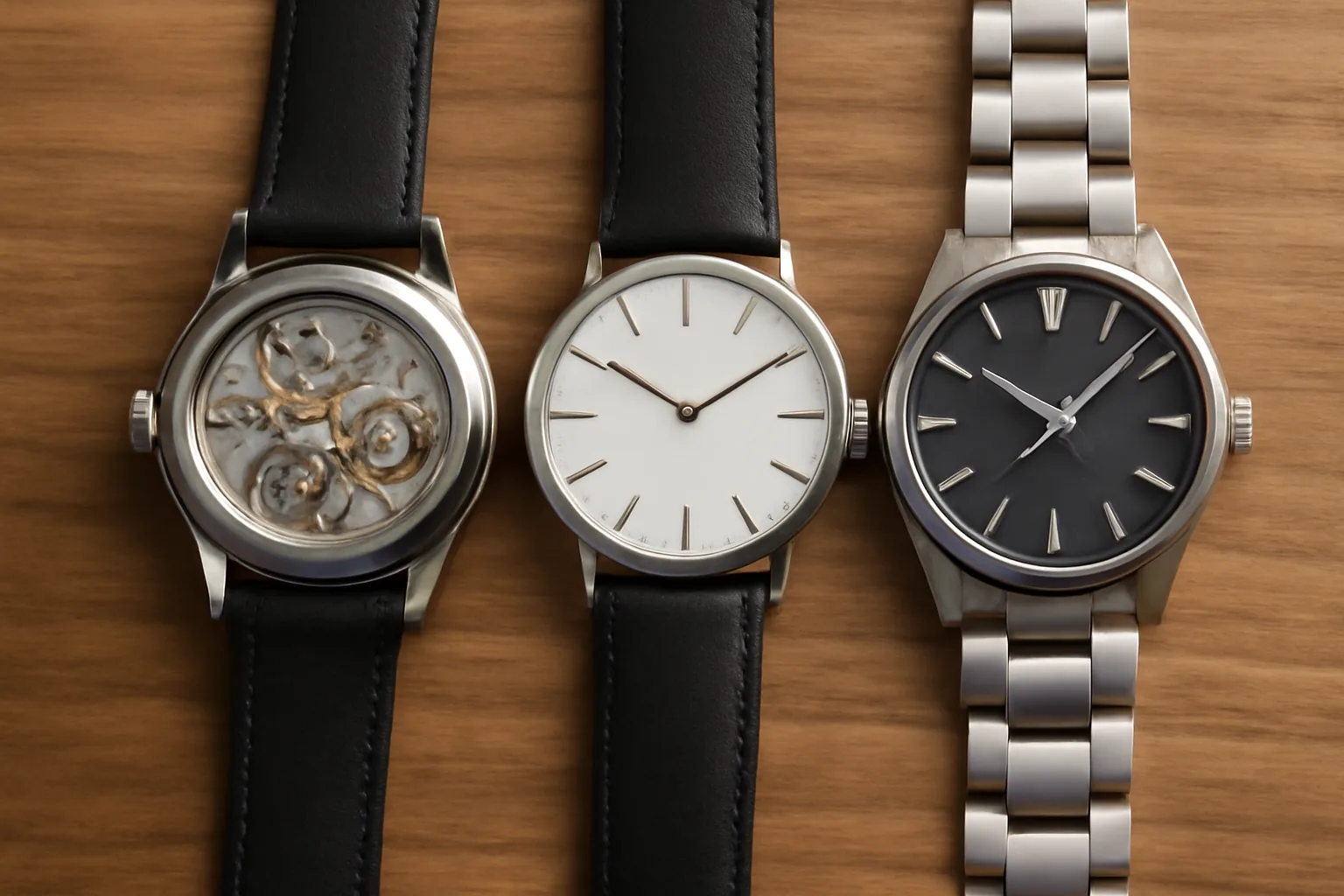
Spec sheets will hand you beats-per-hour figures, accuracy tolerances down to the decimal, and battery-life estimates measured in years — but none of that paperwork tells you what it’s actually like to live with the thing strapped to your wrist. I got a real education in that gap at a cramped repair bench in Kyoto, watching a watchmaker named Hiroshi work on my grandfather’s 1968 Seiko 5. He lifted it toward the window, gave the crown three deliberate turns, and told me: “This watch does not need batteries. It does not need the sun. It only needs you.” That line comes back to me every time someone asks whether they should buy mechanical, quartz, or solar, because the honest answer was never really about accuracy or price. It’s about what kind of relationship you’re after with whatever sits on your arm.
I’ve been at this collecting habit for more than ten years now. My current lineup includes a 1974 Omega Constellation, a Seiko diver running on an NH35, a pair of solar Casios, and several vintage quartz pieces from the late 1970s. I’ve dropped real money — and made some genuinely embarrassing mistakes — across every movement type there is. So what follows isn’t theory pulled from a catalog; it’s built on actual wear, actual repair invoices, and a few lessons that stung enough to remember.
How Mechanical, Quartz, and Solar Movements Actually Work
Here’s the plain version, no marketing gloss. A mechanical watch runs off a wound mainspring. That stored energy travels through a gear train to an escapement, which doles it out in controlled, measured increments. Budget mechanical calibers typically oscillate at 21,600 vibrations per hour (vph); the better-finished movements step up to 28,800 vph, which is where you start noticing smoother sweep of the seconds hand.
Quartz timekeeping runs on a different principle entirely — a battery pushes current through a quartz crystal, and that crystal oscillates at a fixed 32,768 Hz, the frequency spelled out in the ISO 3159 standard governing wristwatch accuracy. A small chip counts those oscillations and advances a stepper motor once a second — that’s the tick you’re hearing. It’s precise, inexpensive to manufacture, and asks almost nothing of the owner.
Solar movements — marketed as “Eco-Drive” by Citizen or “Tough Solar” by Casio, depending on whose dial you’re looking at — are quartz underneath the hood. The distinction is that a disposable battery gets swapped out for a rechargeable cell fed by a photovoltaic panel tucked beneath the dial. Both companies’ charging systems meet IEC 62133 standards for rechargeable battery safety. The real payoff versus ordinary quartz: you almost never have to crack open the case back.
Mechanical Watches: What You’re Really Signing Up For
I’ll say this plainly — mechanical isn’t the sensible choice if practicality is your priority. Depending on the grade of movement, you’ll see anywhere from ±10 to ±25 seconds of drift per day. A COSC-certified chronometer has to hold ±4 seconds a day under lab conditions, and that certification alone adds roughly $500 to the movement’s cost before it even reaches a case. If effortless accuracy is the goal, look elsewhere.
What mechanical gives back is harder to put a number on. There’s something satisfying about winding a crown each morning, and something genuinely impressive about watching a rotor spin behind a display caseback with every flick of your wrist. I found this out the expensive way with my first automatic, a Seiko SNKL23 I picked up for $75 back in 2009. Convinced that a handful of YouTube tutorials qualified me to service it myself, I went after the balance cock and cracked the jewel setting in the process. Fixing my own mistake ran me another $95 at a local watchmaker’s bench. The takeaway: the movement deserves more respect than confidence alone.
Plan on a full service roughly every 5 to 7 years. Mid-range pieces run $150 to $350 for that work; Swiss calibers push it to $400–$800. This is the cost that blindsides most new collectors in my experience — factor it into the purchase price before you buy, not after the invoice arrives.
Mechanical Suits You If…
- You rate horological craftsmanship higher than raw precision
- You look forward to a small daily ritual with your watch
- You’re building something meant to be handed down, not just worn
- You’ve made peace with periodic service bills
Quartz Deserves More Credit Than It Gets
For decades the industry sold the idea that quartz was the “cheap” alternative. That’s a marketing narrative, not an engineering fact. A $40 Casio F-91W stays within ±15 seconds a month. Meanwhile a $4,000 mechanical chronometer can still drift ±4 seconds in a single day. Run the numbers yourself — on pure timekeeping-per-dollar, quartz isn’t close.
The only real upkeep is the battery. A standard SR626SW silver oxide cell costs under $2 and runs 2 to 3 years before needing a swap, which a watchmaker will handle for $10 to $20 including a seal test. That seal test isn’t optional if the piece is rated 100m or more — any time the case back comes off, the gasket needs checking, or you’re inviting water in.
I ran a quartz Tissot T-Classic as my everyday watch for three years here in Portland — rain, humidity, constant knocking around, and it never once lost a beat. The exact model was a Tissot T033.410.11.053.01, averaging ±0.07 seconds a day. For a tool watch or a travel piece, quartz simply does the job without asking anything of you.
Mechanical vs Quartz vs Solar Watch: Why Solar Shifts the Calculation
Solar movements fix the one legitimate annoyance quartz still carries: the battery. More specifically, they remove the need to pop the case back open every couple of years — a real win for water-resistant pieces, dress watches built to tighter tolerances, and anyone who simply dreads the errand.
Underneath the dial, a photovoltaic cell keeps a rechargeable capacitor or lithium-ion cell topped off. Casio’s Tough Solar system, fully charged, can idle in total darkness for up to 6 months — and that’s not a lab claim, I’ve verified it firsthand by tossing a solar Casio in a desk drawer from January through June and watching it keep running the whole time. Reserve times vary by model, though, so check the manufacturer’s stated charge reserve before you buy on faith.
One caveat worth stating plainly: the rechargeable cell does wear out eventually. Somewhere around the 10-to-15-year mark, charge capacity starts to fade. It can be replaced, but that job needs a skilled technician — it’s nowhere near as simple as swapping a coin cell. Even so, a decade or more of never touching a battery is a trade most owners will happily take.
Solar’s Strong Points, Summarized
- No battery changes needed for a decade or more
- Case stays sealed, which keeps water resistance intact longer
- Accuracy on par with standard quartz — ±15 seconds a month or tighter
- Fewer disposable batteries thrown away over the watch’s lifetime
- Well suited to active, outdoors-heavy routines
The Solar Piece That Ended My Indecision
For anyone drawn to mechanical watches in spirit but unwilling to commit to the daily winding ritual — or who wants solar’s low-maintenance reliability without giving up the feel of a proper timepiece — a solar hybrid splits the difference. It’s a natural fit for writers and artists whose hands rarely stop moving, and whose relationship with time is already complicated enough.
Where it delivers
- It’ll take a charge from almost any light — sunlight, a desk lamp, even the dim glow of a studio at dusk — so there’s no dead-watch panic mid-project and no battery-replacement guilt hanging over you.
- Quartz-level accuracy means you’re never losing time while heads-down in work, yet it still reads as an actual watch on the wrist rather than some gadget.
- The day/date display earns its keep for journaling and timestamping creative sessions without having to dig your phone out of a pocket.
Where it falls short
- Spend a lot of time in dim rooms — basements, late-night studios, midnight writing sessions — and the charge drains quicker than you’d expect, forcing the occasional deliberate stretch of “sunbathing” to top it back up.
- You lose the quiet, almost meditative act of handwinding that makes a mechanical watch feel like a small daily gesture of care — there’s no physical hand in keeping this one alive.
I spent three months flip-flopping between mechanical and quartz before realizing I was overthinking a simple question—until I strapped on a solar watch and actually stopped thinking about it at all. If you’re tired of the debate consuming your decision, try the Casio Tough Solar Men’s Watch with Day/Date Indicator MTP-S110-2AVCF.
About This Article

Written by Ellen Ashford. Watch collector, fountain pen enthusiast, and lifelong journaler. Time & Ink is where I explore the craft of analog living — from vintage timepieces and fine stationery to the simple pleasure of putting pen to paper. More about this site.
Verify this against a primary source
Specifics change, and your situation may differ from the one described here. These are the authorities worth checking directly:
- NAWCC — horological reference, archives and research library
- Smithsonian Institution — collection records for historic timepieces and writing instruments