The Notebook That Split at Six Months
I pulled my daily carry journal from my coat pocket last February and heard a soft, papery crack. The spine had split — not catastrophically, not in two pieces on the floor, but enough that a pale gap yawned along the back cover and three signatures of pages fanned loose at an angle they were never meant to hold. Six months of morning pages, watch notes, ink swatches, half-finished thoughts. I set it on the workbench next to a movement I was cleaning and decided, before I did anything else, that I was going to repair the notebook spine with glue rather than retire it to a shelf and start fresh. That decision sent me down a two-hour rabbit hole the first time. Now the same repair takes me about twenty minutes, and I want to walk you through exactly how I do it.
What I Found When I Opened the Split
Before touching any adhesive, I looked at what had actually failed. This matters. A notebook spine can split for two distinct reasons, and treating the wrong one wastes your time.
In my case, the notebook was case-bound — a hard cover with signatures sewn together and then glued to a piece of mull, which is the open-weave fabric strip that bridges the text block to the boards. The mull was intact. What had failed was the original PVA layer bonding the outermost signatures to the mull: it had dried brittle, probably from the heat cycling of a coat pocket through a Chicago winter, and simply let go. The cover was beginning to separate at the front hinge, too — that hairline gap where the cover board meets the spine.
If your notebook is perfect-bound — the kind where single sheets are glued directly at the spine with no sewing — the failure mode is different and often less repairable. More on that in a moment.
What I Use — and What I Will Never Use Again
The right adhesive here is PVA bookbinding glue. It stays flexible when dry, which is non-negotiable for a spine that flexes every time you open the book. It does not wick aggressively into paper. It cleans up with water before it sets. A small jar lasts years of occasional repairs.
Now for the list of things that seem reasonable and are not:
- Super glue (cyanoacrylate). I used this on a Leuchtturm1917 in 2019 and it cost me about forty pages. Super glue dries glassy-hard and brittle, the opposite of what a hinge needs. Worse, it wicks along paper fibers by capillary action before you can stop it. I watched the pages curl and bond to each other in real time. That notebook was not salvageable.
- Hot glue. It cools faster than you can work it into a tight split, and it leaves lumps that prevent the spine from closing flat. The bond also fails at moderate heat — again, a coat pocket in summer is enough.
- Tape of any kind. Scotch tape, packing tape, even so-called “book tape” from an office supply store. Most pressure-sensitive tapes are acidic. They yellow within a year or two, they release at the edges, and they leave a residue that nothing pleasant will remove. A notebook you repair with tape is a notebook you are slowly destroying.
The super glue mistake is the one I am most embarrassed about. I was impatient and I was wrong, and it cost me a notebook I had carried for four months.
How I Work the Glue Into a Split Spine
Here is the actual repair process, in the order I do it.
Step one: flex the split open gently. I hold the text block in one hand and ease the loose signatures away from the spine just enough to see into the gap — maybe four or five millimeters. I am not forcing anything. The goal is to create enough access for the glue to reach the mull and the inner spine surface.
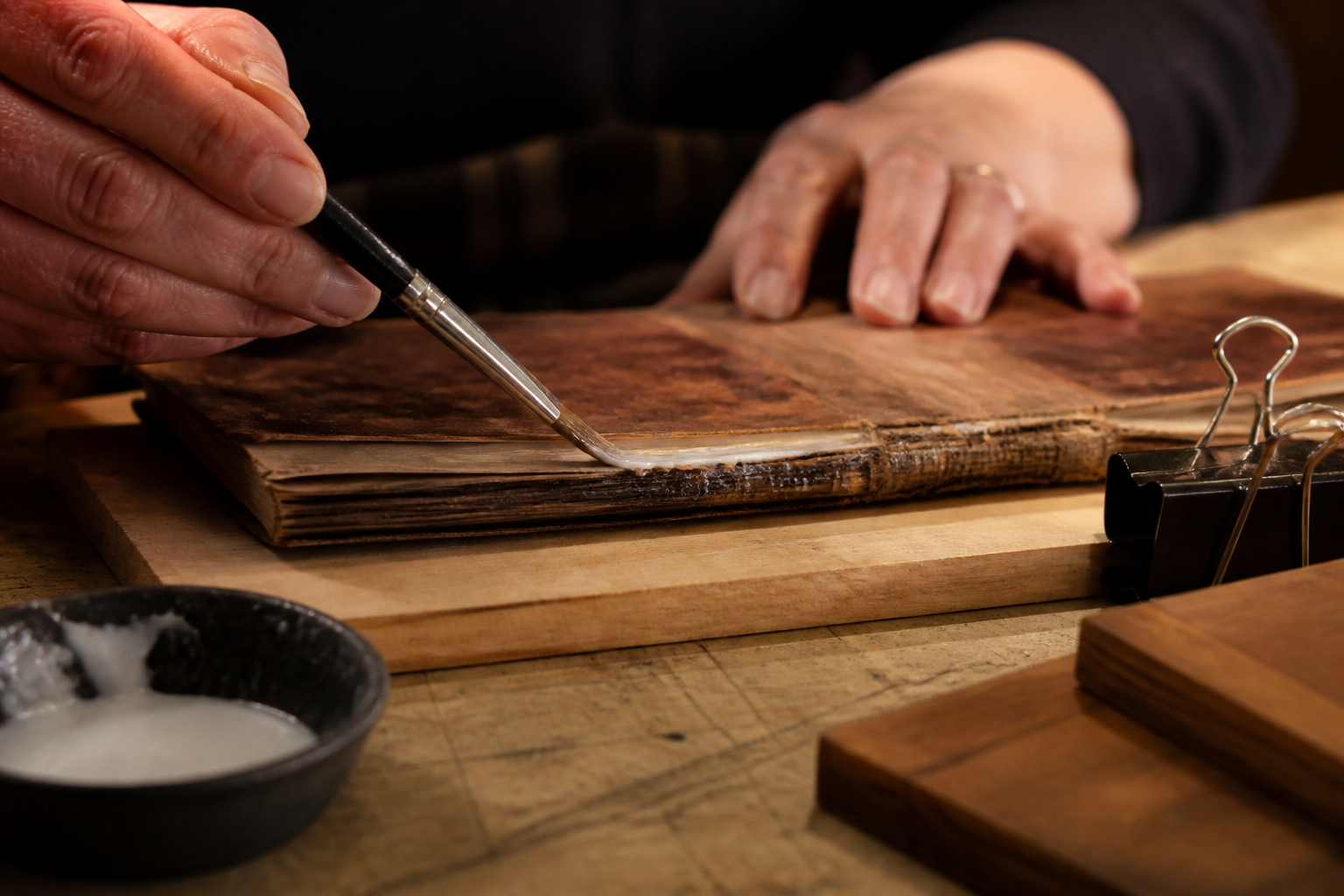
Step two: apply PVA with a scrap card. I cut a strip from an old index card or a piece of card stock, about ten millimeters wide. I dip one edge lightly into the PVA — I want a thin film, not a bead — and work it into the gap with a gentle back-and-forth motion along the full length of the split. The card lets me deliver glue precisely without getting it on the pages or the outer cover. I do two passes, checking that the mull feels wet along its full width.
Step three: close and wipe. I press the spine closed firmly with my fingers for about sixty seconds. Any squeeze-out gets wiped immediately with a barely damp cloth. PVA that dries on the surface of a cover is difficult to remove cleanly.
How I Clamp Without Damaging the Pages
Clamping is where a lot of people go wrong. The instinct is to grab a couple of binder clips and call it done. However, metal clips applied directly to a notebook board will dent the cover, and if any glue has migrated inside, the pages will stick to each other overnight.
My setup: two pieces of thin plywood cut to slightly larger than the notebook, wax paper slipped inside against the first and last pages, and binder clips along the spine edge — never in the middle of the boards, always within ten millimeters of the spine. The wax paper is the important part. PVA does not bond to wax, so even if a little glue wicked further than I intended, the pages release cleanly in the morning.
I leave it overnight — a minimum of eight hours. In my experience, pulling a glued binding after only two or three hours feels set, but the joint is still soft enough to fail under the stress of normal use. Eight hours at room temperature is the floor. Twelve is better.
Reinforcing the Hinge With Cotton Strip
If the cover hinge is also separating — that gap along the front or back where the board is pulling away from the spine — glue alone is not enough. Specifically, the repaired joint needs a mechanical reinforcement, because the hinge takes the most flex stress every single time the book opens.
I cut a strip of thin cotton muslin or similar lightweight woven fabric, roughly fifteen millimeters wide and the full height of the spine. I brush a thin coat of PVA onto the hinge area, lay the strip along it, then brush another thin coat over the top. The fabric becomes nearly invisible once the glue dries and, more importantly, it distributes the flex load across the weave rather than concentrating it at the glue line. As a result, that hinge is almost certainly stronger than the original after this repair.
When I Stop and Rebind Instead
Not every notebook is a glue repair candidate. Perfect-bound notebooks — single sheets glued directly into a square spine with no sewing — are harder. If the spine has dried and the pages are fanning, you can sometimes work fresh PVA in and reclamp. However, if signatures are actually detaching, or if the spine material itself has crumbled away, you are not repairing a binding so much as rebuilding one from scratch.
At that point I pivot to a simple Japanese stab binding. I punch three to five holes along the spine edge with an awl, about eight millimeters in from the edge and spaced evenly, then lace the signatures together with linen thread. It is not invisible — the stitching is external and visible on the spine — but it holds, and it holds in a way that can be undone and redone if needed. It takes closer to ninety minutes, not twenty.
That said, I want to be honest about the limits here. If a notebook has significant water damage, if the boards are delaminating, if the paper itself is acidic and browning at the page edges — that is a job for a conservator, not a workbench repair. A professional book conservator charges somewhere between sixty and one hundred fifty dollars an hour in most cities, and for a journal that matters, that cost is worth considering seriously.
Why I Repair Rather Than Replace
I get this question sometimes. Notebooks are not expensive. A new one solves the problem in thirty seconds. Why spend twenty minutes working glue into a notebook spine when a replacement is waiting on the shelf?
The answer, for me, is that the notebook is the artifact. The paper holds the ink, and the ink holds the thinking — the watch calibers I was puzzling over, the pen nibs I was comparing, the particular cold morning I wrote two pages about why analog tools resist obsolescence in a way their digital counterparts cannot. A fresh notebook does not contain any of that. It contains potential, which is lovely, but it is not the same thing.
I feel this same way about watches. A movement that has been serviced and worn for thirty years carries something a new one does not, even if the new one keeps better time. The repair is not just maintenance. It is an argument that the object is worth continuing.
Learning to repair a notebook spine with bookbinding glue took me one ruined journal, one tube of super glue I should have left in the drawer, and about three subsequent repairs before I trusted the process. The tools cost almost nothing. The time is about twenty minutes. And the notebook, the one with the cracked spine from February — it is sitting on my desk right now, fully intact, still in use, probably with another six months left in it before I have to think about any of this again.
About This Article

Written by Ellen Ashford. Watch collector, fountain pen enthusiast, and lifelong journaler. Time & Ink is where I explore the craft of analog living — from vintage timepieces and fine stationery to the simple pleasure of putting pen to paper. More about this site.
Verify this against a primary source
Specifics change, and your situation may differ from the one described here. These are the authorities worth checking directly:
- NAWCC — horological reference, archives and research library
- Smithsonian Institution — collection records for historic timepieces and writing instruments