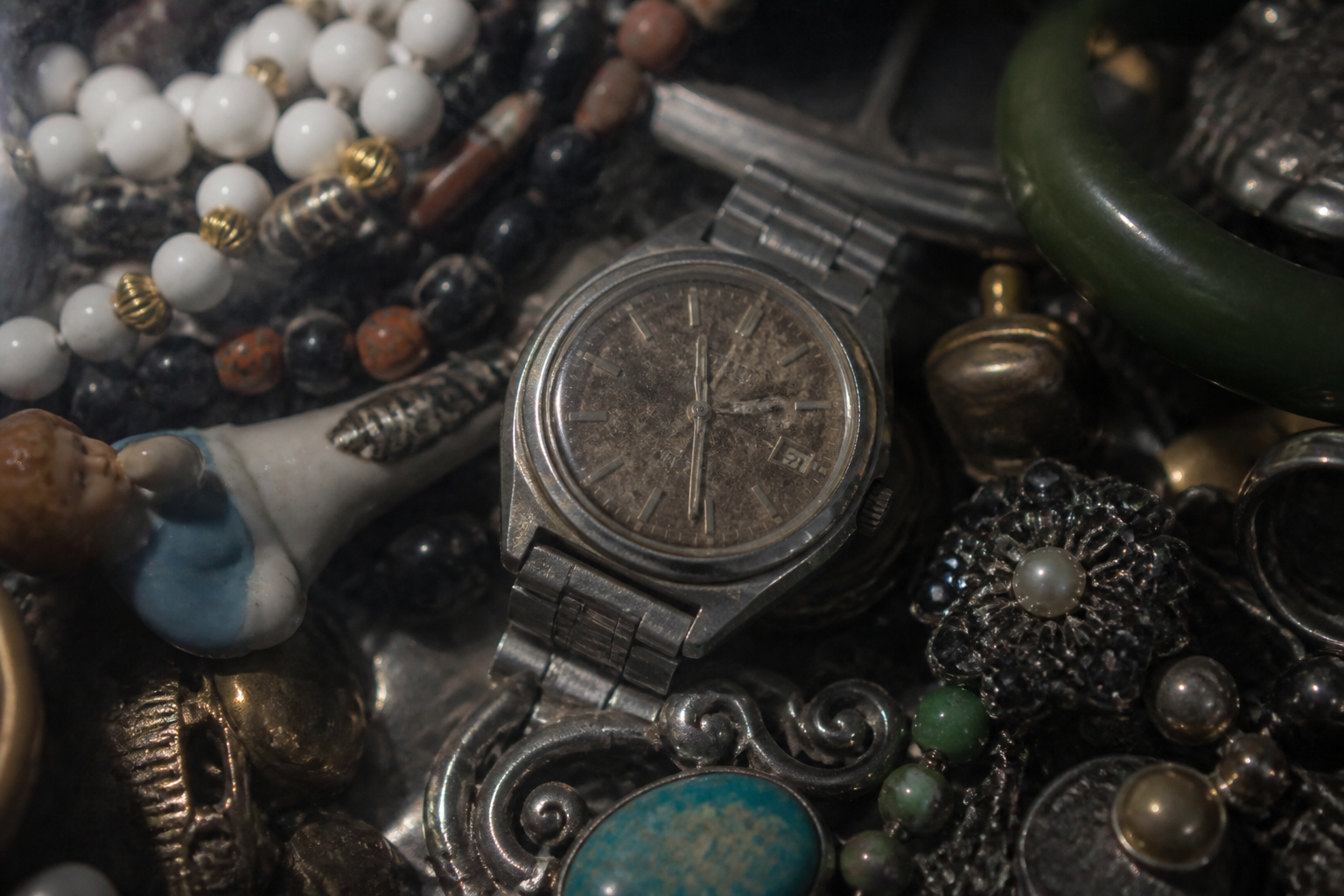
A Watch Buried Under a Tray of Rhinestone Brooches
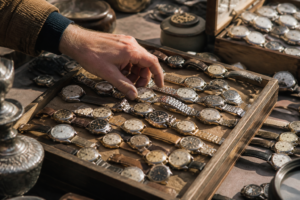
No listing, no catalog entry, no manufacturer copy will ever tell you that a decent watch sometimes surfaces face-down under a snarl of costume jewelry on a folding table with a moving blanket draped over the legs for warmth. That’s a Sunday-in-late-October detail, and it’s the kind of thing you only learn by standing in the cold long enough to notice it. The case in front of me held clip earrings, rhinestone brooches, a string of plastic pearls with a snapped clasp — the usual flea market debris. Watches worth anything tend to get their own case, arranged on velvet, priced by hand in a way that tells you the seller has already looked things up. This one hadn’t earned that treatment. It was wedged under a tangle of bead necklaces, showing me only its case back — brushed stainless, with the chamfered edge I’ve come to associate with 1970s Japanese automatics. I asked the vendor to hand it over.
He pulled it out without much fuss, said he figured it ran, and admitted he had no idea what it actually was. Fifteen dollars.
Into my palm it went, face up.
The Signs That Talked Me Into Buying It
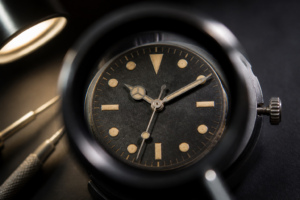
The dial wore a thin skim of grey dust, but underneath it I could make out cream lacquer, original, with applied indices that hadn’t lost their shape. No flaking anywhere. No moisture damage visible from the front, no bubbling near the printing, no mold blooming in the corners — any one of those would have sent me back to the folding table’s other trays. Instead, the grime sat on top of the dial rather than into it, which is a distinction worth training your eye to catch.
The lume gave away just as much. At each hour marker it had aged into that warm, believable amber that tritium settles into after forty-some years — not grey, not flaking off, not simply absent. Lume that’s degraded but still intact usually means the watch spent the bulk of its life shut away somewhere dry, which is generally a promising sign for whatever’s happening inside the case.
I pressed a thumbnail against the case back. Nothing gave, nothing flexed. That tightness matters — a case back that’s been popped open and reseated poorly, or one sitting on a bad gasket, tends to rock slightly under pressure. This one held firm.
Then I lifted it to my ear. The seconds hand was creeping along, slow and a little strained, and a gentle tilt got the rotor turning sluggishly. Running — just barely. I knew that sound before I’d even thought about it: the dragging, resistant tick of oil that’s polymerized somewhere between fluid and varnish inside the gear train. Annoying, sure, but standard fare after decades of neglect, and honestly one of the more forgiving problems a vintage movement can present.
The Movement That Made the Purchase a Formality
I popped the snap-back open in my parked car with a rubber ball opener — grateful it wasn’t screwed down — and there it was, matching what the proportions had already told me: a Seiko 7009 caliber, 17 jewels, beating at 21,600 bph. It came out of the early 1970s by the hundreds of thousands, and it remains one of the best-documented, most serviceable movements you’ll find anywhere in the affordable vintage tier. Parts are out there. Service notes are out there. Watchmakers who’ve had fifty of these apart are out there. That ease of servicing was doing real work in my head at fifteen dollars.
Doing the Arithmetic on a Purchase That Shouldn’t Really Work
Let’s be straight about the numbers, since collectors have a habit of squinting past them when it suits the story. A proper overhaul on something like the 7009 — ultrasonic clean, full teardown, fresh oil, mainspring check, regulation — lands somewhere between $80 and $150, depending on your zip code and your watchmaker. Mine is skilled and fairly priced. He quoted $95.
Add it up: $15 plus $95 is $110. And what does a serviced, running, mid-1970s Seiko with its original dial intact actually fetch? At the time I bought this one, realistically somewhere between $80 and $130, give or take the reference and the buyer. So this was never going to be a flip. The math never supported it, and I wasn’t kidding myself into thinking otherwise.
I still went ahead. I’ve spent years trying to explain this to people outside the hobby with limited success: certain watches justify themselves through daily use and plain enjoyment rather than resale logic. This one had a clean dial, a movement I already trusted, a 37mm case that fit my wrist well, and a total price under two weeks’ worth of coffee. I ran the cost-per-smile calculation, decided it cleared the bar, and handed it to my watchmaker the following Tuesday.
What It Actually Means When a Watch Is “Running, But Barely”
I want to linger on that phrase, since it comes up over and over with people newer to buying vintage, and their gut reaction is usually to treat it as a red flag. From where I sit, it’s frequently the opposite.
A watch that’s running, even badly, is quietly confirming a lot for you. The mainspring hasn’t snapped. The keyless works still function well enough to set the hands. No wheel has sheared off a pivot. The escapement is doing its basic job. In an automatic, “running but barely” is almost always shorthand for dried oils — which points to a movement that sat still, unworn, for a long stretch, which is generally a better history than a watch that’s been worn hard on old, deteriorating lubricant for years on end.
Dried oil is a familiar problem with a familiar fix. That’s what I remind myself whenever I pick up a slow-ticking automatic off a card table.
The Warning Signs That Send Me Walking
None of which means every fifteen-dollar table find is worth fifteen dollars. A decade of buying has left me with a short mental checklist of things I don’t negotiate on.
- Moisture damage on the dial. Rust bloom, mold spotting, or that particular grey tide-line water leaves behind. It usually means the case seal gave out at some point and the movement got wet inside. Restorable, maybe — but not for fifteen dollars.
- A case back that fits loosely or clearly isn’t original. If it doesn’t seat properly, somebody’s already been in there. On its own that’s not a dealbreaker, but stack it with anything else on this list and it becomes one.
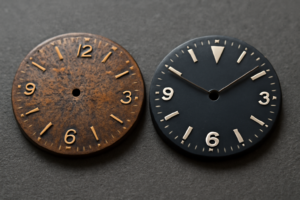
- A dial that isn’t original. Refinished dials have a suspicious, too-flat perfection. Reproduction dials frequently show misaligned printing or a font that’s wrong for the reference. In this hobby, honest and worn beats fake and flawless every single time.
- A missing crown or a damaged crown tube. Swapping a crown is nothing. A wrecked tube means case work, and case work costs more than these watches are typically worth.
- Dead stop, no reaction to winding at all. Could be a snapped mainspring, a frozen train, a sheared pivot. It might come back from the dead eventually, but I’m not paying to find out at the flea market table.
This Seiko cleared every one of those checks. Once the inspection was done, saying yes wasn’t even a hard call.
What Came Back From the Watchmaker’s Bench
My watchmaker kept it for ten days. When I went to collect it, he told me the mainspring was in good shape, the jewels were clean, and the only real culprit had been the varnished-oil situation I’d expected throughout the train. Regulation brought it in at plus-four seconds a day, which for a 7009 is genuinely impressive. He hadn’t touched the polish — I’d specifically asked him not to — and the dial had come clean into something I’d honestly call understated and lovely. That amber lume. The brushed-and-polished contrast on the case, worn gently at the lugs the way four decades of real use tends to wear things. The domed acrylic crystal, curved with that familiar slight fishbowl bulge.
I strapped it on right there in the shop before I’d even left. Wore it the rest of that day and most of the week after.
It’s still in steady rotation. It’s traveled through two winters on my wrist, one long train ride, and more ink-testing sessions at my desk than I could reasonably tally. It holds a few seconds a day and wants for nothing beyond an occasional wearing to keep the rotor turning. At $110 total, it’s arguably the best value-per-wear in a box that includes pieces I paid a lot more to own.
Why the Flea Market Table Keeps Beating the Showroom Case
There’s a specific pleasure in buying something nobody else bothered to look at twice. Not undervalued in the flip-it-for-profit sense — I have no interest in arbitrage — but genuinely, plainly unseen. That Seiko was hiding under rhinestone brooches because not one person at that particular flea market recognized it for what it was: a 7009 movement, intact dial, tight case, simply waiting on fresh oil and someone willing to look closely.
I think this is close to what analog collecting is really about, at its best. Not accumulation for its own sake, but sustained, patient attention. You start noticing what everyone else steps past. You learn what “barely running” actually signals and stop treating it as a death sentence. You learn that a fifteen-dollar watch in the right condition beats a hundred-dollar watch in the wrong condition, and eventually you can tell the difference in about ninety seconds of unhurried looking.
The watch is on my wrist as I type this sentence. Still holding plus-four seconds a day. Still glowing that same warm amber at midnight. Fifteen dollars, and a watchmaker who genuinely knew his craft. That’s really the entire story.
About This Article

Written by Ellen Ashford. Watch collector, fountain pen enthusiast, and lifelong journaler. Time & Ink is where I explore the craft of analog living — from vintage timepieces and fine stationery to the simple pleasure of putting pen to paper. More about this site.
Verify this against a primary source
Specifics change, and your situation may differ from the one described here. These are the authorities worth checking directly:
- NAWCC — horological reference, archives and research library
- Smithsonian Institution — collection records for historic timepieces and writing instruments