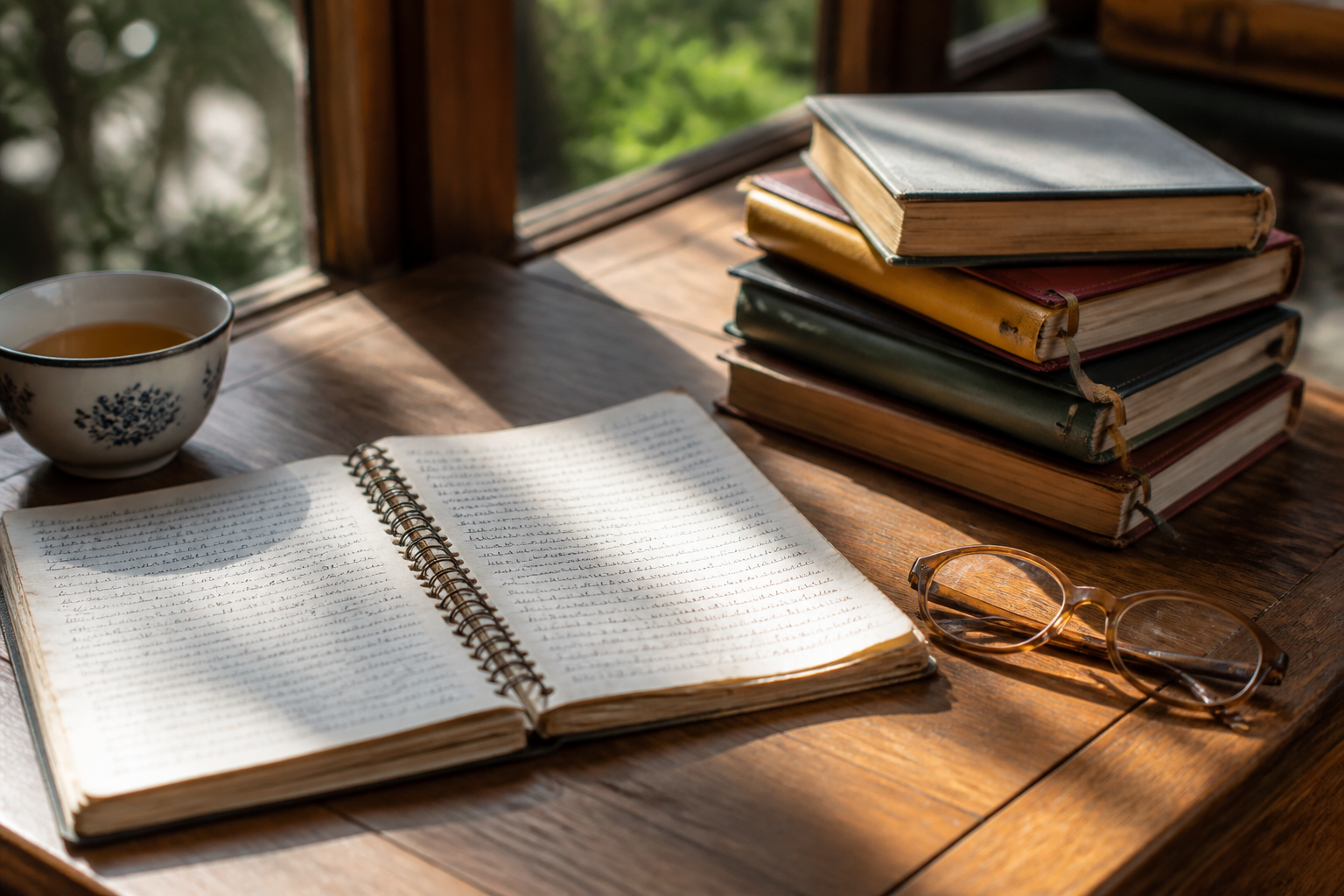
The search itself was for something else entirely — a backup bottle of Diamine Oxblood I could have sworn I’d tucked behind the row of notebooks on my top shelf. My fingers found spiral binding and softened corners instead. Going back through old entries had genuinely never been part of my routine before; I only ever wrote toward the future, never back into the past. But there it was: my very first filled notebook, a $1.89 wire-bound pad from a drugstore in 2014, yellow cover, college-ruled, the sort of nothing-special notebook you grab on autopilot. I brought it to the kitchen table, brewed a cup of tea that went untouched, and lost ninety minutes to a version of myself I’d nearly forgotten existed.
Going in, I assumed I’d find a ledger of the milestones. What I actually found was odder than that, and more worthwhile.
What Actually Turned Up Inside
The notebook opens in February 2014 — I know the exact month because that first entry is dated, one habit I evidently had down from day one, though it didn’t stick. Plenty of later entries just say “Tuesday” or “late, can’t sleep,” which tells present-day me nothing useful. The handwriting is smaller and more cramped than what I write now, as though I were rationing words. I was using a plain Bic ballpoint at the time, and the ink hasn’t dulled much at all — petroleum ballpoints are reliable that way, even if I’ve since come to find them a little lifeless to write with.
I figured the big-ticket moments would hit hardest emotionally. A move across the country in March. A relationship that fell apart badly in June. A job I was quietly counting the days to leave by August. Instead, those pages read almost like wire reports — flat, factual, drained of feeling. “Signed the lease today. Nervous.” That’s a snapshot of an event, not a felt experience.
What actually got me were the throwaway lines — sentences I clearly hadn’t written to be remembered. One about the kitchen in my first rented apartment: smells like old cooking fat and someone else’s spices, weirdly comforting. Reading it, I was back in that room within five seconds — the whole space returned to me. There was also a friend’s exact wording from a hard phone call, jotted down as casually as an item on a shopping list — “you’re not as stuck as you think you are” — and yet her actual voice came back whole.
Why the Milestones Fell Flat and the Throwaway Lines Didn’t
It took a few days of sitting with this before the pattern became clear. Anything that felt momentous at the time, I apparently reduced to a summary. I recorded verdicts instead of moments. “The move was hard but right.” There’s no information in that sentence I couldn’t reconstruct today from imagination alone. It’s a conclusion, not a memory.
The incidental details behaved completely differently. I’d written them with no weight on them, no sense that I was preserving anything worth preserving — and because of that, they were loaded with texture: temperature, smell, exact wording, the specific misery of a folding chair at a dinner party where I barely knew a soul. That chair shows up in a single sentence from September 2014. I’d lost the entire evening from memory entirely. One line brought back the hostess’s dog, the color of the tablecloth, a conversation about a movie I’ve now rewatched some forty times since.
Memory, as it turns out, works by association. It latches onto sensory detail. A smell, a texture, an exact phrase — those are threads you can still tug on. A summary, by contrast, is a door that’s already shut.
The Kind of Entry I Wish I’d Written More Often
Looking back now, the entries I prize most all share traits I had no idea were valuable at the time. They name concrete objects. They log smells and sounds. They quote actual people, even in passing. They describe weather as a physical condition rather than small talk — “cold enough that the windows in the café were fully fogged, and I kept my coat on.” I can step back into that sentence. “It was a cold day in November” offers no way in.
In practice, the entries that felt like the least worth writing at the time — the flat Wednesdays, the forgettable lunches, the walks that led nowhere in particular — are now the ones that function most like a time machine. The days I made a point of memorializing tend to be the hardest to actually get back into.
The Cringe-Worthy Bits, and Why They’re Actually Proof
I’ll admit it plainly: parts of this reread were uncomfortable. Not in some dramatic way — 2014 me wasn’t a bad person. But she was someone with a few firm opinions that haven’t held up, a couple of grudges nursed with genuine commitment, and total certainty about several things I now hold with a much lighter grip. Some entries I only skimmed. One I actually dog-eared — a note to my future self that this particular page is a bit mortifying.
I’ve come around to thinking that discomfort isn’t an argument against keeping a journal — it’s evidence the journal did its job. The person who wrote those pages was, in real and measurable ways, not the person writing this one. She clung to different things. That gap between then and now is only visible because she bothered to write it all down. Without the notebook, I’d have no way to prove the distance exists. Growth without a record is just a vague impression. With a dated notebook behind it, it’s documented fact.
The dog-eared page stays unread for now. Maybe I’ll open it in another decade.
How This Reshaped My Current Writing Habit
That 2014 notebook did more to reshape how I journal than any piece of advice I’ve come across on the subject. In practical terms, I made three changes, and all three have stuck for three years running.
- Every entry gets a full date, no exceptions. Day, month, year, written out completely — never just “Tuesday,” never a page number standing in for it. A decade from now, I’ll want to know it was a Thursday in October specifically, not just “sometime in fall.”
- The uneventful days get written down too. A brief entry about an unremarkable day — four sentences on lunch, the particular quality of the afternoon light, a passing comment from a coworker — ends up mattering more to future-me than a lengthy recap of a trip I already documented in photos anyway.
- I chase texture instead of takeaways. When something feels significant, I try to hold off on the tidy summary and instead get down the sensory stuff — what was in my hands, what the room smelled like, what crossed the other person’s face. Meaning can be figured out later. The details can’t be reconstructed later.
None of this depends on having a nice notebook — my beat-up 2014 spiral pad is proof enough of that. That said, switching to a fountain pen has slowed me down in a genuinely useful way — a Pilot Custom 74 with a medium nib introduces just enough resistance between thinking and writing that I actually finish a sentence before starting the next one. That slower pace turns out to matter a great deal for the level of detail I’m now chasing.
My Current Approach to Storing Filled Notebooks
That 2014 spiral pad is in bad shape these days — the cover’s bent, the wire binding has warped slightly, and roughly six pages are rippled from some kind of water-glass incident I no longer remember and, frustratingly, can’t even date, since the surrounding entry just reads “Thursday, good day.” That, in itself, taught me a lesson about how I store these things.
Filled notebooks now go into a dedicated archival box — acid-free, clamshell construction, about 12 by 10 inches — kept flat and away from the exterior wall of my office, where the humidity swings the most. I’m not vacuum-sealing anything or getting elaborate about it. But flat, dry, and out of the light beats spine-out on a shelf in a room that catches afternoon sun, hands down. Ink fades. Paper yellows. The real threats are UV light, moisture, and pressure on the spine.
The system I really wish I’d adopted back in 2014 is almost laughably basic: a small index card slipped inside the front cover the moment a notebook is finished. On it goes the date range, whatever city or cities I was living in at the time, and five or six index terms — names, recurring themes, specific events — each with a rough page number. Nothing fancy. Now, pulling a notebook and finding what I need takes under two minutes instead of a full reread. Because the effort is so low, I actually reach for them, which is the whole point.
Why Rereading Old Entries Deserves a Spot on the Calendar
Going back through old journal entries was never a deliberate practice for me — I fell into it while chasing a bottle of ink. Now I do it on purpose: once a year, usually in January, I grab a random notebook off the shelf and read it start to finish in one sitting. I set aside ninety minutes and typically use every one of them.
What comes out of it isn’t quite nostalgia. It’s closer to calibration — a check on what I actually cared about, what kept me up, where I was wrong, and where I turned out righter than I gave myself credit for at the time. It’s honest in a way plain memory never manages, because memory edits itself. Paper doesn’t.
That $1.89 spiral pad from 2014 has become one of the more valuable things I own, shelf included. Not because of any important events recorded in it — mostly, there aren’t any. It’s valuable because of what’s specific in it. The kitchen smell. The folding chair. A friend’s exact words on one rough afternoon. Those details are what did the actual preserving. All I had to do was show up and put them on the page.
About This Article

Written by Ellen Ashford. Watch collector, fountain pen enthusiast, and lifelong journaler. Time & Ink is where I explore the craft of analog living — from vintage timepieces and fine stationery to the simple pleasure of putting pen to paper. More about this site.
Verify this against a primary source
Specifics change, and your situation may differ from the one described here. These are the authorities worth checking directly:
- NAWCC — horological reference, archives and research library
- Smithsonian Institution — collection records for historic timepieces and writing instruments