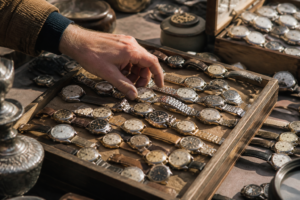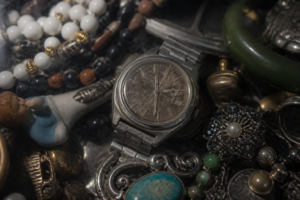

I’ve done my estate sale watch inspection routine so many times that it runs on autopilot now — five minutes, same sequence, every table, every time. It didn’t start that way. It started with a $200 mistake on a Saturday morning in a stranger’s garage, a watch that looked perfect and turned out to be neither. That story is coming. First, let me walk you through exactly what I do before a single dollar changes hands, and why each step exists.
Why I Always Start With the Crystal and Dial
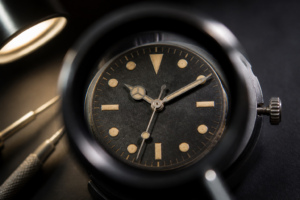
The dial is the face of a watch’s whole life story, and it will tell you the truth if you know how to read it. I pick the watch up and tilt it under the nearest natural light source — a window, an open door, whatever’s available. Artificial lighting at estate sales is almost always terrible, usually a single overhead fluorescent that flattens everything. I’m looking for three things in this first thirty seconds: redials, moisture damage, and lume inconsistency.
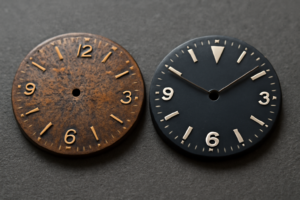
A redial is a refinished dial — someone has repainted or reprinted it to hide age. Redials kill collector value. The telltale signs are printing that sits slightly too high off the surface, text edges that look soft under magnification, and color that is just a half-shade too uniform. Original lacquer on a 1960s dial has texture. It has age. It doesn’t look like it was printed yesterday.
Moisture spots are the next concern. They appear as faint brown or gray rings, often near the edge of the dial where water first settled. Sometimes they look like a ghost of a water droplet. That means the case seal has failed at some point, and there’s a real chance the movement has corrosion I can’t see yet. Not an automatic walk-away, but a significant price-negotiation point.
Lume mismatch is something newer collectors often miss. On vintage watches with radium or tritium lume plots, the hour markers and the hands should age at roughly the same rate. If the hands are creamy ivory and the dial plots are bright white, someone has replaced the hands — possibly with wrong-era parts. I note it and move on to the crystal.
Crystals I can forgive. A scratched acrylic crystal on a vintage piece costs almost nothing to replace. A cracked crystal, however, is a walk-away for me — not because of the crystal itself, but because a cracked crystal means water and debris have had a direct path to the dial and movement. That dial you just inspected? Now you trust it less.
How I Read the Case — Lugs, Plating, and the Caseback
I flip the watch over and run my thumbnail along the lug edges. This sounds strange, but it works. Soft, rounded lugs mean someone has polished this case, probably on a buffing wheel. Sharp, defined lug edges are a sign the case has been left alone or very carefully hand-finished. On a collectible piece, polished lugs can reduce value by 30 to 50 percent. That’s not a small thing.
Worn plating is the next check. Gold-filled and gold-plated cases from the 1940s through the 1970s are common at estate sales. I look at the high-contact areas — the caseback edges, the lug undersides, and the area around the crown. Brass showing through is wear; it’s expected and honest. However, if the plating is lifting or bubbling, the case may have been exposed to moisture or chemicals, which tells me something about how it was stored and treated.
The caseback gets a close look even if I can’t open it. I’m checking for tool marks — those circular scratches around the edge that indicate someone has been in there with an improper tool. Multiple sets of marks suggest multiple amateur openings. That’s not always a disaster, but it means I need to be more cautious about what was done to the movement inside.
What the Crown Tells Me in About Thirty Seconds
The crown check is the single most important step in my inspection. A missing crown is an immediate walk-away — full stop. Replacement crowns for common calibers exist, but crowns are case-specific in diameter and thread pitch, and finding the correct signed crown for a vintage Omega or Longines can be a months-long search. I’ve learned this the hard way.
Assuming the crown is present, I wind it slowly. It should feel smooth and consistent, with a light but definite resistance that builds gradually. Gritty winding suggests debris or dried oil in the mainspring barrel. No resistance at all usually means the mainspring is broken. I wind about ten to fifteen turns — enough to feel the behavior without overwinding a potentially fragile mainspring.
Then I pull to the setting position and move both hands. Both hands, specifically — if only the minute hand moves, the cannon pinion or the setting works have a problem. I also check whether a screw-down crown actually threads properly. A crown that spins without engaging the threads is already failing at its primary job, which is protecting the movement from moisture.
My Listen, My Shake, and the Sniff Test
By minute four, I hold the watch to my ear. A healthy mechanical should produce a clean, even tick — typically somewhere between 18,000 and 28,800 beats per hour depending on the caliber, though I can’t count bph by ear. What I’m listening for is consistency. A tick that stutters, skips, or sounds irregular suggests worn escapement components or, in an automatic, a rotor that’s dragging on the movement.
Speaking of rotors: I give the watch a gentle figure-eight motion and listen for rattling. An automatic’s rotor should spin freely and quietly. A rattle — any rattle — usually means the rotor bearing has failed or a rotor screw has come loose. That’s a watchmaker visit before you wear it.
The sniff test sounds absurd, but I do it every single time. I bring the watch close and smell around the crown and caseback seam. A musty, mildewy smell means water got in at some point — possibly long ago, possibly recently. That smell is biological: it’s the result of moisture interacting with dust and organic material inside the case. In my experience, a watch that smells damp almost always shows corrosion when opened, even when the dial looks fine.
The Three Questions I Ask Every Seller
After my physical inspection, I ask three questions. The answers tell me as much as the watch itself does.
- “Do you know if it was worn regularly or stored?” A watch worn daily for thirty years has been lubricated by motion, to some extent. A watch stored in a drawer for thirty years has dried, congealed oil in every pivot hole.
- “Was it ever serviced, and do you have any paperwork?” Service records are rare, but when they exist, they’re gold. A receipt from a watchmaker dated 2019 changes my whole calculus on what I’m willing to pay.
- “Why isn’t it running?” This is where I get the most useful information. “It fell” is different from “it just stopped one day.” And my absolute favorite answer — the one that almost always signals a sleeper — is “it just needs a battery.”
That last answer is what led me to a 1968 Omega Seamaster De Ville with a caliber 565 inside. The seller genuinely believed it was a quartz watch. She priced it at $45. It needed cleaning and fresh oil, not a battery. It’s been running within four seconds a day for the past two years.
The $200 Mistake I Made Ignoring My Own Crown Rule
In 2018, I found a mid-century Swiss dress watch at an estate sale in Connecticut. The dial was gorgeous — original, unrestored, with beautiful gilt printing and a glossy black lacquer finish. The case was clean, the lume matched, and the movement was running. I was excited, and being excited made me sloppy.
The crown felt slightly loose, but I told myself it was probably just the threads on the stem. I paid $200 and drove home. When my watchmaker looked at it three days later, she told me the crown was the wrong size entirely — someone had forced a too-small crown onto the stem — and worse, the stem itself had a hairline crack from being torqued improperly. Replacing the stem and sourcing a correct signed crown took four months and cost me another $140. Total investment: $340 on a watch worth, in its condition, about $180.
I have not skipped the crown check since. Not once.
My Walk-Away Rules vs. My Green Lights
My absolute walk-aways: missing crown, cracked dial, visible rust at any opening (crown tube, pusher, caseback seam), and rotor rattle I cannot explain. These are not negotiating points. These are exits.
My green lights: scratched acrylic crystal, faded lume that matches across dial and hands, a slightly stiff crown that loosens after winding, and surface scratches on the case. These are signs of a watch that was worn and lived in, not abused. That’s honest wear, and I can work with honest wear.
That said, there are limits to what my five-minute inspection can find. I cannot assess a movement’s true condition without opening the case. I cannot detect a hairline crack in a mainspring, a worn jewel, or a magnetized balance wheel. As a result, any watch I buy with the intention of wearing regularly goes to my watchmaker before it goes on my wrist. That service visit is simply part of the purchase price, and I budget for it accordingly — usually $80 to $150 for a basic clean and oil on a simple manual-wind caliber.
What My Estate Sale Watch Inspection Routine Really Buys Me
The five-minute estate sale watch inspection doesn’t make me an expert in every caliber ever made. It makes me a careful buyer. It keeps me from paying full price for problems I should have seen. Specifically, it saved me from a $45 watch that smelled of mildew under a pristine dial — a watch I put down after the sniff test while the person next to me picked it up and paid happily. I don’t know what they found inside. I know what I avoided.
Every step in this routine came from a mistake, a conversation with my watchmaker, or a watch that taught me something uncomfortable about assuming. The routine is never really finished. Last spring, I added the lume-matching check after paying too much for a watch with replaced hands. The spring before that, I added the caseback smell test. Five minutes sounds short. It has taken me ten years to fill those five minutes with the right questions.
About This Article

Written by Ellen Ashford. Watch collector, fountain pen enthusiast, and lifelong journaler. Time & Ink is where I explore the craft of analog living — from vintage timepieces and fine stationery to the simple pleasure of putting pen to paper. More about this site.
Verify this against a primary source
Specifics change, and your situation may differ from the one described here. These are the authorities worth checking directly:
- NAWCC — horological reference, archives and research library
- Smithsonian Institution — collection records for historic timepieces and writing instruments