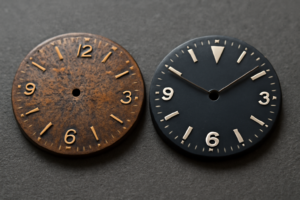
A refinished dial — a redial — is a dial that has been stripped and reprinted at some point in its life, usually during a service decades ago when it was considered a straightforward tidy-up rather than an act of vandalism. It was normal practice. It also, today, removes most of the value from a vintage watch, and it is the single thing I check hardest before buying one.
This is the companion question to deciding whether to refinish a dial yourself. Here the question is narrower and more urgent: has somebody already done it, and is the seller telling you?
The short answer
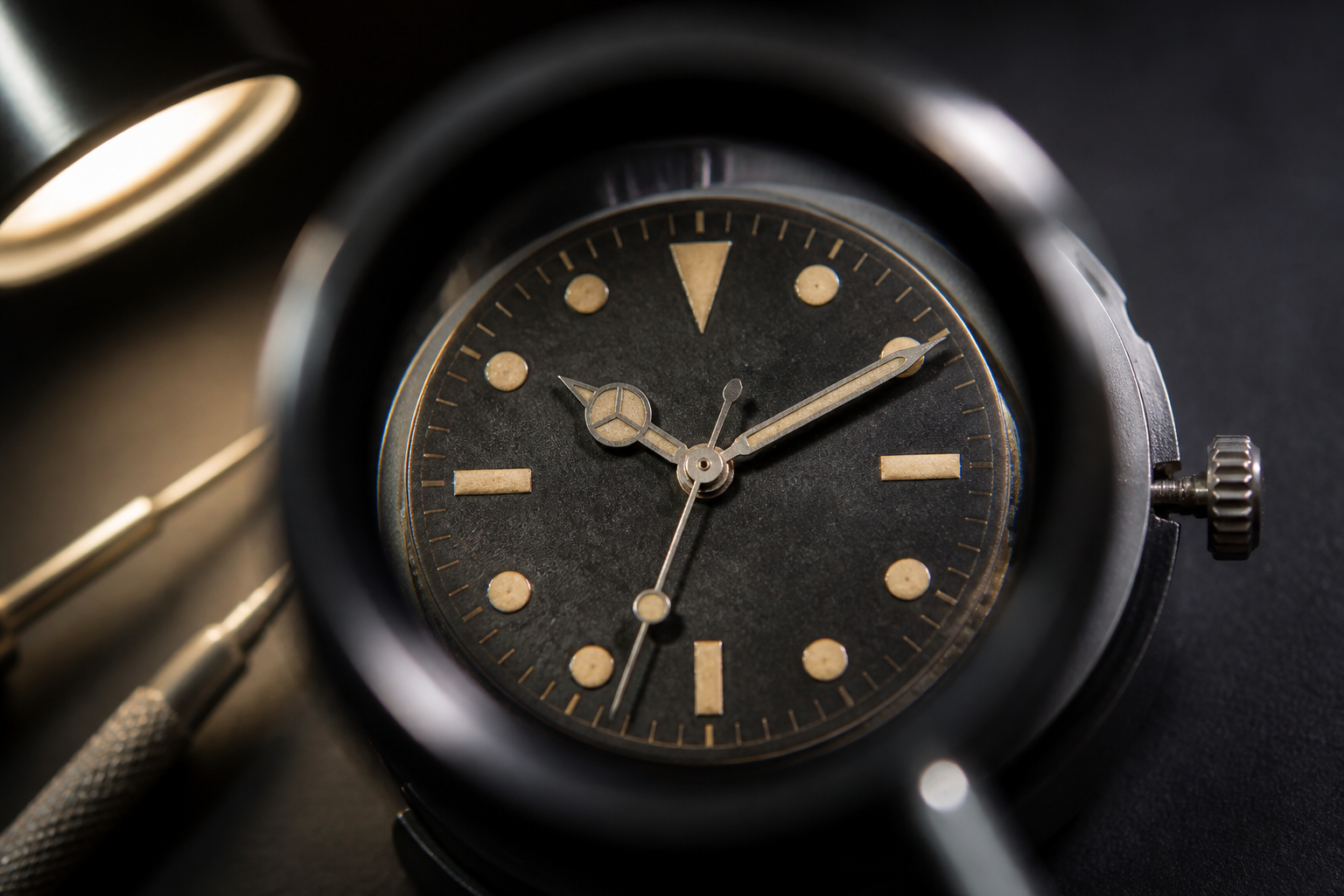
Put a 10x loupe on the dial and look at the printing first. Original dial text is crisp, slightly raised and evenly spaced. Redial printing is fuzzy at the edges, sits flat, and the spacing goes wrong in ways the factory never allowed — text crowding the minute track, a logo at the wrong size, kerning that drifts. If the printing looks soft under magnification, treat it as a redial until proven otherwise.
The Seven Checks, in the Order I Run Them
1. Printing quality under a loupe
Everything starts here, and most redials fail at this step alone. Factory dial printing is pad-printed to a standard that still looks sharp sixty years later: clean edges, consistent ink density, letters that hold their shape at 10x. Refinished text tends to look slightly out of focus, with edges that feather into the dial surface. Once you have compared an original and a redial side by side you will never mistake them again.
2. Font, kerning and spacing
Refinishers worked from what they had. Fonts get approximated, letter spacing drifts, and the overall block of text often sits at a subtly wrong size for the dial. Look particularly at the brand signature and at any line of small text near the bottom — the place where a refinisher was working smallest and had the least room to hide.
3. Where the text meets the minute track
This is my favourite tell because it is so hard to fake. On an original dial the printing and the track were laid out together, so text clears the track with even margins. Refinished dials frequently have text that crowds, touches or overlaps the minute track, or a track that has been reprinted slightly off-centre relative to the hands. Rotate the watch and look at the margins all the way round.
4. The lume plots
Luminous material is where redials give themselves away most obviously. Check that the plots are the right shape for the model, evenly sized, and properly aligned with the hour markers rather than sitting a fraction off. Check that the colour of the dial lume matches the hands — a relume usually treats the dial and forgets the hands, or vice versa, and the mismatch is visible in daylight.
Also check for lume that has been printed over. If dial text runs across a lume plot, or lume sits on top of printing, something has been redone.
5. Small text placement
The lines of small text that vintage dials carry — material declarations, provenance marks, the tritium notations that flank “SWISS MADE” on many mid-century watches — sit in conventional, model-specific places. Refinishers moved them, reproduced them at the wrong size, or left them off entirely. Missing small text on a dial that should carry it is a strong signal.
6. Surface, finish and texture
A refinished dial has been stripped, which removes the original surface treatment along with the old paint. Sunburst finishes come back flat. Matte dials come back either too smooth or too chalky. And the giveaway that costs nothing to check: a fifty-year-old watch with a perfect, uniformly bright dial and an honestly aged case and hands is telling you the dial is younger than the watch.
Patina should be consistent across the whole watch. When the hands have gone creamy and the dial is pure white, they did not age in the same room.
7. The back of the dial, if you can get to it
If a watchmaker has the movement out, the reverse of the dial settles the question. Refinishing houses routinely stamped their own marks on the back — and if the dial feet have been re-soldered, moved, or replaced with adhesive pads, the dial has been off and worked on. Not something you can do at a flea market table, but worth asking a seller who claims originality whether they will let a watchmaker look.
Quick Reference
Scroll the table sideways to see every column →
| Check | Original dial | Likely redial |
|---|---|---|
| Printing at 10x | Crisp edges, slightly raised, even density | Soft, feathered edges, flat on the surface |
| Font and spacing | Consistent, model-correct | Approximated font, drifting kerning |
| Text vs minute track | Even margins all the way round | Crowding, touching or overlapping |
| Lume plots | Even, aligned, matching the hands | Uneven, misaligned, colour mismatch with hands |
| Small text | Present and conventionally placed | Missing, moved, or wrong size |
| Surface | Original finish, patina consistent with case and hands | Flat or chalky, suspiciously fresh against an aged case |
| Dial feet | Factory-soldered, undisturbed | Re-soldered, relocated or glued |
The Check That Settles It: Brand Archives
For several manufacturers you can go past inference entirely. Longines maintains an archive and will issue an extract of the original record for a given serial number, telling you the calibre, the case and the dial configuration the watch left the factory with. Omega and a number of other houses run comparable services. It costs money and takes time, but for a watch at any real price it converts a judgement call into a document.
If you are researching a specific Longines dial, that archive extract is the answer, and any seller who objects to you obtaining one has told you something useful.
Does a Redial Always Kill the Deal?
No — and I want to be careful here, because the collector consensus can tip into snobbery. A redialled watch is worth substantially less than an original-dial example, often less than half, sometimes far less on a desirable reference. That is the market and it is not going to change.
But if a watch is being sold honestly as a redial, at a redial price, and you want to wear it rather than trade it, a clean refinished dial on a healthy movement is a perfectly good watch. The problem has never really been refinished dials. It is refinished dials sold as original.
Frequently Asked Questions
How can you tell if a watch dial has been refinished?
Use a 10x loupe and start with the printing: original dial text is crisp and slightly raised, while refinished text looks soft and feathered at the edges. Then check the font and spacing, whether text crowds the minute track, whether the lume plots are even and match the hands, whether the conventional small text is present, and whether the dial’s freshness matches the age of the case and hands.
Does a refinished dial reduce a watch’s value?
Substantially — often to half or less of an original-dial example, and more on a sought-after reference. The watch still works and can still be worn, but for collectors originality is most of the value, and a redial cannot be undone.
Can you confirm an original dial for certain?
For some brands, yes. Longines and Omega, among others, will supply an archive extract for a serial number showing the configuration the watch left the factory with, including the dial. For brands without an archive service you are relying on comparison against known-original examples and on the physical checks above.
Is a relume the same thing as a redial?
No. A relume replaces only the luminous material in the plots and hands, leaving the printing alone. A redial strips and reprints the whole dial. A relume is less damaging to value but still a modification, and a poorly done one — wrong colour, uneven plots, lume over printing — is often what first draws attention to a dial.
About This Article

Written by Ellen Ashford. Watch collector, fountain pen enthusiast, and lifelong journaler. Time & Ink is where I explore the craft of analog living — from vintage timepieces and fine stationery to the simple pleasure of putting pen to paper. More about this site.
Verify this against a primary source
Specifics change, and your situation may differ from the one described here. These are the authorities worth checking directly:
- NAWCC — horological reference, archives and research library
- Smithsonian Institution — collection records for historic timepieces and writing instruments