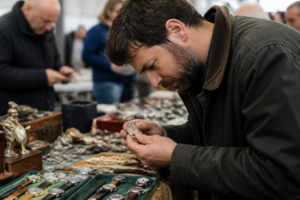
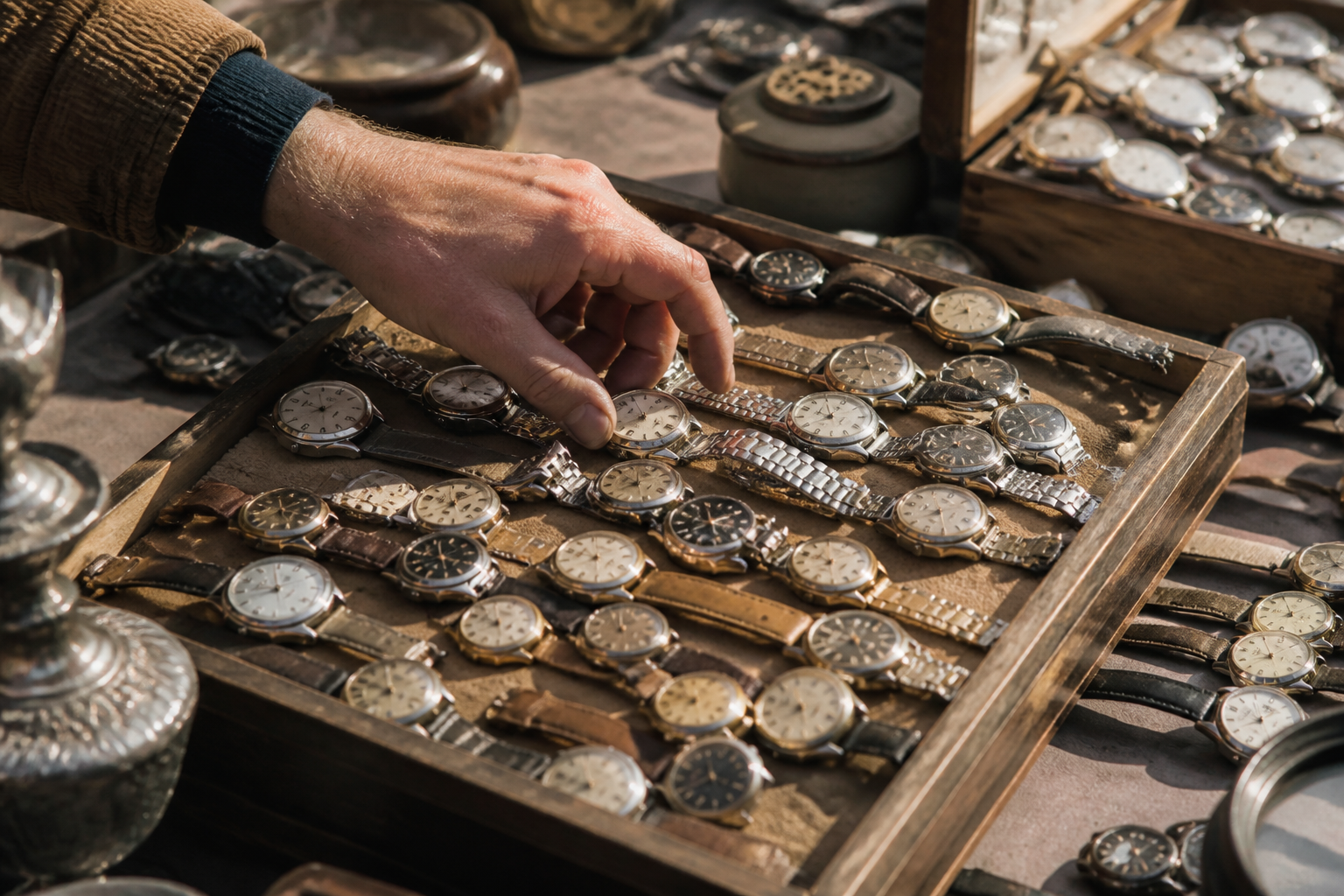
I have written before about the five-minute inspection I run at any watch table — the crystal, the crown, the shake, the sniff test. That post is about how to check a watch. This one is about what to be looking for in the first place, because a triage routine is not much use until you know which watches are worth picking up.
Everything below is a family rather than a single reference. Flea market tables do not stock to a list, and the point is to recognise a shape, a dial layout or a caseback marking fast enough to act before the person behind you does.
The short answer
Hunt 1960s–80s Japanese automatics (Seiko and Citizen above all), mid-century American-era Hamilton, Bulova and Elgin, second-tier Swiss houses like Certina, Tissot and Longines, and Soviet mechanicals. Walk past pin-lever movements, fashion-brand quartz, and anything wearing a famous name at a price that would be a miracle.
The Families Worth Stopping For
Vintage Seiko automatics
This is the one I look for first, and it is the reason I still go. Seiko built enormous numbers of genuinely good automatics from the mid-sixties onward, they turn up constantly in estate lots, and sellers rarely price them as anything special. The 6309 and 7002 divers, the 7005 and 7009 dress automatics, the 6119 and 6106 with their day-date windows, the Bell-Matic alarm — all worth picking up.
My own favourite find is still a 1974 Seiko 5 with a caliber 7009 that I bought for twenty-two dollars with a crystal frosted to opacity. The movement underneath was keeping time within fifteen seconds a day. Crystals polish out at a kitchen table; movements like that do not turn up in a shop for twenty-two dollars.
Vintage Citizen
Consistently overlooked next to Seiko, which is exactly why it is worth attention. The Bullhead chronograph, the Cosmotron electro-mechanicals, the seventies Citizen divers and the Leopard line all show up at flea market prices because the name does not trigger the same recognition. Parts are harder to source than Seiko, so buy running examples.
American-era Hamilton, Bulova and Elgin
Anything made in the United States before the industry collapsed is worth a look, and the cases are frequently far nicer than the asking price suggests — gold-filled, properly finished, with dials that were made when a dial was a serious object. Bulova Accutron tuning-fork watches deserve a special mention: they hum rather than tick, they are wonderful, and they need a specialist who knows them, so factor that in.
Second-tier Swiss
Certina, Tissot, Longines, Wittnauer, Zodiac, Enicar, Movado from the right decades. These were serious watchmakers whose names do not command Rolex money, which means a well-kept example can sit on a table for the price of a modern fashion watch. Longines in particular made superb thin movements in the fifties and sixties, and the brand keeps an archive that can confirm a watch’s original configuration — useful, given how many Longines dials have been refinished. If a Longines dial looks too fresh for the case, read how to tell if a watch dial has been refinished before you commit.
Soviet mechanicals
Vostok Amphibia and Komandirskie, Raketa, Poljot, Slava. Rough finishing by Swiss standards, genuinely robust, and priced at almost nothing. The Poljot 3133 chronograph is the standout — a column-wheel chronograph movement descended from a Valjoux design, for a fraction of what any Swiss column-wheel costs. Fakes and franken-assemblies are rampant in this corner, so buy on condition and mechanics rather than on rarity claims.
What I Walk Past
Scroll the table sideways to see every column →
| What | Why |
|---|---|
| Pin-lever movements (Roskopf-type) | Built to be disposable and never worth servicing. If the crown feels gritty and the name is unfamiliar, assume pin-lever. |
| Fashion-brand quartz | No collector value, and the movement costs less than the battery change plus your time. |
| Famous names at miracle prices | The Rolex on a flea market table for eighty dollars is not a Rolex. This is the single most reliable rule in the whole hobby. |
| Pocket watch movements in wrist cases | Marriages, sold as “vintage oversized”. Interesting objects, not the watch they are being presented as. |
| Anything rattling | A loose movement in a case means it has already been apart, badly. |
| Water damage | Staining or fogging on the dial means the movement has been wet. Whatever you save on purchase you spend on restoration, twice over. |
What to Actually Pay
Prices vary enormously by region and by how much the seller knows, so treat these as the ceilings I hold myself to at a table rather than market values. The whole economics of flea market hunting rests on buying below the cost of the service the watch will need.
- Running vintage Seiko or Citizen automatic: I am happy up to about $40–60, and delighted below $25.
- Non-running but complete, common movement: $10–20, and only if I can see the balance is intact and the case is worth the trouble.
- American-era Hamilton or Bulova, running: $50–100 depending on case material.
- Second-tier Swiss, running, honest dial: $60–150.
- Soviet mechanicals: $15–40. Above that you are paying collector prices at a flea market, which defeats the point.
The number that actually governs all of this is the service cost. A full service runs a few hundred dollars, so a $30 watch needing work is a $330 watch. That is fine for something you want. It is a bad way to accumulate a drawer of projects.
The Practical Habits That Help
- Go early and go back late. Early gets you the pick; the last hour gets you the seller who does not want to pack it all up again.
- Bring a loupe and a torch. A 10x loupe fits in a pocket and settles most questions about a dial in about four seconds.
- Ask to see the caseback. Willingness to open it tells you a great deal about the seller, and the markings tell you the rest.
- Buy the movement, not the dial. Dials can be lived with. Seized movements and hacked-up cases cannot.
- Carry small notes. Cash negotiates. A twenty in your hand is a different conversation from a card.
The last habit is the hardest: walk away from most of it. I look at perhaps forty watches for every one I buy, and the discipline is the entire skill. There is always another table.
Frequently Asked Questions
What vintage watches should I look for at flea markets or estate sales?
Vintage Seiko and Citizen automatics from the 1960s to 80s first, then American-era Hamilton, Bulova and Elgin, then second-tier Swiss names like Certina, Tissot and Longines, then Soviet mechanicals such as Vostok and Poljot. All four groups combine real mechanical quality with names that do not trigger collector pricing at a flea market table.
Is a non-running vintage watch worth buying?
Only cheaply, and only if the case and dial are worth the service. A full service costs a few hundred dollars, so a non-runner is really that price plus whatever you paid. I buy them at $10–20 when the movement is a common one with available parts, and leave them otherwise.
How can I tell a fake at a flea market table?
Price is the strongest signal there is: a famous name at an impossible number is not a bargain, it is the answer. Beyond that, look for printing quality on the dial, whether the second hand sweeps or ticks in a watch that should sweep, and the weight of the case. Ask to see the caseback, and treat refusal as a decision.
About This Article

Written by Ellen Ashford. Watch collector, fountain pen enthusiast, and lifelong journaler. Time & Ink is where I explore the craft of analog living — from vintage timepieces and fine stationery to the simple pleasure of putting pen to paper. More about this site.
Verify this against a primary source
Specifics change, and your situation may differ from the one described here. These are the authorities worth checking directly:
- NAWCC — horological reference, archives and research library
- Smithsonian Institution — collection records for historic timepieces and writing instruments