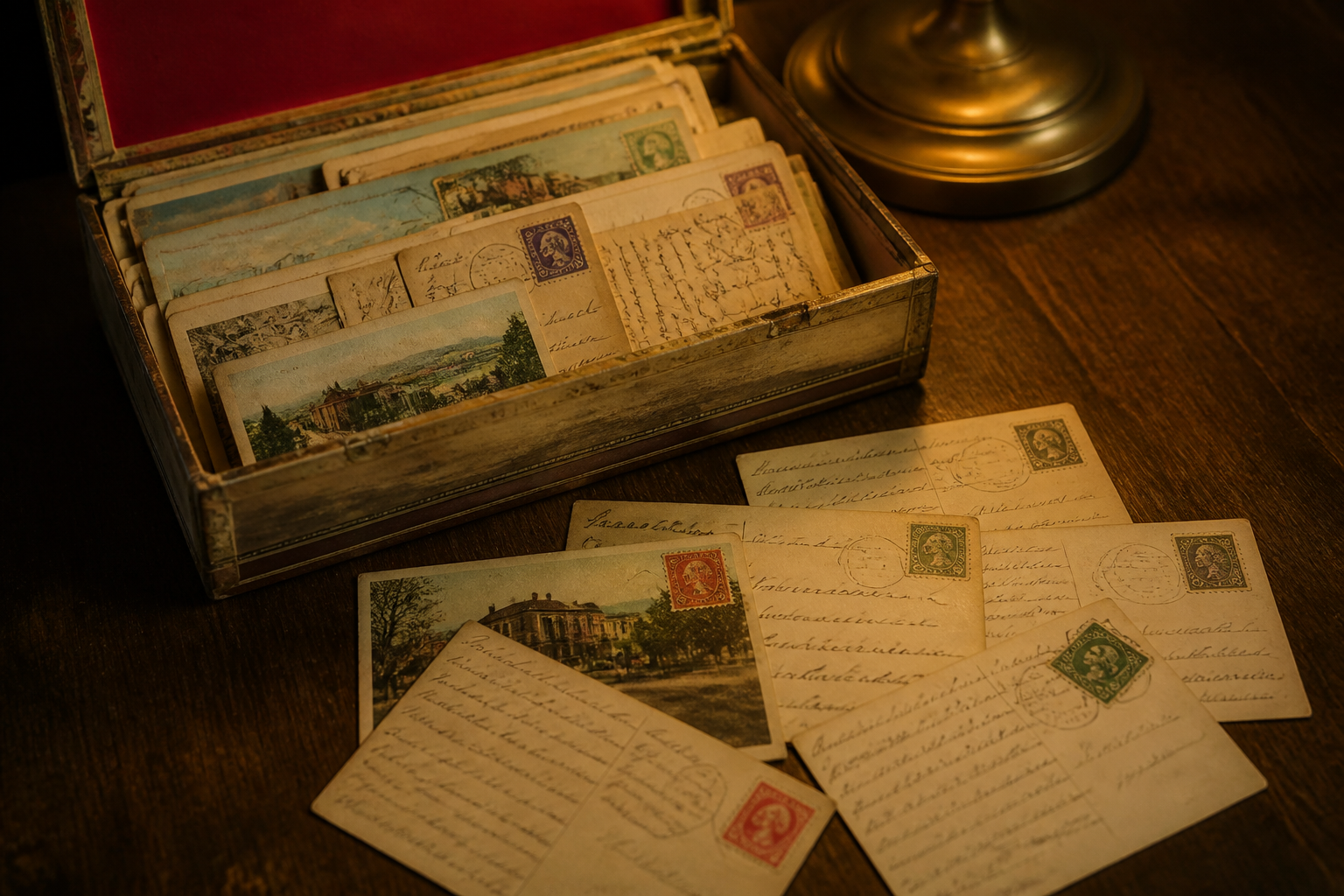
Estate sale season rolled back around last spring, and with it came a folding table crowded with somebody else’s leftover life — a busted slide projector, a ceramic owl, and, wedged at the end, a battered wooden cigar box with a painted lid. Three dollars, cash, no haggling. Inside were roughly sixty postcards from the 1950s, all belonging to a woman named Margaret whose surname I never learned but whose handwriting I could now pick out of a lineup. I hadn’t gone there for postcards — I’d driven out for a Hamilton pocket watch that turned out to be a reproduction — but I bought the box on instinct anyway, at something close to five cents a card.
Sorting Through What Was Actually in the Box
Plenty of collectors chase postcards purely for the pictures — linen stock from the 1940s, glossy chrome prints from the ’50s and ’60s, the whole topographical crowd hunting down a particular Niagara Falls angle or a vanished motel façade. I get it; the printing on those things really is something. But before I’d even gotten the lid fully open, I could see every card in this box had ink on the back. These hadn’t just been printed. They’d been sent.
I didn’t even make it out of the parking lot. Twenty minutes in the driver’s seat, just reading. The postmarks ran from 1951 to 1958, and most of the stamps were one- or two-cent issues — postcard postage sat at a penny through 1951 before jumping to two cents in 1952, so you can date these things with decent precision just from the stamp face value alone. A handful carried a one-cent Jefferson stamp with a hand-cancelled “1¢” mark, putting them right at that transition. There’s a quiet satisfaction in watching postal history show up in ink and rubber like that.
The writing itself was minuscule. Once you subtract the address block and any printed text, a standard postcard leaves you maybe six square inches to work with. These strangers hadn’t wasted a single millimeter of it.
The Lesson Hiding in Four-Sentence Notes
Nearly every message followed the same rough pattern. One line on the weather or the trip itself. One line on arrival, or plans, or both. A small joke or observation, occasionally a name that meant nothing to me. Then a sign-off — “wish you were here,” “home Thursday,” “all my love.” Four sentences was typical. Five, sometimes. Never past six. And yet none of it read as thin or clipped. If anything, these scraps felt warmer than most of the long letters sitting in my desk drawer.
I’ve written long letters for years — thick, ink-heavy pages on Tomoe River paper, usually with my Pelikan M800. I still love that format. But sitting there with those postcards, I realized how much of my own letter-writing is just padding. Hedging. Apologizing for the length before I’ve written a word, then filling the page regardless. These 1950s writers had none of that luxury. Every word on the card had to be doing actual work.
One card, postmarked Dayton, Ohio, in August of 1954, read roughly: “Heat is impossible. Arrived safely, cats survived the drive. Harold says hello though he’s still sulking. Back the 14th — save me some of whatever Agnes is making.” Thirty-eight words, by my count. I read it three separate times. In that span I learned everything worth knowing — the state of the trip, the tension with Harold, the eagerness to be home. Compression, effortlessly, because there was simply no room for anything else.
Why Limits Make Writing Warmer, Not Colder
There’s a principle buried in all this that took me embarrassingly long to notice: warmth isn’t a function of word count. If anything, in my own experience, warmth erodes the more room you give it. A long letter can slide into obligation — obligation to fill the page, to over-explain yourself, to prove you put in the effort. A postcard has no such slack. It has to land immediately, or it lands nowhere.
What these writers were doing, without ever framing it this way, was ruthless prioritizing — forced on them by the size of the card. Room for one piece of news, one emotional beat, one line about what’s coming next. Nothing else fit. No second-guessing whether the news mattered, no apologizing for the handwriting. They chose the single thing worth saying and said it plainly.
Building My Own Weekly Postcard Practice
Roughly two weeks after bringing the box home, I started keeping a small stack of blank postcards on my writing desk, pre-stamped and ready to go. I picked up a mixed pack of vintage-style reprints at an antique shop — nothing precious, sixty-five cents each — and loaded them with Forever stamps so I couldn’t invent an excuse to stall. My rule was plain: one postcard a week, to whoever, about whatever. No outlining. Just whatever was true that day, in thirty-five words or fewer.
The early attempts were clumsy. I overthought every line, crossed things out, swapped pens midway through. My Lamy 2000, fine nib, is nearly the ideal tool for postcard-scale writing — controlled enough for a tight space — but the pen was never the actual issue. My head was still stuck in letter-writing mode, still trying to cram in everything.
Somewhere around the fourth or fifth card, though, something loosened. I quit treating the postcard as a squeezed-down letter and started treating it as its own separate thing entirely — a signal. A small flag reading “you crossed my mind today, specifically, and I wanted you to know it.” Once that clicked, everything got easier.
Early Mistakes I Had to Unlearn
My first misstep was trying to make each card a complete report. I’d try cramming three weeks of life into forty words and watch it collapse under its own reach. The 1950s cards never attempted that. They didn’t try to cover everything since the last letter. They caught one single moment — the heat in Dayton, a sulking Harold — and let that one moment stand in for the whole trip. The instant I stopped summarizing and started just noticing, the writing loosened up on its own.
Practically speaking, I also learned that ballpoint holds up on glossy postcard stock far better than fountain pen ink does. That coated paper resists water-based ink and can smear even minutes after it’s supposedly dry. My drier-inked, fine-nibbed pens survive better than the wet, broad writers do, but if I don’t know the stock, a decent gel pen is the safer bet. That said, I still reach for a fountain pen on cards I trust — the line’s worth the gamble to me.
Hunting Down Used Postcards Cheaply and Responsibly
If you’re after 1950s postcards from estate sales or similar sources, a few things help. Cards that have already gone through the mail — collectors call them “postally used” — usually rank lower in value to image-focused collectors than unused ones, which is good news for anyone like me who’s after the messages rather than the pictures. Expect prices anywhere from five cents to a dollar per card, depending on where you’re buying. Estate sales, flea markets, and the junk bins at antique malls tend to be your best hunting grounds. Postcard-show dealer lots, by contrast, are usually curated and priced accordingly higher.
Dating a card off its postmark is easier than you’d think. Start with the stamp denomination — as I mentioned, domestic postcard postage was one cent through 1951, two cents from 1952 through 1958, three cents from 1959 through 1963. From there, check the postmark date itself, which usually stays legible even on cards that got stamped heavily. The postmark’s city matters too — it tells you where the card was mailed from, not where it was headed, meaning it marks the writer’s location, not the recipient’s.
Go easy on used cards physically. Inks common to the 1950s — iron gall, or the earliest ballpoints — can be delicate on paper this old. Mine live in acid-free sleeves, kept face-away from one another. Cotton gloves aren’t strictly necessary, but they’re worth using on anything you plan to handle often.
What Three Dollars of Old Mail Actually Taught Me
That box of 1950s postcards now sits on the bookshelf in my writing room, next to a 1967 Omega Seamaster and a small glass inkwell I’ve had for six years now. I wouldn’t call myself a postcard collector in any real sense. I keep them the way I keep my best reference books — something to go back to whenever my own writing starts sprawling and self-indulgent.
Margaret and whoever she was writing to understood something without ever needing to theorize it: attention is the actual gift. Not length. Not polish. Not proof of effort. The gift is simply that someone thought of you specifically and told you the truest thing they could fit into the space allowed. That turns out to be plenty. Possibly more than plenty.
My own weekly postcards have been running about eight months now. A handful of people have written back. One friend mentioned she’d pinned three of mine to her refrigerator door. None of them were particularly remarkable, as far as I can tell. But they got sent, they were honest, and they took up far less space than I once assumed I needed. That’s the whole lesson from a cigar box of sixty-year-old mail: warmth doesn’t need room to stretch out. Sometimes all it needs is thirty-five words and a two-cent stamp.
About This Article

Written by Ellen Ashford. Watch collector, fountain pen enthusiast, and lifelong journaler. Time & Ink is where I explore the craft of analog living — from vintage timepieces and fine stationery to the simple pleasure of putting pen to paper. More about this site.
Verify this against a primary source
Specifics change, and your situation may differ from the one described here. These are the authorities worth checking directly:
- NAWCC — horological reference, archives and research library
- Smithsonian Institution — collection records for historic timepieces and writing instruments