Here’s the myth I want to dismantle straight away: pen pal culture is not some relic kept alive by retirees and typewriter enthusiasts trying on a personality. I bought into that assumption too, once. Then six years back, I mailed a handwritten letter to a woman in Kyoto after she’d left a comment on one of my early fountain pen posts. There’s something exposed about writing to a stranger whose only tie to you is a few sentences typed under a blog entry — it felt unearned, almost presumptuous. She answered on washi paper so lovely I still remember it, using a shade of Pilot Iroshizuku amber I hadn’t encountered before. That single letter grew into a correspondence spanning years now, one that’s taught me more about pen culture in Japan than any forum thread ever managed. Pen pal culture hasn’t withered in the internet age. It’s expanding quietly, and arguably it’s stronger than ever — because the internet is precisely the mechanism that connects you to the right people before a single stamp gets licked.
Ten-plus years spent collecting everything from a $15 Seiko SNK809 to vintage Omega Constellation movements, plus testing fountain pens ranging from a $12 Platinum Preppy up to a Pelikan M800 with a broad italic ground by a nibmeister, have taught me something specific: analog objects carry more weight when a real relationship runs through them. A watch means something. A pen means something. But a handwritten letter operates on a different register of intimacy entirely — no DM or email touches it. What follows is my working blueprint for actually building a pen pal practice: where correspondents come from, how to write letters worth receiving, and which materials actually earn their keep from the start.
Why Pen Pal Culture Is Genuinely Resurging Right Now
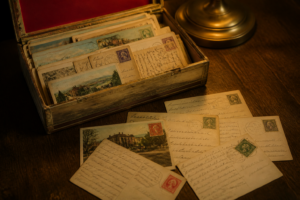
I’ve tracked this community expanding steadily since roughly 2018. r/penpals alone has climbed past 200,000 subscribers. Instagram tags like #snailmail and #happymail together represent tens of millions of posts. Slowly, an app built specifically to pair pen pals across distances, has logged more than 20 million users globally. None of that is vanity metrics — it points to a real, growing appetite for correspondence that moves at a slower, more deliberate pace.
What’s ironic is that social media itself is the thing pushing people toward paper. Years of instant replies, algorithm-fed timelines, and curated online personas have left a lot of people worn thin. A letter carries no notification badge. No read receipt. It shows up whenever it shows up, and you reply when you’re actually ready to. That gap in time is the entire appeal. From what I’ve seen, the people most enthusiastic about reviving this habit tend to be the ones most saturated in digital life — designers, developers, writers, and plenty of us in watch and pen collecting who already understand what analog craftsmanship offers.
Finding a Real Pen Pal Without the Guesswork
The question I get more than any other: “Where do I actually find someone to write to?” It’s a legitimate concern — sending a letter out to a stranger feels like shouting into an empty room. But the truth is, the right communities take most of the guesswork out of matching.
Below are the platforms I’ve either used myself or watched work consistently for other collectors I know:
- r/penpals (Reddit): No cost, plenty of activity, and filterable by age, country, and interest. Write a brief intro mentioning your hobbies — mine always name-check analog tools and watches — and responses from like-minded writers come quickly.
- Slowly (App): Free with optional paid tiers. It mimics actual mail delivery time based on how far apart you and your pen pal are, which builds in a genuinely satisfying sense of anticipation.
- Fountain Pen Network (FPN): For those already deep in pen culture, the pen pal subforum here is a real find. You’ll be matched with people who care about paper weight and ink behavior, which makes the letters themselves better.
- Instagram: Look up #snailmail or #fountainpenpal and actually engage with people. Several of my longest-running correspondents started out as nothing more than mutual follows.
- International Pen Friends (IPF): One of the longest-running organized services, dating back to 1967. There’s a modest yearly fee — somewhere around $15 to $20 — but the matching process is careful and genuinely international.
My real recommendation: begin with one or two people, not ten. I made this mistake myself early on, matching with six correspondents at once. Inside three months, four of those exchanges had quietly died because I simply couldn’t keep pace. Volume isn’t the goal here — depth is. Two correspondences that actually run deep will teach you more than a stack of half-answered letters ever will.
Figuring Out What to Actually Say (Where Most People Stall Out)
I learned this one the hard way. Your opening letter shouldn’t read like a biography. My very first pen pal letter, written in my mid-twenties, ran two full pages covering my entire life story — career, hobbies, family, the works. Reading it back now, it’s exhausting. My correspondent replied kindly enough, but her letter was half the length of mine and clearly unsure where to even begin responding to all of it.
A strong first letter functions more like the opening line of a good conversation than an encyclopedia entry. Pick one or two concrete details about your life — a recent watch you tracked down, a new ink you’re trying out, a walk from earlier that week — and follow them with real, open-ended questions. Specificity does all the work here. Saying “I just found a vintage Seiko 5 ref. 7009 in unusually clean condition for $38” gives someone far more to respond to than a flat “I like watches” ever could. It gives your pen pal a foothold — something to react to, build on, or disagree with.
Still, don’t overthink the content too much. The format itself does half the work. A handwritten letter delights someone before they’ve read a single line. That said, keeping a correspondence alive over years requires actual curiosity about the other person — their daily routines, the place they live, the specific things they care about. Circle back to what they mentioned last time. Ask follow-ups. That habit is exactly what separates a correspondence that fizzles after six months from one that’s still going six years later.
Why Your Tools Determine Whether the Habit Survives
I’ll say this plainly, having cycled through what’s frankly an embarrassing number of paper-and-pen pairings over the years: your tools matter more than most people want to admit, because friction is what kills habits before they take hold. If sitting down to write means hunting for decent paper, scrounging for an envelope that actually fits, and unearthing a pen that’s dried out from neglect — you simply won’t keep it up. Eliminating that friction is itself an investment in the practice.
Picking a Pen Built for Letter Writing
For correspondence specifically, I reach for a medium or broad nib far more often than a fine one. Fine nibs — a Lamy Safari EF, say, or a Japanese fine, which runs closer to a Western extra-fine — can lay down gorgeous, precise lines. But they’re demanding on paper. Anything under roughly 90 gsm, or with weak sizing, will start feathering fast. Broader nibs forgive more, put down ink with more character, and honestly suit a personal letter better, where the handwriting itself carries part of the message.
My current pick for letters is a Pilot Custom 74 with a medium nib, loaded with Diamine Chocolate Brown — a warm tone that photographs well, useful if your pen pal ever shares your letters online. For something easier on the wallet, the Pilot Metropolitan in medium runs about $15 to $20 and holds up admirably on decent paper. I’ve pointed at least a dozen new pen pal writers toward it, and it hasn’t disappointed one of them yet.
The Paper That Made My First Letter Feel Like It Mattered
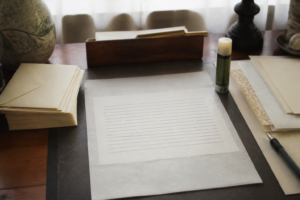
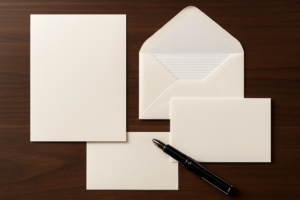
When a correspondence with a stranger is just getting off the ground, that opening letter carries more weight than you’d expect. Flimsy paper stuffed into a generic envelope can undercut the vulnerability of reaching out in the first place — but the right stationery does the opposite, signaling that you’re taking the exchange seriously.
What works
- The ecru tone comes across as deliberate and warm without overreaching — it says “I picked something nice” rather than “look how precious I’m being.”
- Gold-edged borders frame the handwriting itself, giving your fountain pen ink some visual room to breathe on the page.
- Envelopes pre-sized to match remove that small moment of paralysis over which envelope goes with which paper — one fewer decision when you’re already nervous about how you’ll come across.
What doesn’t
- The formality of bordered paper can feel like overkill for a rambling, casual letter — you’ll find yourself second-guessing lighter, looser correspondence.
- A pack of 50 sheets is a real commitment — if your pen pal goes quiet, you’re stuck with a stack of unused paper that just sits there as a reminder of the exchange that didn’t happen.
I almost sent my first letter to Kyoto on plain printer paper because I was afraid the fancy stationery would presume too much — that it would come across as expecting a response. But the moment I wrote on this paper, something shifted. The letter felt like an offering rather than a request. XXINMOH 90 Piece Stationery Set – 60 Vintage-Style Paper
About This Article

Written by Ellen Ashford. Watch collector, fountain pen enthusiast, and lifelong journaler. Time & Ink is where I explore the craft of analog living — from vintage timepieces and fine stationery to the simple pleasure of putting pen to paper. More about this site.
Verify this against a primary source
Specifics change, and your situation may differ from the one described here. These are the authorities worth checking directly:
- NAWCC — horological reference, archives and research library
- Smithsonian Institution — collection records for historic timepieces and writing instruments