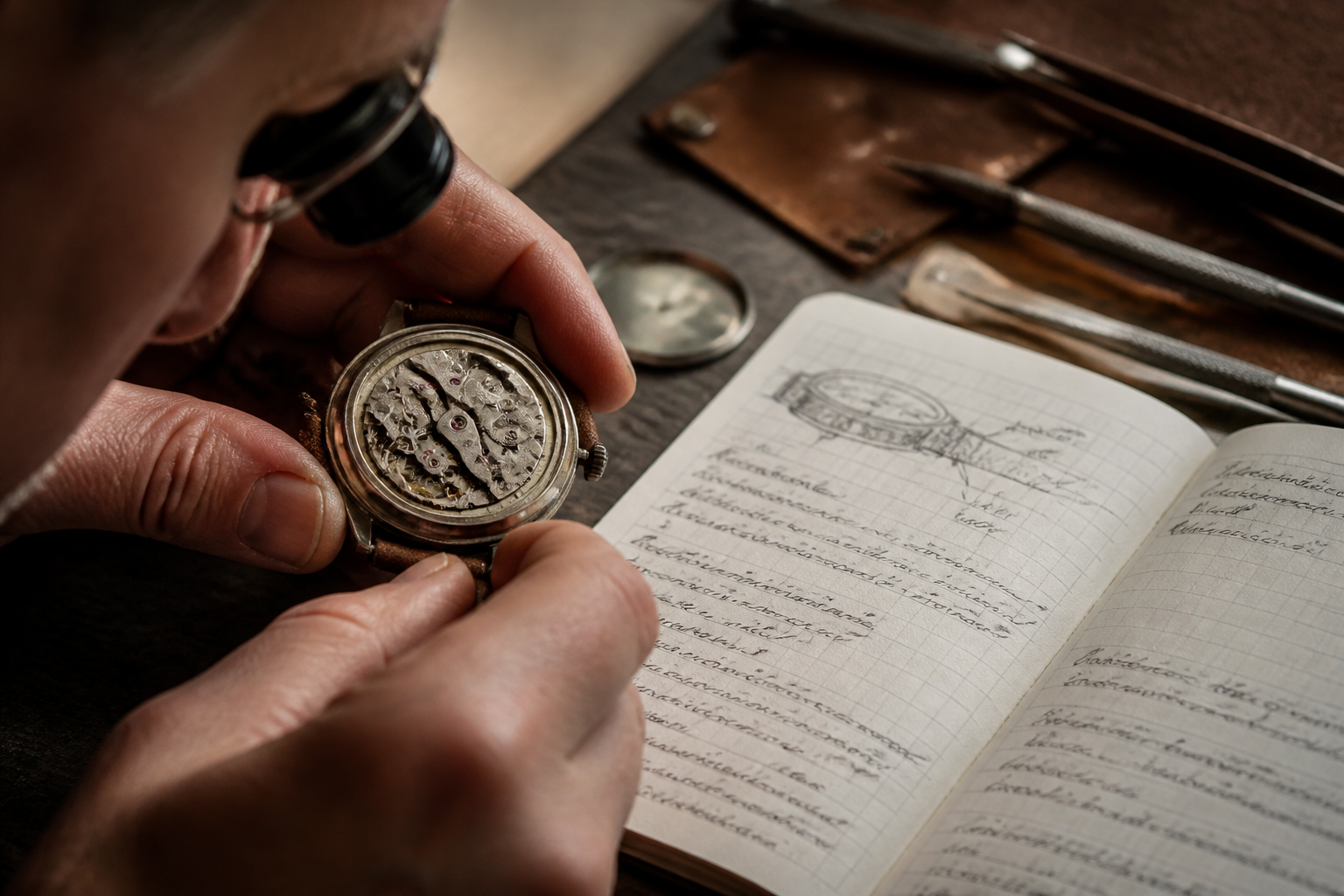
Somewhere in my second year of collecting, I told a stranger at an estate sale that her watch was “definitely a Longines” based on nothing but a dial font I half-recognized from memory. I was wrong. It took me an embarrassing amount of backpedaling and a proper look at the caseback to admit it. That single wrong guess is the reason I built an actual sequence for this now, rather than trusting my gut: dial first, then caseback, then movement, working from the outside of the watch toward its guts. It doesn’t crack every case. But it solves far more than a confident guess ever did.
Where I Begin: What the Dial Tells Me (and What It Doesn’t)
The dial is the part you see first, so naturally it’s where I look first — though I’ve learned not to take its word at face value. That sounds backward, I know. But dial text simplifies things, sometimes to the point of misleading you. A name printed across the chapter ring often tells you who sold the watch, not who built it. Throughout the twentieth century, department stores, jewelry chains, and mail-order catalogs bought watches wholesale and stamped their own names on the dial. “Bulova” on a dial means Bulova made it. “Gimbels,” “Sears,” or “Mappin & Webb” usually means somebody else built the movement and a retailer slapped its name on top.
What actually holds my attention first is the shape and placement of the printed text itself. Swiss houses working through the 1950s and 60s followed fairly consistent typographic habits — particular serif letterforms, particular conventions for where “Swiss Made” or “17 Jewels” sits near six o’clock. Whether that text falls above or below dial-center, whether it’s stacked in one line or split into two — these small placement choices start narrowing down the field before I’ve laid a finger on the case.
From there I check whether the hour markers are applied or simply printed, what color the lume has aged to (radium from before the 1960s tends toward a warm, custardy cream; tritium ages into more of a grey-green), and whether the maker’s logo was stamped directly, printed flat, or added as its own applied metal piece. These are the kinds of physical tells that a faked or reprinted dial rarely replicates convincingly.
Next Step: What the Caseback Reveals
Once the dial has told me everything it’s going to, I turn the watch face-down. A caseback, read properly, holds a surprising amount of data. I keep a plain 10x jeweler’s loupe on hand specifically for this step. Some stamps have worn shallow with decades of handling, so I’ll tilt the case under a lamp until raking light picks out the lettering.
Four categories of markings matter most to me here. First, reference numbers, which pin down the specific model in a maker’s catalog. Second, serial numbers, which for certain brands can be matched to a production year within roughly twelve months either way. Third, metal marks — things like “20 Microns,” “GF” for gold-filled, “14K,” “Stainless Steel,” or “Chrome Plated Base Metal” — which point to the case material and often hint at what price tier the watch was built for. And fourth, import hallmarks: British-market watches carry an assay office mark and a date letter that, in my experience, reliably nail down the decade of import and sometimes the exact year.
Longines, as one example, publishes serial tables that get you within a year or two of accuracy. Omega’s documentation is similarly solid. Smaller Swiss ébauche houses — Felsa, AS, FHF, the companies that predated ETA — have gappier serial records, though collector forums have usually filled in most of the missing ranges over the years.
The Forty-Dollar Lesson I Learned the Hard Way
For a while I assumed any reference number on a caseback had to be the movement’s caliber number. It isn’t, not reliably. I bought a Swiss dress watch from the 1960s purely because its caseback number appeared to partially match a caliber I was researching, and when I pried it open — clumsily, since I hadn’t yet picked up a real case knife — the movement inside was something else entirely. The number I’d been chasing was a case reference, unrelated to the movement. The watch itself came through fine, but my improvised opening tool left a scratch on the bezel, and I ended up reselling it for forty dollars under what I’d paid. That scratch is why, ever since, I keep those two steps mentally separate: reading a caseback and identifying a movement are not the same task, and treating them as one cost me real money.
Getting to the Movement Itself
If the dial and caseback still haven’t settled the question, I’ll open the case — assuming it’s mine. If it belongs to someone else, I send them to a watchmaker who can photograph the movement properly. I don’t open watches I don’t own, and even on my own pieces I’m cautious: a snap-back case pried at the wrong point with the wrong tool leaves marks in the metal that never fully buff out.
Inside, what I’m hunting for is the caliber stamp. Swiss movements typically have it engraved into the main plate, usually near the balance wheel or, on an automatic, tucked underneath the rotor. It might read “AS 1686,” or “FHF 96,” or “ETA 2370.” That’s the ébauche caliber — the base movement everything was built around — and it’s the single most trustworthy identifier anywhere on the watch.
I’ve found that even a watch rebranded beyond recognition tends to give itself up at this point. Building a movement from scratch was expensive; almost nobody bothered when a Swiss ébauche could be bought and finished instead. So once you find a documented caliber sitting inside an otherwise unlabeled watch, a lot of other answers tend to follow along with it: rough production era, original spec, and often which finishing houses typically worked with that particular base movement.
The Reference Tools I Actually Reach For
I lean on a short, unglamorous list of sources over and over. The Ranfft movement database catalogs a huge swath of Swiss and German calibers with clear photos — I’ve confirmed identifications against it more times than I could count. Cousin’s UK and similar parts-supply databases list caliber references that let you double-check what you’re looking at against known part numbers. For dating by serial number, tables kept current by collector communities usually beat anything you’ll find in a printed reference book.
Old forum threads don’t get enough credit. The vintage subforum on Watchuseek, the Omega Museum Community boards, and assorted national collector forums have identification threads stretching back fifteen years or more. There’s a decent chance someone has already photographed the exact movement, in the exact case, under the exact dial you’re puzzling over. Reading carefully through those archives — rather than firing off a fresh question — is usually the faster route to an answer.
That said, I do post when I’ve genuinely hit a wall. The vintage watch community, in my experience, tends to be generous with what it knows and light on the ego about sharing it.
Walking Through One: A Reader’s Photos, Step by Step
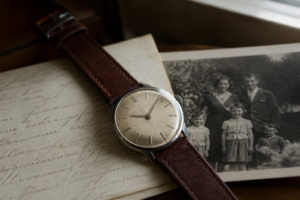
Not long ago a reader sent me four photographs of a small dress watch, around 30mm, plain white dial, no brand name in sight, applied gold-toned indices, a lume pip at 12 gone yellow with age, and what looked like a snap-back case. The caseback carried no brand name either — just a partial reference number ending in something that read as “6,” a “20 Microns” gold-plate stamp, and a small import hallmark she’d photographed at an angle that made it nearly impossible to make out.
I asked for a second photo of the hallmark taken in raking light. That new image showed an anchor mark — the Birmingham assay office — paired with a date letter pointing to 1964 or 1965. That alone pinned down the import window.
On the dial, “17 Jewels” and “Swiss Made” sat in the standard two-line arrangement below center, exactly the layout common to mid-range Swiss production of that period. No retailer name anywhere, which pointed either to a stripped dial or a stock dial bought by a small importer who skipped paying for personalization. The lume had faded to full cream-yellow, consistent with radium — either pre-1963 manufacture, or dial stock that had simply sat in storage before the watch was cased up.
She had a watchmaker crack it open. The stamp inside read “AS 1686” — an A. Schild caliber produced from the late 1950s into the mid-1960s, beating at 18,000 bph, a 17-jewel manual-wind movement. Hundreds of Swiss brands and British import houses used that exact caliber. Between the Birmingham hallmark and the unbranded dial, my best read was a mid-tier Swiss movement, cased and imported by some small British retailer who bought generic dials and cases off the shelf. Nothing famous. Perfectly honest work, though. Probably sold new for somewhere around four or five pounds back in 1965.
We never did pin down which retailer. Still, she walked away knowing exactly what she had — a real Swiss movement, correct for its era, well-built for its price point, and worth holding onto. For her, that was plenty.
Knowing When to Let a Mystery Stay a Mystery
Every so often, the whole process just runs out of road. The caseback is bare. The dial’s been refinished and won’t tell you anything true. The caliber stamp has worn away past legibility. Or the caliber, once you do identify it, turns out to have been used by two hundred different companies over fifteen years. When I hit that wall, I stop pushing.
There’s a certain collector’s itch that wants every object fully labeled and its provenance nailed down to the day. I get it — I’ve felt it. But a watch that runs true, holds reasonable time, and carries an honest mechanical history is still worth wearing, whether or not I can ever name the importer behind it. The unanswered part is just part of the object at this point — it’s been that way since whoever bought it new in 1965 lost track of where it came from.
Here’s the one thing I’ll say without hedging: if a watch looks like it might genuinely be valuable — a precious-metal case stamped on the back, a movement that reads like a high-grade in-house caliber rather than a generic ébauche, a dial with hints of real rarity — stop doing amateur detective work and get it in front of a professional watchmaker or a specialist auction house instead. A proper opinion costs far less than a confident mistake.
Dial. Caseback. Movement. Outside in, one detail at a time. That’s the entire method, and most of the time, it’s all you need.
About This Article

Written by Ellen Ashford. Watch collector, fountain pen enthusiast, and lifelong journaler. Time & Ink is where I explore the craft of analog living — from vintage timepieces and fine stationery to the simple pleasure of putting pen to paper. More about this site.
Verify this against a primary source
Specifics change, and your situation may differ from the one described here. These are the authorities worth checking directly:
- NAWCC — horological reference, archives and research library
- Smithsonian Institution — collection records for historic timepieces and writing instruments