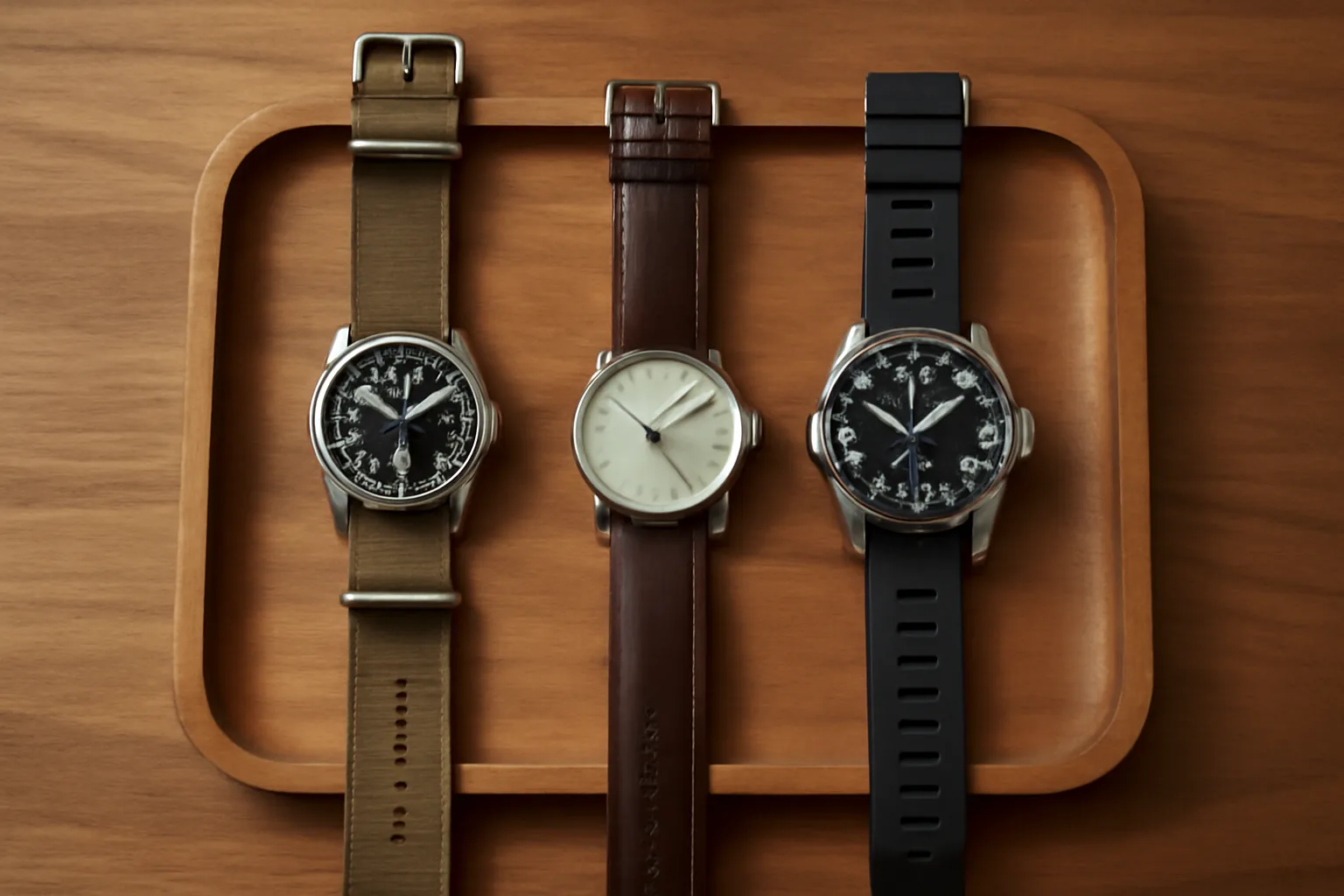
Don’t get leather wet. That’s the blunt version of a lesson that cost me an entire strap and a fair amount of pride. I had a gorgeous cognac leather band strapped to a dive watch, wore it kayaking on the Chesapeake, and by the time I dragged the boat back onto the sand the leather had swollen into something resembling damp cardboard. The buckle had already stamped a rust-colored shadow into the hide. One paddle, and the strap was finished for good. That single ruined afternoon is why, whenever someone asks me to settle the NATO-versus-leather-versus-rubber debate, my answer is always the same: there’s no universal “best.” There’s only the strap that fits what you’re doing with your day.
Roughly ten years into this habit of mine, I’ve cycled a lot of strap material through a lot of real situations — saltwater, boardroom tables, muddy trails, dim jazz clubs, red-eye flights across the Atlantic. Cheap gas-station nylon, precious hand-cut cordovan from a London bench maker, all of it. Some of it I destroyed within a season. Some of it has quietly outlasted watches. What I’m laying out below is the accumulated result, arranged so that the next time you’re rifling through a drawer full of straps, you’ll actually know which one belongs on your wrist.
The Three Strap Materials, and What Each One Is Actually For
Matching a strap to an occasion only works once you understand what each material physically does, not just how it photographs. Most of the strap industry sells you on looks first. I’d argue that’s backwards — function should decide the shortlist, and style only gets a vote after that.
NATO Nylon: Built to Get Wrecked and Keep Going
The NATO strap was formalized by the British Ministry of Defence back in 1973, cataloged under NATO Stock Number 6645-99-130-9087. That bureaucratic detail actually matters — it tells you the strap was never meant to be pretty, it was meant to survive combat conditions. The original design ran a single woven nylon strip underneath the case itself, so if a spring bar snapped, the watch stayed lashed to your wrist instead of vanishing. That one feature alone has spared more than a few watches from a hard landing on concrete.
Nylon shrugs off moisture, dries fast, and can go straight into a washing machine. A decent NATO runs somewhere between $8 and $50, and most 20mm versions weigh in under 20 grams — practically nothing on the wrist. For active use, the cost-to-usefulness math isn’t close. The tradeoff is that nylon telegraphs “casual” loudly; it leans sporty rather than refined. That’s not a defect, exactly — it’s just a boundary. It tells you where you can’t wear it without looking a bit mismatched.
Leather: Genuinely Elegant, Genuinely Fragile Around Water
Leather is still the traditional answer for a dress watch, and there’s a reason for that. Full-grain, vegetable-tanned leather from someone like Hirsch or Jean Rousseau ages into a patina you can’t fake, and that gradual character is a large part of why people love it. For anything formal ��� weddings, presentations, dinners where the linens cost more than the entrée — leather is simply the correct visual choice.
Now for the part nobody wants printed on the box: leather and water do not get along. Sweat quietly eats away at the interior stitching over months. Full submersion can undo it almost instantly. I had a Horween Chromexcel strap on a Seiko SKX007 that looked fantastic for about eight months — until one summer hike through Virginia, after which the stitching near the buckle simply let go. I had a replacement ordered within the week. Leather in the $30–$150 range asks for real upkeep in return: conditioning roughly every four to six weeks, storage out of direct sun, and staying away from water whenever you can manage it.
Rubber: The One-Job Specialist
Rubber — usually vulcanized rubber or FKM fluoroelastomer — exists to deal with water. ISO 6425, the standard governing dive watches, sets a minimum water resistance of 100 meters, and most rubber straps rated for diving are built to sit comfortably alongside watches meeting that bar or better. FKM rubber specifically, the material Seiko, Tudor, and aftermarket makers like Horus Straps favor, holds up to UV exposure, chlorine, and saltwater noticeably longer than ordinary silicone does.
Aftermarket rubber straps typically land between $20 and $120, and the upkeep is close to nonexistent — rinse it under fresh water, let it air dry, that’s the whole routine. Where it loses points is heat management. Rubber holds warmth against skin more than nylon ever does, and in summer it can start feeling downright stuffy after a few hours strapped on. For diving, surfing, or any real time in the water, nothing else competes. For daily wear somewhere hot, your tolerance for a warm wrist decides whether it’s worth it.
Pairing Strap Material to the Occasion You’re Actually Facing
Here’s the actual working system. I sort my own strap rotation into four buckets — active or outdoor, everyday casual, business professional, and formal — and each one steers me toward a different material, sometimes a completely different strap altogether.
Outdoors and Physical Activity
Hiking, kayaking, cycling, gym sessions — that’s NATO or rubber territory. Of the two, NATO generally wins for general outdoor use since it breathes and dries out in under 30 minutes after getting soaked. Rubber pulls ahead specifically for water sports. My Hamilton Khaki Field wears a grey NATO whenever I’ve got an outdoor weekend planned, and it’s survived mud, rain, campfire smoke, and one canoe that flipped entirely. A cold rinse later, and it’s ready to go back to work Monday.
Ordinary, No-Occasion Days
This is NATO’s real home turf. Low fuss, comfortable all day, and increasingly fine in relaxed offices. A single-color NATO — navy, olive, black — reads clean without you having to try. My own rotation runs two or three NATOs per watch, and the whole rotation costs under $75 total. For something that covers the bulk of my waking hours, that’s an absurd amount of value per dollar.
Leather also works fine for casual days, provided you’re not sweating heavily or spending the day outdoors. A tan leather strap on a plain field watch sits in that comfortable middle ground between put-together and relaxed. I reach for that pairing most often in fall and winter, when the temperature keeps sweat out of the equation entirely.
Client Meetings and the Office
Leather is the default choice here, and it earns that position. A black or deep brown leather strap looks deliberate and put-together. Walking into a meeting, a presentation, or anything client-facing, a proper dress leather strap quietly signals that you thought about your presentation. That said, a muted, solid NATO can still hold its own in creative or tech offices where the dress code is looser — I’ve worn a clean black NATO on a minimalist watch through plenty of modern offices without a single raised eyebrow.
Black Tie and Anything Dressier Than Smart Casual
Leather, no exceptions. Weddings, black-tie dinners, gallery openings — any event with a dress code above “smart casual” calls for fine leather, black or dark cordovan. Show up in a NATO and it looks like you simply forgot to change clothes. Show up in rubber and it looks like you’re headed straight to a triathlon afterward. I own one crocodile-embossed black leather strap reserved exclusively for this — I break it out perhaps six times a year, it cost $65, and nine years later it’s still going strong precisely because I only ever ask it to work under ideal conditions.
The Strap That Finally Held Up Through My Kayak Trips
After the cognac leather incident, I went looking for a strap that could handle real water without turning into mush or branding my wrist with rust. NATO nylon turned out to be the honest answer for anyone whose watch actually sees water — though I’ll say up front that not every NATO strap performs the same way.
Where it delivers
- Water just rolls off the nylon — I’ve been rained on mid-paddle and gone swimming in saltwater without once worrying that the strap was soaking it up.
- The hardware itself won’t rust or corrode the way leather-compatible buckles tend to, so there’s no rust shadow creeping onto your skin after a single wet outing.
- You can run it straight under a faucet with zero concern about damage, which makes it the only strap I trust on beach days or anything on a boat.
Where it falls short
- It sits noticeably bulkier on the wrist than leather does, so any dressed-up look disappears entirely — this is a strap built purely for function, not appearance.
- Left damp too long without a proper chance to air out, the nylon picks up a faint odor — something I didn’t see coming until a multi-day kayaking trip taught me otherwise.
I’ll admit I was skeptical that something so utilitarian could feel right on a watch I actually cared about—but a year of regular water exposure proved NATO believers have a point. If you’re serious about wearing your watch where leather can’t go, grab a BluShark Original Collection Military-Style Waterproof Watch Strap and stop sabotaging your gear choices.
About This Article

Written by Ellen Ashford. Watch collector, fountain pen enthusiast, and lifelong journaler. Time & Ink is where I explore the craft of analog living — from vintage timepieces and fine stationery to the simple pleasure of putting pen to paper. More about this site.
Verify this against a primary source
Specifics change, and your situation may differ from the one described here. These are the authorities worth checking directly:
- NAWCC — horological reference, archives and research library
- Smithsonian Institution — collection records for historic timepieces and writing instruments