The Routine That Keeps Ten Watches Running Without a Single Tool Purchase
I own ten watches. At any given moment, three of them are being worn regularly, two are rotating through the weekly tray, and five are sitting in the box doing absolutely nothing. For years, that was fine — until it wasn’t. Building a consistent monthly watch care routine was not something I planned. It evolved after a very bad Tuesday when I picked up my 1974 Omega Constellation, wound it, and heard something I had never heard before: a faint, papery creak from the crown that told me the gasket had compressed into near-nothing. A service I could have caught early became a $340 repair because I had ignored that watch for eleven months. That Tuesday cost me money and taught me a habit.
The routine I run now takes between eight and twelve minutes, start to finish. No ultrasonic cleaner. No watchmaker’s loupe. No case-opening tools. The entire kit is a microfiber cloth, a wooden toothpick, and enough attention to actually look at what I am holding. That is genuinely it.
How I Set Up My Monthly Circuit
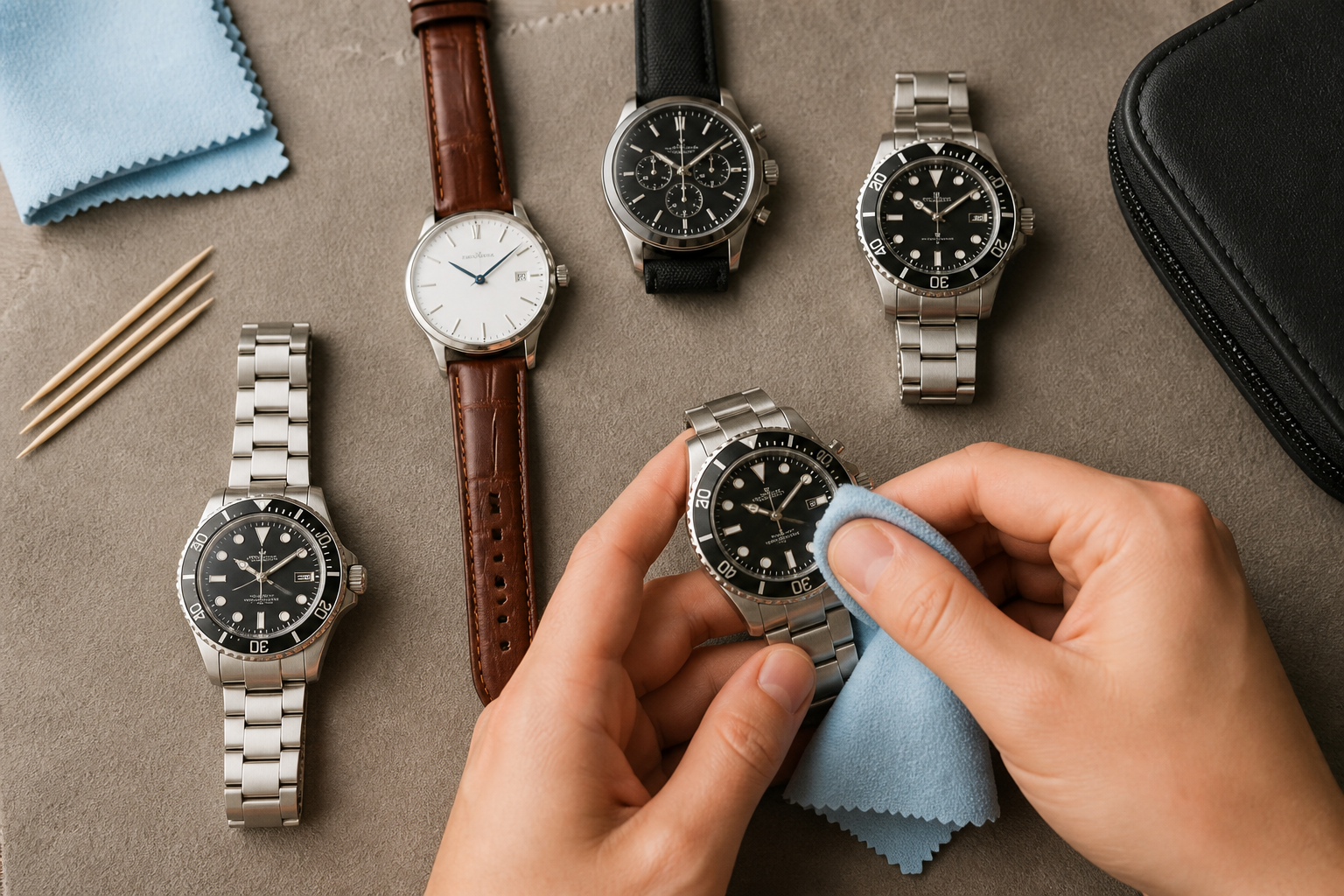
I do this on the first Sunday of every month, usually with coffee, usually in decent light near the window. I pull every watch out of the box and line them up on a folded cloth on my desk — ten pieces in a row, straps detached if they are on NATO or quick-release, still on the case if they are on integrated bracelets. The visual of all of them together is part of the point. You see things side by side that you miss when you handle one watch in isolation.
I work left to right. Each watch gets the same sequence, and I do not skip steps because a watch “looks fine.” The one time I rushed through my Seiko SKX007 — a $180 beater I bought in 2016 — was the time I missed a spring bar that was nearly sheared through. Looked fine. Was not fine.
Step One: The Microfiber Wipe-Down
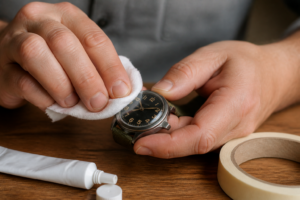
Every case and crystal gets a slow, deliberate wipe with a dry microfiber cloth. I mean slow — five or six full seconds per surface, not a quick buff. The crystal first, checking for chips at the edge where the bezel meets the glass. Then the case, paying attention to the lugs, the caseback edge, and anywhere the finish transitions from brushed to polished. That transition zone collects debris and also shows micro-scratches before they become actual scratches.
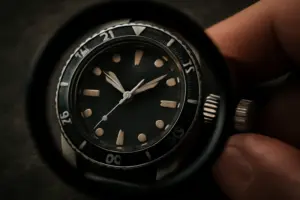
This step catches surface grime, yes. More importantly, it forces me to hold the watch in good light and actually look at it. In 2021, I found a hairline crack in the crystal of a 1968 Tissot Seastar during exactly this step. The crack was three millimeters long and ran along the inside edge of the bezel. Another few months and moisture would have been inside the case. Crystal replacement ran $55. A movement service from moisture damage would have run considerably more.
Step Two: The Toothpick-and-Breath Clean
A wooden toothpick — not plastic, which can scratch — does excellent work in lug holes and caseback crevices. I breathe gently on the surface first, which creates just enough condensation to loosen compacted dust and skin cells without introducing real moisture. Then the toothpick, used as a sweeping tool rather than a probe. The goal is not to dig; it is to coax debris out of the channel.
Lug holes are where dirt packs hardest, especially on watches that have been worn with leather straps in warm weather. That packed grime is mildly acidic. Over years, it works into the lug finish and accelerates wear. This step takes about ninety seconds per watch and is, in my experience, the most underrated minute of basic maintenance anyone can do.
Step Three: Crown Check
Every screw-down crown gets a careful clockwise turn to confirm it is fully seated. I do this by feel rather than by torque — I am looking for the slight resistance that means the threading is engaged, not the hard stop that means it was already fully down. The distinction matters. Overtightening a crown repeatedly damages the gasket faster than almost anything else.
Push-pull crowns get pulled to the time-setting position and pushed back in to confirm the stem is seating cleanly. A crown that feels loose or gritty in this motion is telling you something. Specifically, it is telling you to take the watch to a watchmaker, because the stem or the crown tube may need attention that goes beyond anything a monthly routine can address.
Winding, Timing, and the Step I Used to Skip
Every automatic in the lineup gets 20 manual winds via the crown, regardless of whether it has been worn recently. Automatic movements that sit static for weeks develop a phenomenon called “lubricant pooling,” where the oils settle away from the parts they are meant to protect. Winding moves the rotor, yes — but manual winding via the crown engages the mainspring directly and gets lubricant redistributed across the gear train far more effectively than passive oscillation during wear.
20 turns is not a scientifically precise number. However, it consistently brings most ETA 2824-based movements and Seiko NH35 calibers to a functional power reserve without risk of overwinding modern movements. For genuinely vintage pieces — anything pre-1970 with an earlier caliber — I cap at 15 turns and check for any roughness in the crown feel.
The Timing Check I Almost Stopped Doing
After winding, I set each watch to exact time against my phone and note any drift from the previous month in a small notebook I keep with the box. Most of my watches run within manufacturer spec — plus or minus 10 to 15 seconds per day for the automatics. When a watch that normally runs at +8 seconds a day suddenly starts losing 30 seconds a day, that is not normal wear variation. That is a movement telling me something has changed internally.
I almost stopped doing this step in 2022 because it felt redundant. That same year, my Glycine Airman — a 1960s-era manual-wind I paid $210 for at an estate sale — started losing 45 seconds a day after running within 5 seconds per day for two years. Watchmaker found a worn click spring. Repair was $85. Had I missed it, I would have eventually been looking at a full service. The timing log is worth the two minutes it takes.
Strap Inspection and Rotation — Where I Catch Most Problems Now
Straps get inspected at the spring-bar wear points — the small indentations where the spring bar sits inside the strap’s keeper loop. This is where leather fails first, typically as a thin white cracking along the underside of the strap about 8 to 10 millimeters in from the lug. I found a strap in exactly this condition on my daily-wear Hamilton Khaki Field in March of last year. The strap was three months old. It had been worn hard in humid weather. The spring-bar hole had expanded almost a millimeter, and the leather around it was beginning to delaminate.
Had it failed while worn, I would have lost the watch — a piece I paid $495 for — to a sidewalk. Catching it during the routine cost me nothing except noticing. Rubber and NATO straps get checked at the buckle wear point and at the keepers, where repeated friction creates stress fractures long before visible cracking appears.
Why I Rotate What Lives in the Top Tray
The last step in the circuit is physical rotation. The top tray of my box holds five watches; those five change every month. Nothing sits static for more than six weeks. This matters for two reasons. First, lubricants in unworn automatics do degrade faster when movements sit completely still. Second — and honestly more important to me — it forces me to handle every watch every month. You cannot catch a failing gasket or a cracked crystal on a watch you have not touched in eight months. Rotation is the mechanic that makes every other step possible.
When My Monthly Watch Care Routine Hits Its Limits
I want to be direct about what this routine is not. It is not a substitute for professional service. Modern automatics generally need a full service — movement cleaning, lubricant replacement, gasket replacement — every 5 to 7 years. Vintage pieces, particularly anything running at 18,000 bph or lower with older lubricant formulations, often need attention every 3 to 4 years. A monthly care routine extends the time between services and catches problems early. It does not replace the watchmaker.
Specifically: do not open the caseback. Do not attempt to replace gaskets without proper tools and a dust-free environment. Do not try to adjust beat rate or regulate a movement based on your timing log alone — take that information to a professional and let them act on it. The value of noticing is that you go to the watchmaker with a specific observation rather than a vague complaint. That saves time, and it often saves money.
The whole point of a monthly watch care routine — ten minutes, a cloth, and a toothpick — is that attention is the rarest and most useful thing you can give any mechanical object you care about. Not products. Not tools. Just the habit of actually looking, every single month, before something small becomes something expensive.
About This Article

Written by Ellen Ashford. Watch collector, fountain pen enthusiast, and lifelong journaler. Time & Ink is where I explore the craft of analog living — from vintage timepieces and fine stationery to the simple pleasure of putting pen to paper. More about this site.
Verify this against a primary source
Specifics change, and your situation may differ from the one described here. These are the authorities worth checking directly:
- NAWCC — horological reference, archives and research library
- Smithsonian Institution — collection records for historic timepieces and writing instruments