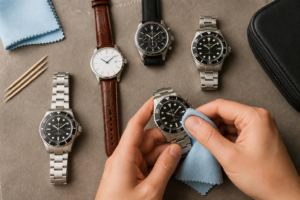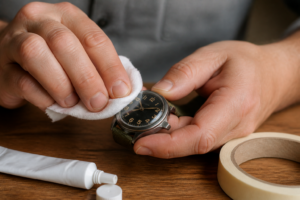
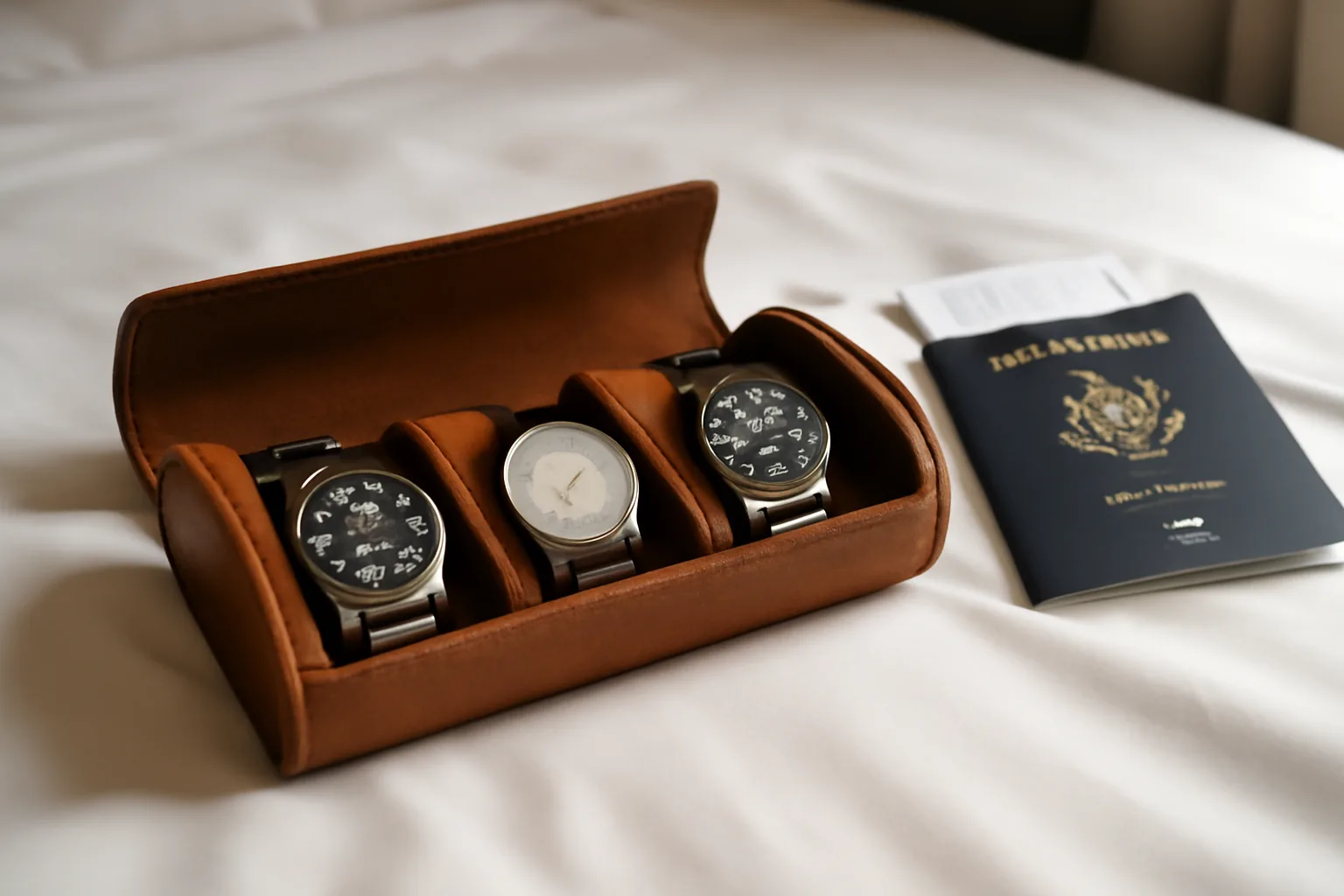
Never wrap a watch in a sock and call it packed — that’s the short version of a $60 lesson I learned the hard way. At twenty-six, cocky and completely clueless about what a rolling suitcase does to an exposed case back, I flew into Portland only to find a hairline scratch cut across the crystal of the first serious dress watch I owned, a slim Tissot Le Locle I’d spent eight months saving up for. Polishing that scratch out ran me $60; the lesson itself came free, because I’ve never repeated the mistake since. If you landed here searching for watch travel case packing tips, you’re already further along than I was back then. Consider this my attempt to spare you the scratch, the regret, and the bill that follows.
Ten-plus years into this habit, my daily rotation runs a Seiko SARB033, a vintage Omega Seamaster De Ville, and a Hamilton Khaki Field Mechanical that comes along on hikes. Moving all three — or even just a pair of them — across an airport used to feel like solving a small logistics problem every single trip. Stuffing them into a dopp kit is obviously the wrong move, but here’s the part nobody tells you: even a case marketed specifically for watches can let you down if you haven’t learned what actually matters. I’ve run cheap fabric pouches, rigid boxes, and dedicated rolls through their paces over the years, and by now I can tell you precisely what separates a case that actually protects from one that just photographs well on a shelf.
What follows is the full rundown — evaluating a travel case, prepping watches ahead of packing, positioning them correctly in transit, and the specific case I trust with my own collection right now. Consider it field-tested advice built from actual trips, not another rehash of a manufacturer’s spec sheet.
Where Most Watch Travel Cases Go Wrong
Cheap watch cases almost always fail for the same reason: a weak pillow. Both rolls and boxes depend on a firm, tight-fitting pillow to keep a watch from moving. A pillow with too much give lets the watch rock every time the plane hits turbulence or a bag gets tossed onto the cargo belt. That rocking creates contact — crystal against fabric, bezel against the case wall — and repeated contact, even tiny amounts of it, wears into scratches over time, padding or not. More than once I’ve opened a flimsy roll to find fresh marks on a bezel that wasn’t marked when I zipped the case shut.
Weak dividers cause the second kind of failure. Without a solid wall between watches, they drift toward each other, and bracelets are usually to blame. A metal link bracelet is basically a miniature file. Let one watch slide into its neighbor during a rough taxi ride, and you’ll have marks to show for it. I found this out firsthand after storing a Tudor Black Bay next to a dress watch in one flimsy two-slot case — the Black Bay’s steel bracelet left faint scratch lines on the Longines beside it. That case went in the trash the same afternoon.
Solid construction protects against more than internal shifting — it also fights compression. Compression is what a bag does to its contents at the bottom of an overstuffed suitcase, or when a carry-on gets crammed into an overhead bin. A soft case barely pushes back against that kind of pressure. My rule for anything worth more than $300: a semi-rigid or rigid case with separate compartments, full stop. The gap in price between a case that does the job and one that doesn’t is often under $30 — hardly worth debating.
Prepping Each Watch Before the Case Ever Closes
My prep work starts well before the case comes out. Every watch gets inspected first. I check that the crown is pushed all the way in and seated properly. For screw-down crowns — the kind you’ll find on a Seiko SKX or a Rolex Submariner — I make sure it’s screwed down completely, no exceptions. A loose crown is the leading cause of water getting where it shouldn’t, and it’s also just a small protrusion waiting to snag on fabric during transit.
From there I move to the bracelet or strap. Any folding clasp needs to be shut and locked all the way. A clasp that pops open mid-transit means the watch is now free to slide around the compartment however it wants. On metal bracelets, I flatten the clasp before setting the watch on its pillow. Leather straps I leave in their natural curve rather than forcing them into a tight loop — bending a straight strap hard enough can crack the leather, especially somewhere dry or in a cold cargo hold.
Whether a watch is running also factors in. I don’t bother stopping mechanical movements before a trip, but magnetism is on my mind. Security conveyor belts and body scanners both throw off electromagnetic fields. ISO 764 sets the standard for anti-magnetic resistance, and most modern watches shrug off everyday exposure without trouble — but older movements with unshielded lever escapements are a different story. Anything vintage and sensitive stays in my carry-on, on my person, never in checked luggage. No exceptions there either.
Getting the Positioning Right Once the Watches Are in the Case
About This Article

Written by Ellen Ashford. Watch collector, fountain pen enthusiast, and lifelong journaler. Time & Ink is where I explore the craft of analog living — from vintage timepieces and fine stationery to the simple pleasure of putting pen to paper. More about this site.
Verify this against a primary source
Specifics change, and your situation may differ from the one described here. These are the authorities worth checking directly:
- NAWCC — horological reference, archives and research library
- Smithsonian Institution — collection records for historic timepieces and writing instruments