Nearly every new collector assumes that if a watch’s most visible parts check out — a correct-looking dial, a case that seems right — everything underneath follows along honestly. That assumption is exactly how I came within a signature of handing over $1,400 for a Rolex Datejust built from spare parts pretending to be a whole watch. The dial was correct. The case wasn’t. Somewhere along the way, someone had swapped the original movement for a cheaper ETA caliber and bolted on a mismatched aftermarket bracelet worth maybe $40. Learning to recognize the counterfeit and mismatched pieces hiding inside a frankenwatch is what kept that mistake from happening. For anyone buying vintage or pre-owned watches, this isn’t a nice-to-have skill — it’s non-negotiable.
Strip away the jargon and a “frankenwatch” is simply a timepiece stitched together from parts that were never meant to share a case — genuine components living alongside non-original or outright counterfeit ones. Sometimes this happens by accident, the residue of decades of repair work. Far more often, though, it’s engineered fraud: sellers dress these composites up as untouched, original examples and charge full price for the illusion. The secondary market for luxury watches moves billions of dollars every year, and frankenwatches turn up at every price tier within it, uncomfortably often. I’ve had hundreds of watches pass across my kitchen table over the past ten years, and sellers still manage to surprise me with a new angle on the con.
What follows is my actual checklist — the order I work through it in, and the tools sitting next to me while I do. It doesn’t matter if you’re picking through an estate sale table, scrolling Chrono24, or arranging to meet someone from a forum — the same inspection holds. Get through every step of it before any money changes hands.
The Dial Comes First: Why It’s the Part Most Often Swapped
A dial is the first surface a buyer’s eye lands on, which is exactly why it’s the first thing a dishonest seller tampers with. Legitimate dials carry printing quirks, lume placement, and text styling tied tightly to the year they left the factory. A Rolex dial from the late 1960s, for instance, was printed in a specific typeface with a specific lume compound — details a modern reprint can’t quite replicate, no matter how convincing it looks at a glance.
Whenever I have access to the movement, dial feet are the first thing I look at. On an original dial, the feet are soldered or pressed into exact factory positions. A replacement dial tends to show solder residue, feet spaced incorrectly, or feet that have been filed down and relocated — that last one is about as close to a confession as you’ll get. Feet that have been altered mean the dial has been moved at some point, and that alone is worth asking hard questions about.
Put the printing under a loupe. Genuine lettering holds crisp, even ink depth throughout. Reprinted or counterfeit text tends to bleed slightly, vary in weight, or shift color under UV. Tritium and Super-LumiNova, in particular, age along known, predictable paths — so a “vintage” dial glowing bright and perfectly even is a red flag, not a selling point. Aged lume should carry oxidation patterns that line up with the wear on the case and crystal.
Reading the Case and Bracelet for Frankenwatch Tells
Faking a case convincingly costs real money, which is why sellers more often pair a genuine case with a swapped bracelet, or the reverse. On Rolex specifically, reference numbers are stamped into the lugs — the case reference sits at 12 o’clock, the serial at 6 o’clock — and both should date to the same production window. A case carrying a 1985 serial number has no business wearing a bracelet style that Rolex didn’t introduce until 1995.
I found this out the expensive way with a Submariner I nearly bought back in 2018. The case checked out fine. The clasp, though, carried a “D” serial prefix, which places it in the early 2000s — decades removed from the case’s mid-1980s date. The seller’s explanation was a “period service replacement.” Possibly true. But that explanation should always come with a substantial price cut attached, since originality drives both resale value and buyer confidence enormously.
Study the case finishing up close. Polished areas should carry consistent, directional brushing or a uniform mirror finish. If one lug is brushed differently than its neighbor, that mismatch suggests the case was refinished at some point after picking up replacement parts. Check the caseback too. Factory engravings hold consistent depth and a consistent font. Aftermarket engravings, or a swapped caseback entirely, tend to show machining marks, off fonts, or serial numbers that don’t line up with any reference database for that model.
Tracking Down Fake Parts Inside the Movement
This is where the biggest money is at stake. A frankenwatch running on a swapped movement loses somewhere between 40 and 70 percent of its value the moment that’s discovered, depending on the model. And yet movement swaps are one of the easiest substitutions to pull off — an ETA 2824 will drop into plenty of cases built around a proprietary caliber with only minor fitting. Sellers are counting on the buyer never popping the caseback open.
Open it anyway. Every time. Any seller who won’t allow the caseback off during an inspection has told you everything you need to know — walk. There’s no honest reason to refuse that in a private sale. For screw-down casebacks, bring your own case opener, or ask for a watchmaker on-site to do it. A genuine movement carries rotor engravings, serial conventions, and finishing that follow the brand’s own standards precisely.
From what I’ve seen, the clearest fingerprints of a swapped movement are: rotor engravings that don’t match the model’s production year, bridges finished with the wrong côtes de Genève pattern, and movement serial numbers that fall outside the range the brand has documented. Omega keeps particularly thorough movement serial records — cross-checking a serial against their published tables takes about two minutes and settles the originality question outright. Rolex, IWC, and Patek Philippe all maintain comparable records, accessible through specialist databases and official service centers.
Crown and Crystal: Small Components, Loud Warnings
Crystals and crowns get swapped constantly, often without a word of disclosure. That’s not automatically dishonest — crystals crack, crowns wear out — but it turns into fraud the moment a seller calls a replacement “original.” Genuine sapphire crystals on modern luxury pieces carry particular anti-reflective coatings, throwing off a distinctive blue or green reflection. Aftermarket crystals frequently show a greenish cast at certain light angles that the factory original never had.
Crowns give up just as much information. On a Rolex, the crown carries a specific number of dots for that model, set at a precise position. The crown tube itself should show no sign of rethreading or replacement work. If the crown spins with too little resistance, or winds unevenly, that’s a strong signal of a non-original part. All of this shows up almost instantly under 10x magnification.
The Magnification Tool That Caught What My Naked Eye Missed
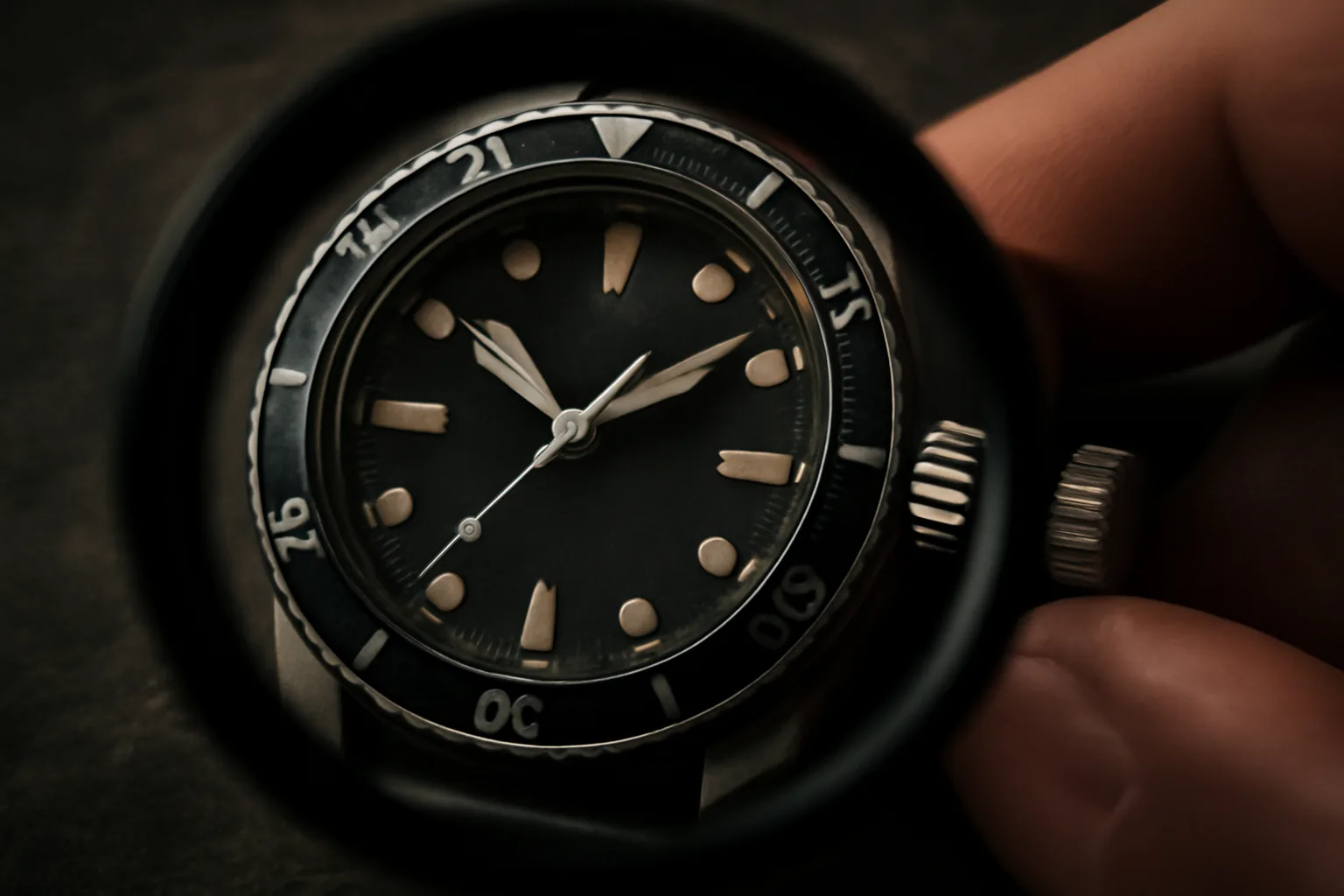
None of this works without real magnification. Skip the right loupe and you’ll miss the small tells — refinished dials, ground-down cases, swapped movements — that separate an honest vintage piece from an expensive pile of parts wearing one watch’s name.
What earns its keep
- White LED lighting picks apart dial detail without throwing the harsh shadows that make close inspection harder — printing flaws and refinishing tells suddenly become obvious.
- The UV setting is genuinely worth having on its own — reapplied lume and case re-polishing fluoresce differently than original factory work ever does under it.
- 10x magnification lands in the sweet spot — strong enough to catch serial number mismatches and movement markers, without being so extreme that keeping your hand steady mid-inspection becomes its own challenge.
Where it falls short
- The battery compartment is temperamental — check it before you head out to a show or dealer meeting, because a dead battery means no light and no leverage during inspection.
- For what it costs, the build feels lighter in hand than expected, and it’s easy enough to drop mid-examination — handle it carefully and it’ll hold up, but don’t mistake it for indestructible.
I’ve stood across from a seller, loupe in hand, watching their confidence crumble as the UV light revealed a freshly refinished dial they’d claimed was original—that moment of clarity is worth every dollar. Grab the Gain Express Jewelers Loupe Magnifier with White LED and UV Light and make sure your next vintage watch purchase is actually what you think it is.
About This Article

Written by Ellen Ashford. Watch collector, fountain pen enthusiast, and lifelong journaler. Time & Ink is where I explore the craft of analog living — from vintage timepieces and fine stationery to the simple pleasure of putting pen to paper. More about this site.
Verify this against a primary source
Specifics change, and your situation may differ from the one described here. These are the authorities worth checking directly:
- NAWCC — horological reference, archives and research library
- Smithsonian Institution — collection records for historic timepieces and writing instruments