The Bottle I Almost Threw Away
Last winter I pulled a bottle of Diamine Oxblood from the back of my ink cabinet and nearly didn’t recognize it. What had been a fluid, wine-dark red was now a thick paste clinging to the glass walls like old jam. I’d left the cap slightly loose — a rookie mistake I should have outgrown — and months of slow evaporation had done their quiet damage. I know how to fix thickened fountain pen ink now, but that bottle taught me most of what I know through failure first. If you’re staring at a similar jar of sludge and wondering whether it’s salvageable, pull up a chair. I’ve been there more than once, and the answer is almost never a simple yes or no.
How I Assess the Damage Before I Touch Anything
Before I unscrew a single cap, I look. I hold the bottle up to a daylight bulb and tilt it slowly. Thickened ink moves like honey — sluggish, maybe streaky, but still cohesive. That’s recoverable. What isn’t recoverable announces itself clearly if you know the signs.
I’m looking for three specific red flags. First, mold islands — those fuzzy grey or white discs floating on the surface. Second, rubbery sediment that doesn’t dissolve when I swirl the bottle gently. Third, and most importantly, smell. I crack the cap and sniff carefully. A sulfur note, something like struck matches or bad eggs, means the dye chemistry has broken down. In my experience, that process is irreversible. Mold contamination is also irreversible — not just aesthetically, but practically, because mold spores will colonize your pen’s feed within weeks.
If any of those three are present, I bin it without guilt. A contaminated ink isn’t a treasure. It’s a liability.
Why I Only Use Distilled Water — and Why I Add It Slowly
Tap water contains chlorine, dissolved minerals, and bacterial load. All three cause problems. Chlorine can react unpredictably with iron gall inks specifically, accelerating their already aggressive oxidation. Minerals leave deposits in feeds and on nib tines. Bacterial load, however, is the worst offender: it seeds mold growth inside a bottle you’re trying to save. I buy distilled water in one-litre bottles and decant it into a clean dropper bottle. This costs me about £1.20 a litre and lasts years for this purpose.
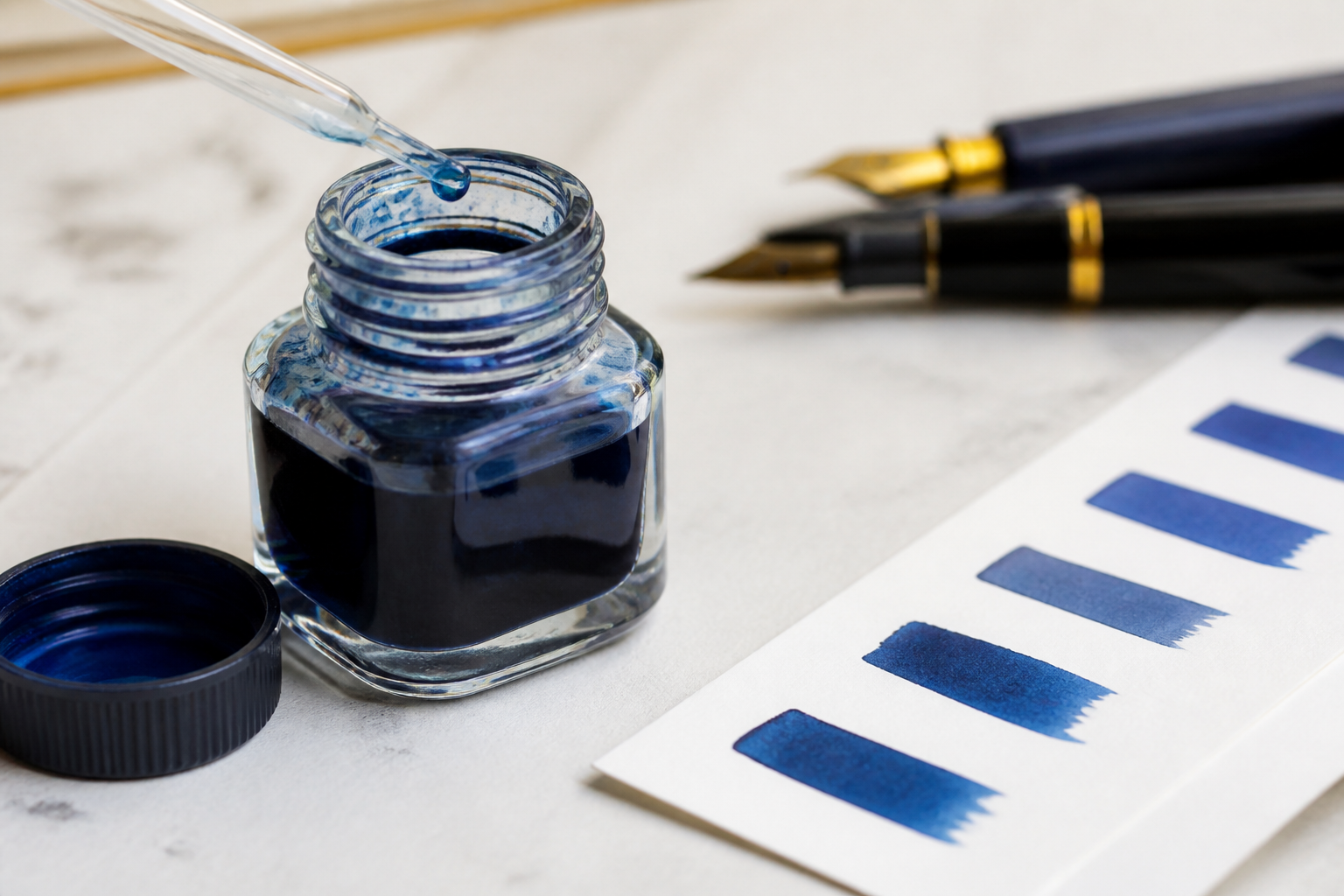
The restoration process itself is slow by design. I add distilled water three drops at a time using a pipette, reseal the bottle, and roll it gently between my palms for about ninety seconds. I do not shake it. Shaking introduces air bubbles that can affect how the ink flows during the test swatch, and it also creates foam in heavily dye-loaded inks that takes twenty minutes to settle.
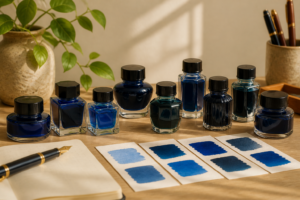
Then I wait five minutes and swatch it on a strip of Rhodia paper. I’m checking flow consistency, colour intensity, and whether the ink is still depositing evenly. If the swatch looks streaky or the ink drags, I repeat the cycle. Three drops, roll, wait, swatch. Sometimes I do this six or seven times before the ink behaves the way I want. Patience here is not optional — it’s the method.
How I Know When I’ve Added Enough Water
Overhydration is a real problem. Too much water thins the dye concentration to the point where the ink writes like a ghost — pale, watery, and prone to feathering on anything but the most sized paper. My benchmark is the colour on the swatch, compared against an old swatch card I keep in a folder. When the restored ink matches the original colour depth within about fifteen percent, I stop. That’s a judgment call, but it’s one you develop after swatching the same inks repeatedly over time.
Which Inks I’ve Found Survive Revival — and Which Don’t
Dye-based inks generally tolerate this process well. Diamine, Pilot Iroshizuku, and most standard European inks are formulated with water-soluble dyes that reconstitute reliably when diluted. The molecular structure hasn’t changed — you’re simply restoring the original water-to-dye ratio.
Iron gall inks are trickier. They thicken through a different mechanism: oxidation, not just evaporation. The tannic acid and iron sulfate react with oxygen over time, producing the permanent, slightly corrosive bond that makes iron gall so archivally durable. That reaction doesn’t reverse. You can thin an iron gall ink with distilled water, but if it has thickened through oxidation rather than evaporation, the restored ink will still be more corrosive than the original formula intended. In my experience, use it quickly and keep it away from pens with steel nibs and feeds if you’re uncertain about the degree of oxidation.
Pigmented inks — think certain Platinum Carbon Black formulations or similar archival pigment inks — are the most variable. The pigment particles can settle permanently into clumps that won’t re-suspend properly, specifically if the bottle has been undisturbed for more than eight or ten months. I have saved two pigment inks this way and ruined two others. It depends heavily on how long they’ve been sitting.
The Discontinued Ink I Ruined Trying to Stretch It
I have to confess this one. In 2019 I had roughly twelve millilitres of Noodler’s Apache Sunset left in the bottle — a colour I adore and one that had been discontinued without warning. It was slightly thicker than usual, probably from sitting for two years with occasional use but imperfect resealing. I panicked at the low volume and made a bad decision: I added too much water too fast, trying to extend what I had.
I added roughly a millilitre in one go — no swatch testing between additions, no patience. The colour shifted. Apache Sunset’s layered orange-to-red shading depends on a precise dye concentration balance, and I upset it entirely. What came out of the pen afterward was a flat, washed-out orange with none of the chromatic depth that made the ink special. I had twelve millilitres of mediocre orange ink instead of ten millilitres of something irreplaceable. That cost me nothing in money and everything in regret. The lesson was obvious and I should have known it: scarcity makes you reckless, and recklessness makes the scarcity worse.
The One I Saved
About eighteen months later I found a bottle of Waterman Tender Purple that had thickened considerably — probably four years old, bought secondhand and poorly stored. Using the slow three-drops-at-a-time method, six additions over about forty minutes of patient swatching, I brought it back to something that swatched within ten percent of a reference sample I found online. It fills my Parker 51 beautifully to this day. That’s the method working as intended.
Storage Habits That Prevent the Problem Entirely
The best restoration is the one you never need. My current storage system took me about three years to settle into, and it’s genuinely simple.
- Tight caps, checked twice. I wipe the bottle threads with a clean cloth before closing, and I give the cap a quarter-turn extra after I think it’s sealed. Ink evaporates through imperfect seals faster than most people expect — a loosely capped bottle in a warm room can lose five percent of its volume in six months.
- Cool, dark shelves. My ink cabinet sits on a north-facing wall, away from radiators. Heat and UV both accelerate dye degradation. An Iroshizuku bottle left on a sunny windowsill for a summer will shift colour measurably.
- Decanting into small vials for daily use. This is the habit that changed everything for me. I transfer ten to fifteen millilitres of a working ink into a small glass vial — the kind sold for sample inks — and use that for filling. The mother bottle gets opened perhaps four times a year rather than every week. As a result, the mother bottle stays sealed, stays full, and lasts indefinitely.
The vial system adds about ninety seconds per ink change. That’s the entire cost of the habit. I now have bottles that are seven and eight years old and still writing exactly as they should.
When to Fix Thickened Fountain Pen Ink — and When to Walk Away
Let me be direct about the limits, because I think a lot of guides on this topic oversell success rates. You can fix thickened fountain pen ink when the thickening is purely from evaporation, when the ink shows no mold, smells chemically normal, and has no rubbery or permanent sediment. That covers perhaps sixty percent of neglected bottles in my experience.
The remaining forty percent — the moldy, the oxidised beyond recovery, the sulfurous — cannot be rescued by any home method I know of. There is no professional service for fountain pen ink restoration in the way there is for watch movements or vintage nibs. No one is going to re-formulate your discontinued ink back to spec. When it’s gone, it’s gone, and the dignified response is to pour it out, rinse the bottle if it’s worth keeping, and move on.
Analog tools ask for attention and a little humility. The ink doesn’t owe you a rescue. However, when it is rescuable — and it often is — twenty minutes of patience and a dropper of distilled water is one of the more quietly satisfying repairs in this hobby. Three drops at a time. Swatch between. Trust the process.
About This Article

Written by Ellen Ashford. Watch collector, fountain pen enthusiast, and lifelong journaler. Time & Ink is where I explore the craft of analog living — from vintage timepieces and fine stationery to the simple pleasure of putting pen to paper. More about this site.
Verify this against a primary source
Specifics change, and your situation may differ from the one described here. These are the authorities worth checking directly:
- NAWCC — horological reference, archives and research library
- Smithsonian Institution — collection records for historic timepieces and writing instruments