Don’t trust a journal entry until you’ve flipped the page. That shadowy double of yesterday’s handwriting rising up through today’s paper is the single most common complaint I field from other people who write daily with a dip or cartridge pen — and it fooled me for years before I finally sorted out what was actually going on underneath the ink. Ghosting and show-through get treated as the same problem, but they’re not, and mixing them up is how you end up with the wrong bottle of ink, money wasted, and a notebook you can only write in on one side.
What does ghosting mean in fountain pen writing?
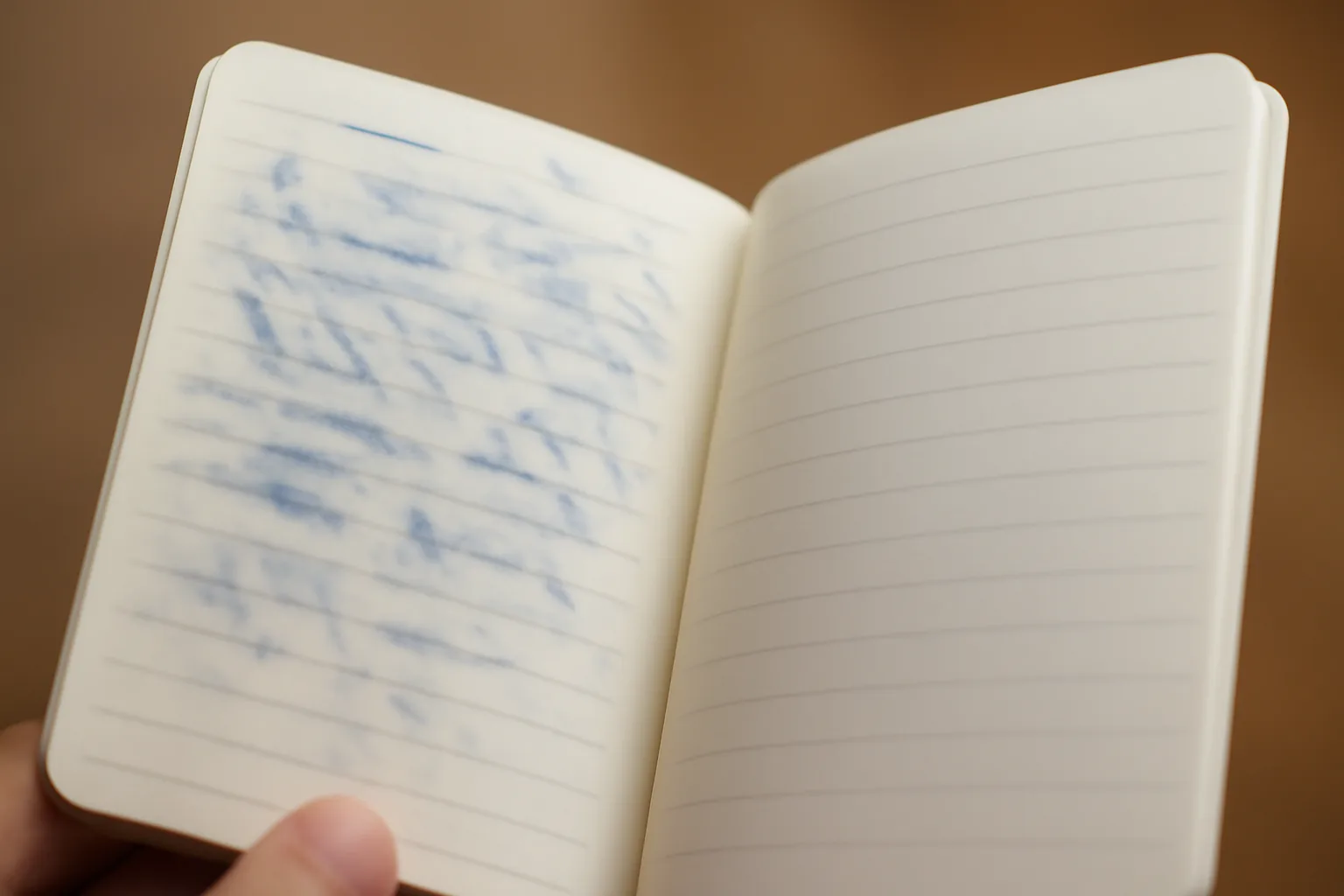
Ghosting is the faint outline of your writing that appears on the reverse of a page when you tilt it under a light — the ink has not gone through, it is just close enough to the surface to catch the light differently. It is a cosmetic problem, and you can still write on that side. That makes it different from show-through, where the writing reads clearly from the back and effectively costs you the page, and from bleed-through, where the ink has physically soaked through the paper.
Fountain pens have been my daily writing tool for more than ten years now. Somewhere north of 60 notebooks have gone through my hands in that span, along with upward of 100 different ink-and-paper pairings. My shelves run the gamut from Leuchtturm1917 A5 hardcovers to Hobonichi Techo Weeks, and at last count my ink drawer held 34 bottles standing open. I’ve made basically every misstep there is to make in this department, so consider this your shortcut around them.
What follows is a plain accounting of what ghosting and show-through really are, what triggers each one, how the weight and sizing of your paper tips the outcome one way or the other, and which inks have held up best across the notebooks I actually reach for every day. Read to the end and you’ll be picking ink-and-paper pairings with something closer to certainty than guesswork.
Ghosting and Show-Through: Not the Same Problem
People online toss these two words around as if they mean the same thing. They don’t. Ghosting is that faint outline of writing you catch on the back of a page when you tilt it under a light — annoying to look at, but it doesn’t stop you from writing on that side. Show-through is a different animal entirely: the ink has soaked so deeply into the paper fibers that the writing reads clearly from the reverse, which effectively kills that page as usable space.
Here’s the shorthand I use: ghosting is a cosmetic issue, show-through is a functional one. A faint ghost on 90gsm Tomoe River doesn’t register for me at all. Real show-through on 80gsm Leuchtturm stock, on the other hand, costs me half the pages in that notebook. That one distinction drives nearly every ink-and-paper decision I make now.
The causes split apart too. Ghosting usually shows up when ink stays close to the paper’s surface and catches light differently when you angle the page. Show-through happens when the ink pushes down into the fiber structure itself — often because of heavy dye concentration, an especially saturated formula, or paper that’s light on internal sizing. Knowing which mechanism you’re dealing with means you can actually troubleshoot instead of just cycling through bottles hoping one sticks.
Why Paper Weight and Sizing Matter More Than the Number Suggests
Weight by itself is a poor predictor. I learned that lesson courtesy of Tomoe River’s 52gsm sheet. On paper — no pun intended — 52gsm sounds almost too flimsy to trust. In actual use, it’s one of the best fountain-pen papers ever produced, and the reason is its remarkable internal sizing, a chemical treatment that keeps ink from soaking straight into the fibers.
Internal sizing — usually built with alkyl ketene dimer, or AKD — forms a barrier so ink stays near the surface rather than sinking in. Surface sizing does something similar from the outside, laying down a starch or gelatin coating over the sheet. Both approaches cut down significantly on feathering and show-through. Papers built specifically for fountain pens — Clairefontaine at 90gsm and pH neutral, Rhodia at 80gsm and cold-pressed, Life Noble at 80gsm out of Japan — pour real effort into this step. Bargain composition books skip most of it, which is exactly why a Pilot Metropolitan will soak straight through one.
My working floor for writing on both sides of a page is 80gsm with genuinely good sizing, or any Japanese paper made specifically with fountain pens in mind. Drop below that and ink behavior turns unpredictable no matter which bottle you’re pouring from.
Where Ink Saturation and Dye Load Come Into Play
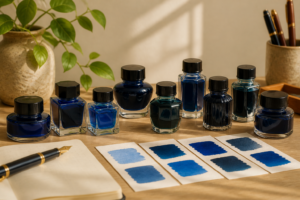
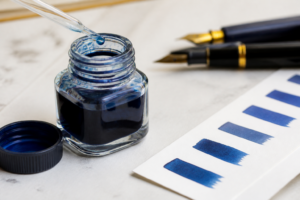
Heavily saturated inks are gorgeous on the page and a headache everywhere else. Something like Diamine Oxblood, Noodler’s Baystate Blue, or a rich shading green carries a heavier dye load per milliliter than most. That extra dye has to settle somewhere once it hits the sheet. On paper with strong sizing, it stays put and pools handsomely. On weaker stock, it spreads sideways and drills downward through the fibers instead.
Waterproof and pigment-heavy inks — iron gall formulas among them — play by different rules again. Rather than resting in the fiber, they form an actual chemical bond with it. In one sense that makes them tougher against ghosting, since the ink genuinely holds its ground. But that same deep bond means they can still show through on thin paper, because the ink has traveled further into the sheet, not less.
What Actually Happened in My Six-Notebook, Twelve-Ink Trial
Over three years I’ve run this test in a fairly controlled way: six notebooks, twelve inks. Fifty words per sample, a full 24 hours to dry, then I flip the page and check both ghosting and show-through under daylight and again under a direct LED lamp. Below are the pairings that told me the most.
Rhodia No. 16 at 80gsm paired with Diamine Sherwood Green gave me real ghosting and a middling amount of show-through — the green’s heavy saturation muscled its way through even paper with a solid reputation. Swap in a drier, lower-saturation ink on that same notebook — PILOT Iroshizuku Take-Sumi, specifically — and the show-through disappeared completely, with the ghosting fading down to almost nothing.
Leuchtturm1917 at 80gsm with Waterman Mysterious Blue produced only a trace of ghosting and no show-through at all. Leuchtturm’s paper is fine, not remarkable, but Waterman inks are known for good behavior — light saturation, moderate flow — and that combination held up every time. Swap in Noodler’s Black on that same Leuchtturm notebook, though, and you’ll see moderate show-through, since Noodler’s Black runs both wet and saturated.
My original Hobonichi Techo Weeks, printed on 52gsm Tomoe River paper, ghosts with almost every ink I’ve tried but almost never shows through. That paper is a small miracle. I trust it now with even my most saturated inks, because the sizing simply outperforms everything else on my shelf.
An Overlooked Variable: Nib Width
Most ink guides never mention this, but nib width changes everything. A broad nib deposits somewhere between 30 and 50 percent more ink per stroke than a fine one does. Same paper, same ink, different result: my TWSBI Eco with a broad nib produced obvious show-through on 80gsm Leuchtturm, while my Pilot Custom 74 with a fine nib on that identical page showed nothing — zero show-through, and ghosting so faint it barely counted.
If you’re set on running wet, broad nibs through thinner notebooks anyway, your ink selection stops being a preference and becomes damage control. You want the driest, least saturated formula you can find. This is precisely the territory where an ink like Iroshizuku has built its reputation.
The Bottle That Ended My Habit of Checking the Back of Every Page
After enough years spent testing inks that looked deep and rich on the front only to go see-through the moment light hit the reverse, what I actually wanted was something that could handle ordinary daily writing without wrecking the legibility of the page behind it. PILOT Iroshizuku Take-Sumi is the bottle that finally got me to stop second-guessing whatever paper I’d grabbed that day.
What works
- Stays put with barely any show-through even on thinner, cheaper stock — both sides of the page remain usable without a ghost wrecking the reverse entry
- A deep, saturated black that holds its color over time, so entries stay readable years down the road no matter how much light they’ve seen
- Handles medium nibs beautifully, so you’re not forced down to extra-fine just to control the ink — your handwriting gets to stay itself
The Black That Stopped My Ghosting Problem Without Going Watery
Years of hunting for an ink that wouldn’t ghost had me settling for formulas so thin they looked practically drained of color on the page. Take-Sumi broke that trade-off — it’s dark enough to feel like a real black, yet it behaves as though it was engineered for thin paper and tightly packed page spacing.
What works
- Keeps its line intact without bleeding through, even in journal layouts where the pages sit tight against each other
- The black on the page reads as deliberate and confident, not washed-out or timid the way a lot of low-ghost inks end up looking
- Dries fast enough that you can write on the back within minutes without smearing what you wrote the day before
What doesn’t
- The bottle only holds 50ml, which adds up to a steep per-milliliter cost if you’re filling a pen every day
- Put it on genuinely thirsty or bargain-bin paper and you’ll still catch *some* show-through — no ink defies physics, and this one doesn’t pretend otherwise
I almost dismissed it as too expensive until I realized I was finally using both sides of my pages again instead of abandoning them mid-journal. PILOT Iroshizuku Take-Sumi Bamboo Charcoal Black (50ml, Item 69224)
About This Article

Written by Ellen Ashford. Watch collector, fountain pen enthusiast, and lifelong journaler. Time & Ink is where I explore the craft of analog living — from vintage timepieces and fine stationery to the simple pleasure of putting pen to paper. More about this site.
Verify this against a primary source
Specifics change, and your situation may differ from the one described here. These are the authorities worth checking directly:
- NAWCC — horological reference, archives and research library
- Smithsonian Institution — collection records for historic timepieces and writing instruments