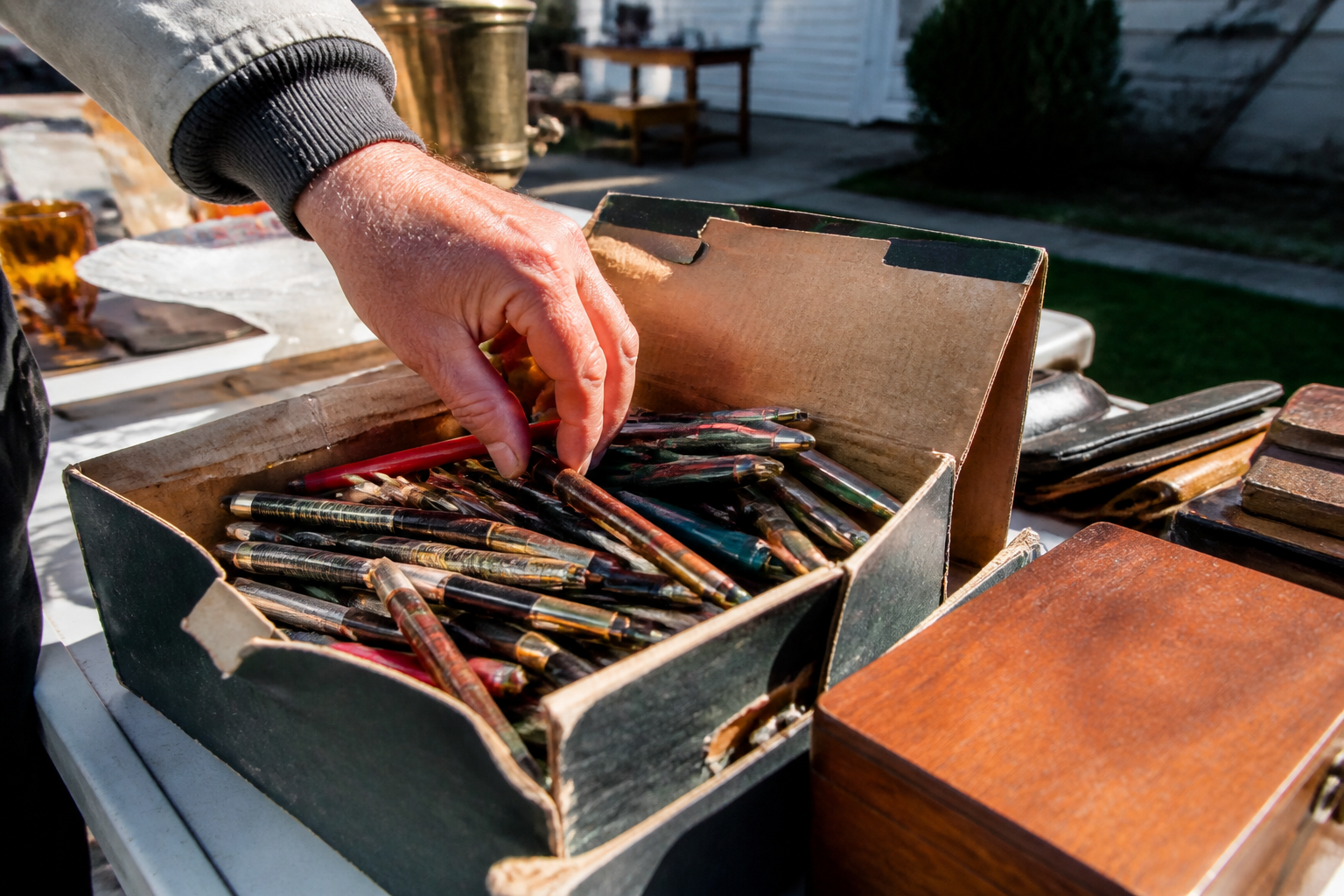
My eyes go straight to the shoebox before I’ve even scanned the rest of a garage sale table. Taped shut, marker-scrawled, wedged under some card table between a dead clock and a stack of paperback thrillers — that’s the box I want. Last June I handed over three dollars for one labeled “PENS + STUFF” in someone’s handwriting, and what followed was five minutes of the exact sorting ritual I’ve refined over a decade of doing this. That box turned an ordinary Saturday into a good one. It’s also a decent reminder of why I keep showing up to these things.
The Case for Betting on a Shoebox
Three dollars won’t buy you a decent latte. It’s essentially nothing. Yet plenty of shoppers walk right past these boxes every weekend, unwilling to gamble on forty pens when thirty-eight are probably crusted-over Bics. That reasoning isn’t wrong, exactly. What I don’t share is the shrug that goes with it — because in nearly every mixed box I’ve cracked open over the years, there’s been at least one thing worth the trouble.
Ten-plus years into collecting both fountain pens and mechanical watches, one lesson has stuck with me: the good stuff rarely announces itself. A Parker 51 sitting in a pile doesn’t sparkle. A vintage Omega Seamaster won’t tick loud enough to catch your attention from across a folding table. Finding either requires actual looking, and knowing what you’re looking for. A shoebox is that same challenge, just condensed.
None of this means I’m sentimental about it. Most boxes let you down, plain and simple. I’ve handed over three dollars and gotten forty-three hotel-branded ballpoints plus a gnawed pencil for my trouble. Five dollars once bought me nothing but a novelty pen molded into the shape of a fish. The risk is genuine every single time. Still, the sorting method I’ve built over the years keeps my losses cheap and my occasional wins worthwhile.
My Five-Minute Sorting Method at the Sale Table
I do this right there at the table, seller watching the whole time. There’s nothing sneaky about it — most sellers just seem relieved someone’s actually paying attention. The full process runs about five minutes, sometimes quicker, and breaks down into three distinct passes.
Pass One: The Ten-Second Visual Scan
My eyes land on the clip before anything else, almost every time. Cheap pens ship with thin, stamped-steel clips that have zero spring and even less personality. Pens worth a second glance carry clips that were clearly designed on purpose. Parker’s arrow clip is instantly recognizable — a narrow machined point settling into that signature silhouette. Cross clips carry fine rolled longitudinal ridges. Any clip that feels substantial and refuses to bend like foil is my first sign to keep going.
Next come the imprints. I angle each barrel toward whatever light is available and read what’s stamped there. German houses — Kaweco, Pelikan, LAMY — usually leave crisp, deeply cut markings. Japanese makers like Pilot, Platinum, and Sailor stamp with a similarly precise hand. Mid-century Parker and Sheaffer imprints carry a distinct formal typeface all their own. None of this guarantees quality on its own, but it’s enough reason to keep examining a pen rather than tossing it back.
Running through the June box this way took roughly ninety seconds. Four pens got pulled sideways out of the pile almost immediately. Everything else stayed put.
Pass Two: What the Hand Tells the Eye Can’t
Weight and balance are much tougher to fake than looks alone. A brass body doesn’t feel anything like an aluminum one, and neither feels close to plastic. I’m not putting anything on a scale here — I’m just lifting each pen and letting my hand register the difference. A pen with real front-heaviness usually has a metal nib assembly with genuine mass behind it. A pen that feels like an empty tube probably is exactly that.
Balance point matters just as much. I hold each pen uncapped near where my fingers would sit while writing — roughly a third of the way back from the nib. A pen built with care won’t tip sharply toward either end. It just settles. That settled feel is genuinely hard to fake on the cheap, and it tells you something honest about the engineering underneath.
This same pass covers a quick structural check. I’m hunting for cracked celluloid, which shows up as a web of fine surface fractures, most often near the section or the cap lip. Celluloid can’t be patched or welded back to invisibility, so a crack usually means the pen’s future is decorative rather than functional. I also check for the obvious losses — caps that won’t seat properly, snapped-off clips, nibs bent from being forced. None of that kills the deal at three dollars, but it absolutely reshapes what the pen is capable of becoming afterward.
Pass Three: What Ten Years of Handling Already Taught Me
The final pass is pure memory work. After a decade of handling pens, I catch shapes the way a birder catches a silhouette against the sky. A Sheaffer Snorkel has a telltale profile right at the section — that small retractable tube mechanism — visible before you’ve even uncapped it. A Pilot Vanishing Point carries that oddly front-loaded body with the clip mounted near the nib, which still somehow reads as strange and correct at once. Having these outlines memorized is really what makes the whole five-minute process trustworthy.
I’ve been burned by my own hesitation before. Early on, I skipped a Sheaffer 1000 because the plating looked tired and the imprint had faded. Somebody else in the crowd grabbed it twenty seconds after I set it down. The only real cost was the lesson: worn finish and low quality are not the same thing. On an old pen, worn plating frequently means solid brass underneath — which is precisely what you want to find.
The Actual Contents of My Three-Dollar Box
Thirty-one pens, total. That number matters because it sets the odds honestly. Of those thirty-one, twenty-four turned out to be dried-up ballpoints — hotel-branded, bank giveaways, a handful of pharmacy promo pens. Three were felt-tips in varying stages of crustiness. One mechanical pencil showed up with a snapped lead-advance mechanism. And one novelty item, shaped loosely like a paintbrush, clicked together from hollow plastic parts.
That’s thirty pens that were, by any honest measure, junk. But the remaining two are the entire reason this story exists.
Pen one: a Cross Century in rolled gold plate, the 10 karat variety Cross churned out heavily from the late 1970s into the 1980s. Ballpoint, not fountain pen, refill long dead. But the body had held up beautifully — just a trace of wear near the clip spring — and the click mechanism still gave that solid, expensive-feeling resistance Cross baked into that line for decades. Three dollars bought the whole box. Cleaned up and fitted with a fresh refill, that pen writes flawlessly today.
Pen two was the real find. A first-generation Pilot Vanishing Point in matte black, likely made in the early 1990s judging by the slightly different body proportions and the pre-1997 clip design. The nib was an 18 karat medium — softer and more expressive than the 14 karat nibs Pilot ships now. Inside, the converter sat empty, crusted with old dried ink, blue-black by the look of the residue, possibly iron gall given a bit of corrosion I spotted inside the section.
I brought it home, pulled the nib unit apart, flushed everything under room-temperature water for about twenty minutes, and let it air-dry on a paper towel for six hours. Now it fills, writes, and retracts as smoothly as any Vanishing Point I own. Other collectors have priced its resale value somewhere between sixty and ninety dollars depending on condition. I’m not selling it — not now, not ever, as far as I’m concerned.
Why Finding It Beats Just Owning It
I’ve turned this over in my head more than once — why sorting through a garage sale box feels so different from buying a pen online, even when the online purchase is the smarter move on every rational count. You know precisely what’s arriving. You can look up the exact production year, the nib size, the filling system. The price is usually reasonable. There’s no uncertainty anywhere in it.
And still, it feels like nothing much at all. The pen shows up wrapped in bubble wrap, already found by somebody else’s search bar before it ever reaches your hands.
A shoebox demands attention in a way a listing never will. It asks for the kind of trained noticing that only comes from years of handling objects and getting them wrong sometimes. That Sheaffer I let slip away from the crowd — I still think about it now and then. Not regret, exactly, but a kind of alertness that kept me looking closer for months afterward. The losses seem to teach more than the wins ever do.
My June-box Vanishing Point sits on my desk as I write this. It’s currently loaded with Diamine Registrar’s Ink, an iron gall formula that will almost certainly outlast me, provided I don’t drop the thing. Every time I pick it up, I remember exactly how it felt coming out of that box — heavier than I expected, faintly sticky from old dried ink on the section, unmistakably a serious object surrounded by a pile of promotional plastic junk.
Three dollars. Five minutes. Thirty pens worth nothing, two pens worth keeping. That ratio feels about right to me, and I’d take it again every single weekend for as long as I keep doing this. The find is never guaranteed going in. As far as I’m concerned, that’s exactly the appeal.
About This Article

Written by Ellen Ashford. Watch collector, fountain pen enthusiast, and lifelong journaler. Time & Ink is where I explore the craft of analog living — from vintage timepieces and fine stationery to the simple pleasure of putting pen to paper. More about this site.
Verify this against a primary source
Specifics change, and your situation may differ from the one described here. These are the authorities worth checking directly:
- NAWCC — horological reference, archives and research library
- Smithsonian Institution — collection records for historic timepieces and writing instruments