Don’t buy a Hobonichi Techo expecting an ordinary notebook — that’s not what you’re paying for, and misunderstanding it will cost you money and patience. For three straight Januarys I watched the planning world work itself into a frenzy over this slender Japanese import, and for three straight Januarys I scoffed and reached for something with more presence on my shelf. I’ve spent decades handling well-made watches and pens; I know craftsmanship when I feel it, and a planner north of $50 printed on paper weighing a mere 52 grams per square meter struck me as a lot of money for something so insubstantial. Then, at a pen show in 2023, a fellow collector handed me one without a word of explanation. He simply stood there while I ran my Pilot Custom 742 — inked with Iroshizuku Yama-budo — across the page. That silent demonstration is when the whole thing clicked. This isn’t really a review of a planner. It’s a review of paper.
Through all of 2024, I made the Hobonichi Techo Cousin A5 my everyday planner and my catch-all creative notebook. Fourteen inks passed through it, five nibs from an extra-fine Sailor up to a broad Pelikan M800, and it rode along with me through rain, airports, and the ordinary disorder of a full year of living. The results weren’t quite what I expected — and they confirmed something I’d long suspected about products that acquire near-mythical reputations. Below is the full account.
Why the Hobonichi Techo Doesn’t Behave Like Other Planners
Hobonichi, the Japanese publisher behind this planner, takes its name from Hōbonichi — “almost every day.” Their signature release is a compact daily planner built on Tomoe River paper, a tissue-thin 52-gsm stock manufactured by Tomoegawa. On paper — pun intended — that weight sounds like a liability. In actual use, it’s some of the most fountain-pen-cooperative stock I’ve come across in ten-plus years of testing paper.
What sets Tomoe River apart is a hard, nearly glossy sizing that pushes back against ink absorption. Because the ink lingers on the surface rather than sinking in immediately, shading and sheen get amplified well beyond what most papers allow. A bottle of Diamine Emerald of Chivor — already a heavy sheener in green-gold — put on a better show on these pages than it has on any other stock I own. But that same slow-drying quality cuts both ways: it’s the paper’s biggest weakness, and anyone left-handed or fast-writing risks real smearing.
My Cousin A5 measured 148mm by 210mm across 480 pages, and the 2024 edition cost roughly $54 USD direct from Hobonichi’s own store — with covers, sold as a separate purchase, running anywhere from $30 to well past $200 depending on material or collaboration design. That’s not pocket change. This is a system you’re buying into, not a single notebook you’re picking up.
A Full Year of Daily Use: My Honest Hobonichi Techo Verdict
Somewhere around February I found my footing with the daily-page format. One page per day, ruled with a faint 4mm grid. That grid stays quiet enough to be invisible when you don’t need it, and helpful enough to rein in handwriting when you do. Writing daily with a medium-fine Pilot Custom 74 — laying down roughly a 0.4mm line — I noticed my usually erratic handwriting falling into line thanks to that guide.
Some ghosting shows through, but it stays within tolerable limits. Actual show-through — ink visibly bleeding to the reverse — was practically absent with well-mannered inks such as Pilot Iroshizuku or Sailor Jentle. Saturated inks told a different story, and I found that out the hard way in March. I’d loaded a broad Pelikan M800 with Noodler’s Heart of Darkness, a black ink famous for both its saturation and its wet flow. It soaked straight through, leaving a permanent mark on the following page. The planner survived; that day’s entry on the reverse side did not. Message received — broad, wet nib-and-ink pairings belong on heavier paper.
By the time summer rolled around, the binding hadn’t given an inch. Hobonichi sews its pages so the book lies genuinely flat when opened — a small thing that matters a great deal when you’re writing in it every single day. I’ve broken the spines of cheaper notebooks trying to force that same flatness. This one behaved like a paperback already softened by use, right out of the gate. The one exception: a softcover A6 original Techo I tried briefly showed noticeable wear after only three months riding in a pocket daily. The larger A5 Cousin belongs in a bag, not a jacket pocket.
Which Ink and Nib Pairings Actually Shine on This Paper
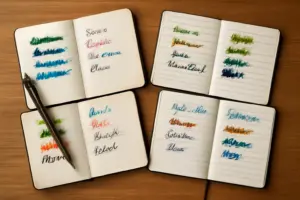
Twelve months of testing gave me a clear read on which ink properties this paper rewards. Aim for low-viscosity inks with middling saturation — dye-based formulas out of Japan, in particular, perform exceptionally well. I cycled through Pilot Iroshizuku’s Tsuki-yo, Take-sumi, and Fuyu-syogun, and every one behaved flawlessly regardless of the nib. Sailor Jentle inks were equally well-mannered, delivering deep color without tipping into oversaturation.
Steer clear of heavily lubricated inks and iron gall formulas here. Iron gall ink relies on a mild acid-etching action meant for absorbent papers — put it on Tomoe River’s hard-sized surface and that acid component turns unpredictable. When I tested Diamine Registrar’s Ink, a well-known iron gall option, with a medium Lamy Z50 steel nib, I noticed odd feathering creeping along the edges of my letters. Nothing disastrous, but it took the crispness right out of the line.
On nib size, medium or finer is the sweet spot on this stock. Extra-fine nibs produce clean hairlines that pop against the cream-toned page. Medium nibs handle restrained inks with no trouble. Broad and stub nibs simply lay down more ink than the paper’s slow absorption can handle. My best pairing all year, hands down, was a Pilot Falcon with a soft fine nib loaded with Iroshizuku Yama-budo — the nib’s springy give produced expressive line variation, and that burgundy-rose ink sheened on nearly every stroke.
The Weak Points the Fan Community Tends to Skip
A review isn’t worth much if it dodges the flaws. The Hobonichi has genuine shortcomings, and I suspect the fervor surrounding it means those problems get glossed over more often than they should. Here’s what actually bothered me over the year.
Start with the price structure, which is unforgiving. The planner body alone costs $54. Add a decent cover and you’re spending another $40 to $150 on top. All told, you’re committing over $100 to a planning system before writing a single word in it. For that same money I could stock up on two years’ worth of Leuchtturm1917 notebooks and still afford a bottle of ink. The Hobonichi setup rewards someone who sticks with it long-term — but it makes casual experimentation an expensive proposition.
Then there’s the daily-page structure itself, which won’t fit every planning temperament. One page, one day, no exceptions. On a quiet Sunday, a sick day, or a holiday, you’re left staring at a mostly empty page. On a packed day, you’re squeezed into that same single page with nowhere else to go. I got around this by turning light days into journaling space and overflow days into running bullet lists, but that kind of improvisation doesn’t come naturally to everyone — and anyone attached to weekly-spread planning will find this format constraining.
The third thing caught me off guard: this famous paper isn’t universally great for every writing tool. Pencil performs poorly on it — the hard surface resists graphite grip, leaving faint, smudge-prone marks. Ballpoints function but feel strangely slick gliding across the surface. At its core, this is fountain-pen paper, full stop, and every other instrument is working around that fact rather than with it.
The Companion Notebook That Ended My Battle With Thin Paper
A full year with the Hobonichi’s featherweight pages taught me the actual problem wasn’t the thinness itself — it was finding a second notebook with comparable heft that could still stand up to my fountain pens without ghosting or bleed-through. LEUCHTTURM1917 turned out to be the answer, and it’s a solution that clicked for someone unwilling to trade away writing quality for anything else.
Where it earns its keep
- Despite being noticeably thicker than the Hobonichi’s stock, the 80-gsm paper performs like a premium sheet, giving you that best-of-both-worlds feel without worrying whether your favorite pen will feather
- Its dotted grid suits daily planning perfectly — enough structure for lists and spreads, but loose enough to let your handwriting move naturally instead of feeling boxed into a rigid system
- The hardcover breaks in rather than breaks down, softening with handling until it takes on a worn-in character that feels like a genuine part of your creative routine rather than just another purchase
Where it falls short
- North of $40, it isn’t a casual buy — you’re paying for the quality, so if you tend to abandon notebooks midway, this one will end up gathering dust as a guilty-feeling splurge
- The ribbon marker and elastic band do their job well but can feel like extra fuss if you’d rather just toss the thing in a bag — this is a notebook that expects a bit of deliberate handling
I nearly returned mine after two months, convinced I was overthinking the whole thing and that my old spiral-bound approach was “good enough.” Then I picked it up one morning and realized I’d actually been using it daily without forcing myself—and my fountain pen hadn’t ghosted once. LEUCHTTURM1917 Hardcover Medium A5 in Forest Green with dotted ruling
Hobonichi Techo: Common Questions
What does “Techo” mean, and what is the “Techo Hon”?
Techo (手帳) is simply the Japanese word for planner or pocket notebook, so “Hobonichi Techo” translates to something close to “Hobonichi Planner”. Hon (本) means book, and Hobonichi uses it for book-format editions within the range.
The lineup shifts a little each year, but the core is the A6 Original, the A5 Cousin, the slim Weeks, and the undated Day-Free, with English editions of several. If you are shopping for a specific edition, check Hobonichi’s current-year lineup directly — names and formats do change between releases.
Is the Hobonichi Techo good for fountain pens?
Unusually good, which is most of why it has the following it does. The Tomoe River stock resists bleed remarkably well for its weight and shows sheen and shading that most planner paper flattens. The trade-offs are heavy ghosting and slow dry times, both covered above.
About This Article

Written by Ellen Ashford. Watch collector, fountain pen enthusiast, and lifelong journaler. Time & Ink is where I explore the craft of analog living — from vintage timepieces and fine stationery to the simple pleasure of putting pen to paper. More about this site.
Verify this against a primary source
Specifics change, and your situation may differ from the one described here. These are the authorities worth checking directly:
- NAWCC — horological reference, archives and research library
- Smithsonian Institution — collection records for historic timepieces and writing instruments