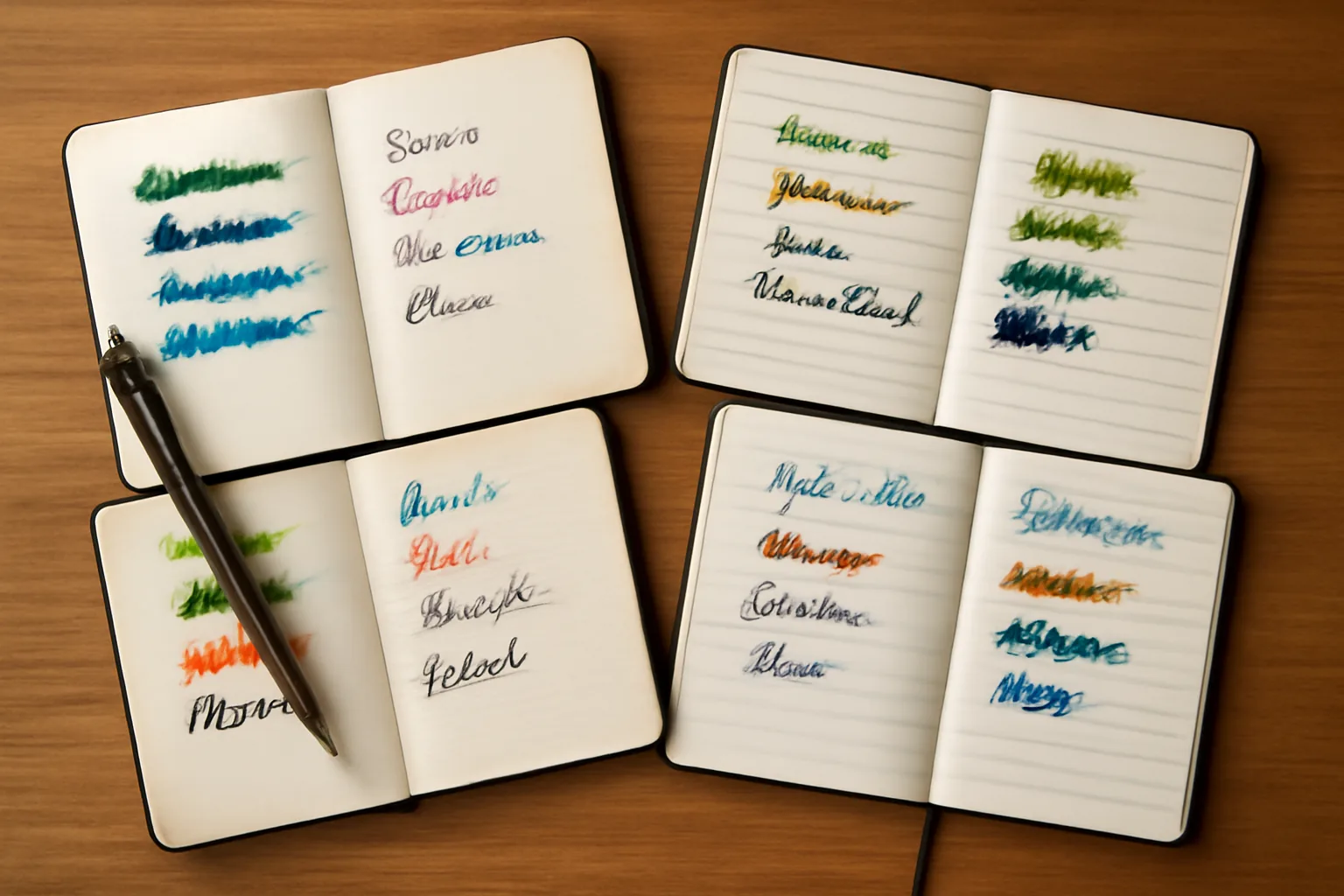
No spec sheet lists “will eat an entire month of journal entries” as a possible outcome, but that’s exactly what happened when I trusted the wrong notebook with my then-favorite wet-noodle flex nib. It was loaded with Diamine Registrar’s — a heavily saturated, slow-drying formula — and page after page soaked straight through to the reverse side. A proper fountain-pen bleed-and-ghost test, run before I ever committed pen to paper, would have spared me thirty ruined pages. If you write with fountain pens and actually care about what happens to your paper, this is the ranking I wish someone had handed me three years back.
Notebooks are not interchangeable, no matter what the packaging implies. Paper weight, sizing agents, cotton content, and surface texture together decide how a sheet handles liquid ink. A 90 gsm sheet with good sizing will beat a 100 gsm sheet with poor sizing every time — that’s simply the chemistry at work, and it’s why some bargain-bin notebooks surprise you while some pricier ones let you down. Over the past four years I’ve run more than thirty notebooks through testing, logging results with at least five different inks per book, from dry writers like Pilot Iroshizuku Ku-jaku to known troublemakers like Noodler’s Baystate Blue.
What follows is the ranking built on that data: which inks I used, which nib sizes, how long each page took to dry, and unvarnished notes on bleed-through and ghosting for every entry. I’ll also name the one notebook I reach for daily now, and explain why that particular format beats out everything else I’ve tried.
Bleed vs. Ghosting: Two Different Problems, Not One
People tend to talk about bleed and ghosting as if they’re the same complaint, but they come from different causes entirely. Bleed-through is what happens when ink completely saturates the paper fibers and soaks clear to the other side — you can look at the back of the page and see actual ink marks. Ghosting (also called show-through) is quieter: the ink stays put on the front, but your writing casts a shadowy impression visible when the page is held to light, and sometimes even under regular reading light with darker inks.
Bleed traces back to sizing. Agents like alum-rosin, gelatin, or AKD (alkyl ketene dimer) form a barrier that slows how fast ink gets absorbed. When sizing is weak or sparse, ink wicks freely through the fiber structure with nothing to stop it. Ghosting works differently — it’s mostly a function of paper weight and opacity. A 70 gsm sheet can have flawless sizing and still ghost, simply because the paper is thin enough to let light pass through.
Put plainly: bleed wrecks whatever’s on the page behind your writing, while ghosting makes the back of that same page hard to use. Anyone journaling or writing letters seriously needs to care about both. My method scored each notebook on a 1–5 scale for bleed and a separate 1–5 scale for ghosting, testing with a wet flex nib (my Pilot Falcon, soft nib), a standard medium nib (LAMY Safari M), and a broad nib (Pelikan M400 B).
The Full Bleed-and-Ghost Rankings
Let me just say it plainly: most notebooks let fountain pen writers down at some point. Of the thirty-plus I put through testing, only eight qualified as what I’d call a “daily driver.” Below are the ones worth naming — the good ones and the ones to steer clear of.
Tier 1 — Excellent: Barely Any Bleed, Barely Any Ghosting
- Tomoe River Paper (Hobonichi, Taroko Studio): Only 52 gsm, but built from the ground up for wet ink. Bleed is essentially nonexistent regardless of nib. Ghosting shows up, but faintly. The catch is dry time — 20 to 40 seconds per page.
- Clairefontaine / Rhodia (90 gsm): Still the standard everyone measures against. Bleed score: 5/5. Ghosting score: 4/5. Consistently smooth, easy to find, and priced around $12–$18 a notebook.
- LEUCHTTURM1917 (80 gsm): This is the one I actually reach for day after day. More detail on it below — it earns the spot through daily use, not just controlled testing conditions.
Tier 2 — Good: Trouble Shows Up With Wet Nibs or Heavy Inks
- Moleskine (70 gsm): Bleed score: 3/5 once broad nibs enter the picture. Ghosting is noticeable on both sides of the sheet. The surface feels smooth to the touch, but it’s actually fairly absorbent underneath. At $20-plus, I don’t think it earns the price tag.
- Midori MD (MD-paper, ~72 gsm): Ghosting resistance is genuinely excellent, though bleed appears with wet flex nibs and iron gall inks. Drier writers will love it. Drying happens fast, under 10 seconds for most inks.
- Maruman Mnemosyne (70 gsm): A real surprise given the $8–$10 price point. Medium nibs behave beautifully on this paper. Push it with a broad nib, though, and you’ll start seeing mild ghosting.
Tier 3 — Skip These: Bleed and Heavy Ghosting, Reliably
- Generic composition books and most “sketch” pads: Bleed shows up almost without exception, even paired with a fine nib and drier ink. These sheets were made with pencil and ballpoint in mind, full stop.
- Paperblanks notebooks: The covers are gorgeous; the paper inside is not. Listed at 85 gsm, but the sizing is all over the map. I tested three separate editions and got three separate results — that unpredictability alone rules them out for me.
- Field Notes (original): 60 gsm, built for pencil and ballpoint use. Bleed score: 1/5 against any wet nib. I still love these for pencil work. They simply aren’t fountain pen notebooks.
Why GSM Alone Won’t Tell You Anything
Here’s a lesson that cost me two wasted months: I went around chasing high-gsm notebooks on the assumption that weight by itself equaled fountain-pen compatibility. That assumption was wrong. Paper weight — grams per square meter — measures density, not resistance to ink. A 100 gsm uncoated wood-pulp sheet can bleed worse than 52 gsm Tomoe River, because sizing, not weight, is what actually governs how ink behaves on the page.
Sizing is what determines how much a paper surface pushes back against liquid. Both internal sizing (mixed in during pulp processing) and surface sizing (applied as a coating after the sheet forms) play a role. Tomoe River relies on a proprietary surface sizing that functions almost like an ink-proof shield. Rhodia’s 90 gsm leans on heavy internal sizing paired with a lightly calendered finish. Either way, the resistance is built into the structure of the paper, not bolted onto the surface as an afterthought.
The ink itself matters too. Dye-based formulas — most standard bottled inks — soak in faster than pigmented ones. Iron gall inks, being thin and acidic, cut through paper more aggressively than neutral-pH inks do. Noodler’s Baystate Blue has a reputation for a reason: its pH and dye concentration overwhelm even decent sizing. I’ve made it my go-to first test for any unfamiliar notebook — if a sheet survives Baystate Blue, it’ll survive almost anything else in my ink drawer.
The Notebook That Finally Held Up to My Toughest Ink
Once thirty pages of a journal had bled through, I went looking for a notebook that could handle fountain pens without asking me to compromise. The LEUCHTTURM1917 Hardcover Medium A5, squared pages, became my benchmark for what “fountain-pen friendly” is actually supposed to mean.
Where it delivers
- At 80 gsm, the sheet is thick enough to soak up even a saturated, slow-drying ink like Diamine Registrar’s without letting it through to the back.
- Ghosting stays light — a faint trace of text shows through on the reverse, but never enough to make the opposite page unusable or annoying to look at.
- The grid lines are printed faint enough to disappear into the background, which means the same notebook works for journaling, sketching, or whatever experimental writing I’m in the mood for, without ever feeling locked into one use.
Where it falls short
- The surface runs a touch smoother than some competitors, which means flex nibs and broader nibs will sometimes skip or feel a little unresponsive if the ink you’re using is on the drier side.
- Running $15–18 a notebook, it’s not cheap, and if you’re the type who burns through pages testing multiple inks, that cost accumulates faster than you’d expect.
I almost didn’t spend the money on a “premium” notebook after my bleed disaster—I was tempted to grab whatever was cheapest to rebuild my confidence. But LEUCHTTURM1917 – Notebook Hardcover Medium A5-251 Numbered proved that the right paper is worth the investment.
About This Article

Written by Ellen Ashford. Watch collector, fountain pen enthusiast, and lifelong journaler. Time & Ink is where I explore the craft of analog living — from vintage timepieces and fine stationery to the simple pleasure of putting pen to paper. More about this site.
Verify this against a primary source
Specifics change, and your situation may differ from the one described here. These are the authorities worth checking directly:
- NAWCC — horological reference, archives and research library
- Smithsonian Institution — collection records for historic timepieces and writing instruments