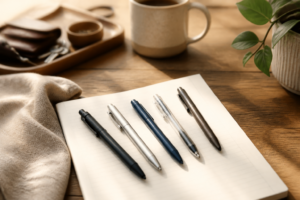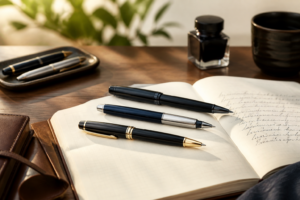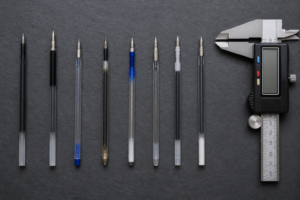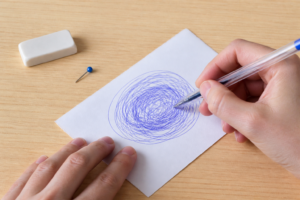
Right here on my desk sits a battered Staedtler Mars Lumograph next to a Zebra F-301, and between the two of them I’ve settled an argument that used to send me back and forth in the stationery aisle like an indecisive fool. Ten-plus years into hoarding analog writing tools — watches, fountain pens, ballpoints, mechanical pencils, all of it — people still ask me to pick a side, as though one tool could possibly win every time. It can’t. What wins depends on what you’re recording, the surface underneath it, and how long that information actually needs to survive.
Is it better to take notes in pen or pencil?
For most note-taking, pen — because the point of notes is being able to read them later, and graphite smudges and lifts with handling. Switch to pencil when the page involves working rather than recording: maths, diagrams, drafts, marginalia in a book you care about, or anything you expect to erase. The deciding question is not which writes better. It is whether this page needs to survive being flipped through for the next five years.
Pen or Pencil: The Decision, by Situation
Scroll the table sideways to see every column →
| Situation | Pick | Why |
|---|---|---|
| Lectures and meetings | Pen | Speed and permanence. You will flip back through these pages, and smudged graphite gets harder to read every time you do. |
| Maths, physics, anything with working | Pencil | You will be wrong repeatedly and need to erase without turning the page into a mess. This is the clearest pencil case there is. |
| Drafting and outlining | Pencil | Erasing is part of the process. Ink turns a draft into a crossed-out record of a draft. |
| Anything signed, dated or official | Pen | Pencil is alterable, and for records that matter this is the whole argument. |
| Marginalia in a book | Pencil | Reversible, and it will not bleed through onto the next page of thin book stock. |
| Field notes, cold or damp conditions | Pencil | Graphite writes on wet paper and in freezing temperatures. Most ink does neither. |
| Long-term journalling | Pen | Ten-year-old pencil pages rub against each other and go grey. I have the notebooks to prove it. |
Somewhere along the way, people decided pencils belong to schoolchildren and pens belong to adults with real jobs. I’d push back hard on that. Some of the sharpest technical drafters I’ve met touch nothing but graphite. And I’ve flipped through bullet journals so carefully kept that erasability was clearly the whole point — take that away and the system collapses. Prestige has nothing to do with it. Function does. And in daily note-taking, function is the only metric that matters.
I’ve run both tools against each other across multiple paper stocks, under different light, through different note-taking routines. What follows isn’t theory pulled from a spec sheet — it’s what actually held up, and when.
Why Choosing Between Pen and Pencil Isn’t a Trivial Question
The tool in your hand shapes more than the marks on the page — it shapes how you revise, how long the record survives, and honestly, how sure of yourself you feel while writing. I found this out the expensive way when I filled a whole Leuchtturm1917 with a soft 2B pencil during one overzealous stretch. Six months on, half those pages had smeared into illegibility. The graphite had shifted and bled into itself. Whatever I wrote in those autumn meetings is, functionally, gone.
The pencil itself cost me nothing — a few dollars, maybe — but the notes were priceless in the way lost information always is. Since that mess, I choose deliberately: permanence needs, the surface I’m writing on, how often I expect to revise, and the conditions I’m writing in. Get a handle on those four variables and the pen-or-pencil question mostly answers itself.
The Situations Where Graphite Simply Outperforms Ink
There are clear, narrow conditions where a pencil is the obviously correct tool. Top of the list: anything you’ll need to erase. Floor plans, rough schedules, sketched diagrams — graphite bends to revision in a way ink flatly refuses. My go-to is a Staedtler Mars Lumograph HB, roughly $8 for a dozen, whenever spatial layout or visual mapping is involved. That HB hardness lays down a clean line without chewing through 80gsm paper.
Next: cold and damp conditions favor graphite outright. Ballpoint ink starts skipping below 40°F. Graphite couldn’t care less about temperature. Anyone writing outdoors — hikers, field researchers, whoever — will find a decent pencil holds up where a pen might quit. My Pentel GraphGear 1000, around $14, runs clean 0.5mm leads and gives you fine-point precision without any weather-related drama.
Third point: light-handed writers do better with pencil. After years of heavy pen use, I started noticing hand fatigue from rigid ballpoints — some people feel this more acutely than others. Graphite needs barely any downward pressure to leave a mark. The tradeoff is smudging, which climbs as leads get softer (2B and beyond); go with an H or 2H if that bothers you, though you’ll trade smoothness for a lighter, scratchier feel.
Where Graphite Falls Short
Pencil marks aren’t built to last. Friction over time smudges, migrates, and dulls graphite until it’s barely there. Speed suffers too — sharpening a point or clicking out more lead eats seconds you don’t always have mid-meeting, and in a fast-moving conversation, that second counts. Coated or glossy paper is another dead end; graphite just won’t grip it. Anything you plan on keeping past the six-month mark, I’d write in something other than graphite.
Where Ink Takes Over: Lasting Power, Pace, and a Certain Professional Edge
On permanence, there’s no real contest — pens win outright. Ballpoint ink is oil-based, so it shrugs off water, smudging, and the passage of years better than almost anything else. Notes I wrote in ballpoint back in 2014 are still perfectly readable today; I can’t say the same for a single pencil note from that period. If you keep a journal, run a planner, or take meeting notes you’ll need months later, ink is the more trustworthy record-keeper.
Pens are quicker in practice, too. There’s no pressure to dial in — tip meets paper, ink flows, done. Ballpoints in particular ask almost nothing of your technique. Across an entire workday, that adds up to real time saved. And there’s a psychological side to it: knowing you can’t erase tends to make you think a beat longer before you commit words to the page. Some people treat that as a limitation. I’ve come to see it as useful discipline.
Not all pens behave the same way, though. Fountain pens — my own weakness — deliver line variation and a tactile pleasure that ballpoints can’t touch, but they demand upkeep and heavier paper, ideally 90gsm or more, to avoid feathering. Gel pens dry quickly and glide well but can stutter across textured surfaces. Ballpoints remain the reliable middle ground: consistent, low-fuss, and forgiving of nearly any paper you hand them.
Where Ink Falls Short
Ink doesn’t negotiate. Get the meeting time wrong, misjudge a dimension, write the wrong word — you’re crossing it out, not erasing it. Any task built around revision — drafts, brainstorm maps, that sort of thing — turns a pen into an obstacle course of workarounds. Fountain pens make this worse: I once wrecked a Pilot Iroshizuku nib trying to write on flimsy 60gsm paper, and the feathering left the page barely legible. What I took from it: match the nib to the paper, and match the ink tool to how much revising the job actually requires.
The One Ballpoint That Cured My Urge to Retreat to Pencil
If pen is your stated choice for daily notes but the finality of ink keeps pulling you back toward a pencil, the Zebra F-301 is the fix. Its 0.7mm fine point gives you nearly the control you’d expect from a mechanical pencil, paired with the speed and permanence of a ballpoint — minus the smudge paranoia that comes standard with fountain pens.
What actually works
- That fine tip is sharp enough for cramped margins and small annotations — nothing crayon-like about it next to your usual mechanical pencil
- On ordinary paper the ink sets almost instantly, so dragging your hand across a fresh line — a real concern if you write left-handed — won’t smear a thing, and you can write at your normal speed
- Given how little a 12-pack costs, “wasting” a page or scratching something out stops feeling like a loss, which frees you to write as loosely as you would with pencil
What doesn’t
- The barrel is plain molded plastic — no ritual, no satisfying heft, nothing for anyone who collects fountain pens or wooden pencils for the feel of the thing
- Ink is final the moment it lands — there’s no eraser to lean on, which can grate if you’re a perfectionist used to pencil bailing you out
I almost gave up on pen entirely after watching a week’s worth of notes bleed through cheap paper and smudge across my palm. The Zebra F-301 changed that—it’s what convinced me that pen could work for daily notes without compromise. Pick up a Zebra Pen F-301 Ballpoint in 0.7mm Fine Point, available in a 12-pack.
Pen or Pencil: Common Questions
Is it better to take notes in pen or pencil?
Pen, for most note-taking, because notes exist to be read later and graphite smudges and lifts with handling. Pencil is the better choice when the page is working rather than recording — maths, diagrams, drafts, marginalia, or anything you expect to erase.
Why do some people insist on pencil for notes?
Two good reasons and one weak one. The good ones: erasing without mess, and graphite writing on damp paper and in the cold where ink fails. The weak one is permanence anxiety — the sense that ink commits you. In practice, committing is usually the point of a note.
Does pencil writing fade over time?
Graphite itself is remarkably stable — more so than many inks, which is why archivists use pencil. The problem is mechanical, not chemical: pages rubbing against each other in a closed notebook smear the graphite until everything reads slightly grey. Ink does not have that failure mode.
What about taking notes in pen and correcting in pencil?
It works, and it is close to what I actually do. Ink for the record of what was said, pencil in the margin for the thinking I did afterwards. The two layers stay visually distinct a year later, which is more useful than it sounds.
About This Article

Written by Ellen Ashford. Watch collector, fountain pen enthusiast, and lifelong journaler. Time & Ink is where I explore the craft of analog living — from vintage timepieces and fine stationery to the simple pleasure of putting pen to paper. More about this site.
Verify this against a primary source
Specifics change, and your situation may differ from the one described here. These are the authorities worth checking directly:
- NAWCC — horological reference, archives and research library
- Smithsonian Institution — collection records for historic timepieces and writing instruments