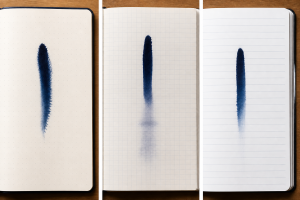
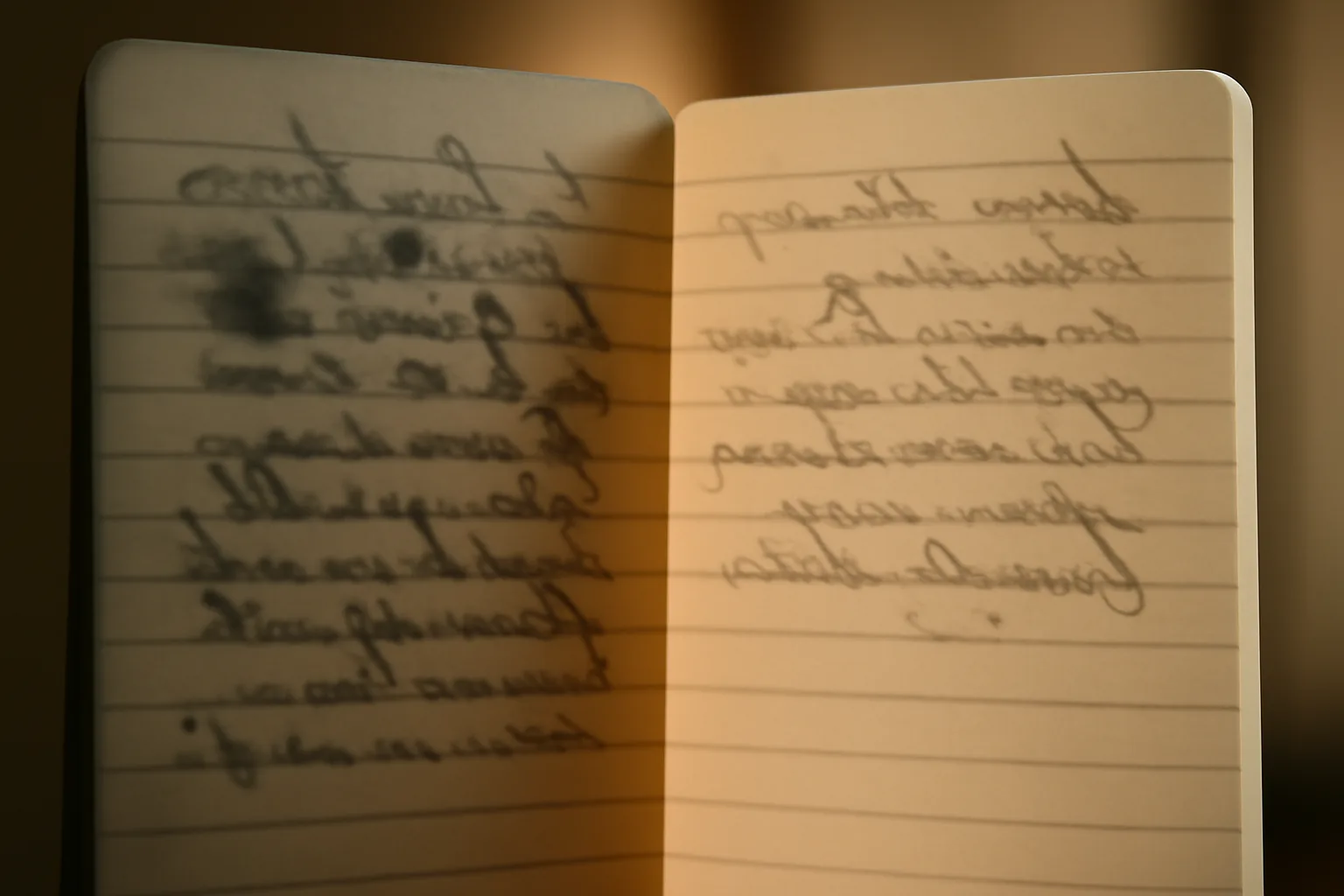
Nearly every beginner picking up a fountain pen assumes that if a notebook feels sturdy and looks nice, it’ll handle ink just fine — thickness equals quality, or so the logic goes. That assumption cost me $34 and three weeks of ruined journal entries. I’d loaded my TWSBI ECO with Pilot Iroshizuku ink and started writing in what seemed, by any reasonable judgment, like a solid notebook. Two pages in, the bleed-through was bad enough that I could read my own handwriting straight through from the back of the sheet. That one ruined notebook is what dropped me into paper testing — specifically what I now think of as the fountain pen paper bleed through test — and five years on, I still haven’t climbed back out. Honestly, I’ve stopped trying to.
Fountain Pen Paper Specs Compared
The single most useful thing I can tell you here: GSM does not predict fountain pen performance. Sizing does — the internal treatment that stops ink sinking into the fibres. That is why 52 gsm Tomoe River resists bleed better than 70 gsm Moleskine, which fails on both counts. The table is ordered by how well each paper handles a genuinely wet nib.
Scroll the table sideways to see every column →
| Paper | GSM | Bleed (wet nib) | Ghosting | Texture | Dry time | Best for |
|---|---|---|---|---|---|---|
| Clairefontaine Triomphe | 90 | Very rare | Very light | Ultra smooth | Slow | Letters, correspondence |
| Rhodia (Clairefontaine stock) | 80 | Very rare | Light | Smooth, satin finish | Slow | Everyday fountain pen writing |
| Midori MD | 80 | Rare | Light to moderate | Lightly textured, matte | Moderate | Journalling with some feedback |
| Tomoe River | 52 (also 68) | Rare, despite the weight | Heavy — you will see the reverse | Smooth, slightly slick | Very slow | Sheen and shading, thin planners |
| Leuchtturm1917 | 80 | Occasional with broad or wet nibs | Moderate | Slightly toothy | Moderate | Bullet journalling, mixed media |
| Moleskine (classic) | ~70 | Common | Heavy | Toothy, absorbent | Fast | Pencil and ballpoint |
| Field Notes (standard) | ~60 | Common | Heavy | Toothy | Fast | Pencil, pocket use |
Two caveats worth stating plainly. Manufacturers revise their stock without announcing it, so a notebook bought three years ago may not behave like the same notebook bought today — the Leuchtturm row in particular is where I see the most variation between production runs. And every rating above assumes a wet medium nib; a dry extra-fine will make almost any paper on this list look excellent.
If you want one answer
Rhodia at 80 gsm is the safest paper on this list for fountain pens, and it is not close. Tomoe River is the specialist pick when you want to see what an ink actually does — sheen, shading, the lot — and you can live with reading your own writing through the page.
Forty-some notebooks and five years of testing later, here’s the thing that’s become obvious: bleed-through isn’t a coin flip. It follows rules. Once you know what actually triggers it, you can size up a bad paper before you’ve committed a single page to it. What follows is the exact method I use, pen by pen and page by page.
Fountain Pen Ink vs. Ballpoint: Why Paper Reacts Differently
The default theory goes like this: heavier paper means safer paper, end of story. There’s some truth in that, but not the whole truth. Fountain pen ink is water-based and moves loosely across the page — it works its way into paper fibers in a way oil-based ballpoint ink simply never does. Which is exactly why a sheet rated perfectly fine for a ballpoint can fall apart the second a fountain pen touches it.
Weight gets measured in grams per square meter, shorthand gsm or g/m². Standard copier paper sits around 75 to 80 gsm, while decent fountain pen notebooks typically run 80 to 100 gsm. But gsm only tells half the story. Sizing — a chemical treatment applied during manufacturing — matters just as much. It seals the fibers and slows down how quickly ink gets absorbed. Skip that treatment, and even a hefty 100 gsm sheet will bleed through without much resistance.
Sizing comes in two forms — internal, worked into the pulp itself, and surface, applied after the sheet has already formed. From everything I’ve tested, paper with strong surface sizing consistently wins out against wet fountain pen ink. Tomoe River remains the benchmark nobody’s really topped. At just 52 gsm, it should be a liability, not an asset — yet its surface sizing is good enough that it shrugs off even the most saturated inks without flinching.
Setting Up Your Own Bleed Through Test at the Kitchen Table
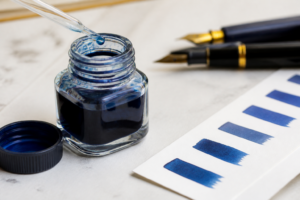
No lab required — just three pens, two inks, and about twenty minutes. Here’s the exact routine I run every time a new notebook lands on my desk.
Step 1 — Line Up Your Pens and Inks
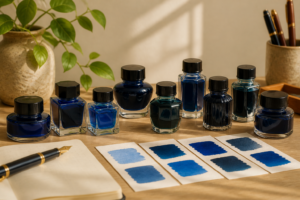
Vary both nib width and ink behavior. My usual lineup: a fine nib carrying a well-mannered ink like Pilot Iroshizuku Kon-peki, a medium nib loaded with an ordinary Waterman formula, and a broad or stub nib filled with something heavily saturated or shimmer-based. Shimmer inks are merciless on weak paper — if a sheet can take a broad nib full of shimmer ink and hold up, it’s earned a pass.
Step 2 — Put Down a Repeatable Writing Pattern
Skip the random scribbling. Repeat identical content every time so the results actually compare to one another. My pattern: three lines of cursive, a row of block capitals, several solid-filled circles, and a diagonal cross-hatch. Solid ink coverage exposes bleed-through far faster than ordinary handwriting, and it also reveals feathering — ink creeping along the fibers instead of staying crisp.
Step 3 — Inspect the Back Once the Ink Has Fully Cured
Give it at least ten minutes before flipping the sheet — wet ink always looks worse from behind than dry ink does. Hold the page up to a window or lamp; backlighting is what separates real bleed-through (ink visible as solid marks through the page) from mere ghosting (a faint shadow of the writing). Ghosting is perfectly acceptable in most notebooks. Bleed-through isn’t — it means the recto and verso can’t both be used comfortably, which effectively cuts your usable page count in half.
Telling Bleed, Feathering, and Show-Through Apart
Even experienced pen people mix these three terms up constantly. They’re not interchangeable — each one traces back to a different failure in the paper.
Bleed-through is when ink has soaked completely through the sheet — run a finger over the back and you’ll feel it. That’s a paper failure, plain and simple. Feathering happens when ink spreads sideways along the grain, leaving fuzzy, ragged edges where clean letterforms should be. That’s a surface sizing failure. Show-through (people also call it ghosting) means you can make out faint outlines of the writing from the back when held to light, but the page itself stays dry and clean. That’s normal for most decent fountain pen papers and generally nothing to worry about.
If I’m honest, feathering bothers me more than a little show-through ever does. Feathered handwriting looks messy even when the ink technically never broke through the page. The worst offenders tend to be ordinary composition notebooks and cheap traveler’s notebook inserts selling for under $5. Case in point: I ran a popular budget insert brand through the test last fall — won’t name it, though you’d likely recognize it — and a medium nib Lamy Safari had already turned into a feathered mess by the fourth letter.
How I Grade Each Paper
- Grade A: Zero bleed-through, zero feathering, show-through minimal at worst. Fine for any ink and any nib size.
- Grade B: No bleed-through, feathering kept minor, some show-through visible. Works for fine and medium nibs with standard inks.
- Grade C: No bleed-through, but feathering or ghosting becomes noticeable. Fine nibs only — steer clear of wet or heavily saturated inks.
- Grade D: Bleed-through shows up. Don’t bother with fountain pens on this paper at all.
Most of the decent notebooks I test settle into Grade A or Grade B territory. Anything scoring Grade C or below gets returned or demoted to pencil-only use.
The Notebook That Cleared Every Round of Testing
Once that first notebook was ruined, I went hunting for paper that could take saturated ink without turning transparent. The LEUCHTTURM1917 Hardcover Medium A5 in Black Squared ended up as my benchmark — the notebook every other candidate gets measured against whenever I run the bleed-through test.
What Holds Up
- Even soaked with wet fountain pen inks — juicy colors like Iroshizuku included — the back of the page stays free of both ghosting and bleed-through.
- The squared grid stays fine and unobtrusive while you write, so it doesn’t compete for attention when you’re really just trying to judge how the ink performs.
- Thanks to the hardcover binding, the notebook takes repeated flipping, testing, and writing without the pages starting to come loose.
Where It Falls Short
- At $34 retail, dedicating it purely to test duty feels a little indulgent — though that expense is partly why I’ve stuck with this same notebook long enough to trust what it tells me.
- Because it’s A5, you’re not necessarily testing the same paper stock your larger notebooks might use — so think of this as a controlled comparison, not a perfect stand-in.
I almost returned mine after the first few pages because I was waiting for the bleed-through that never came—part of me didn’t trust that a notebook this expensive could actually solve the problem I’d just wasted money discovering. But three months of daily testing across fifty different ink samples proved me wrong. If you’re serious about understanding how your fountain pens interact with paper, grab the LEUCHTTURM1917 – Notebook Hardcover Medium A5-251 Numbered and start your own rabbit hole.
Fountain Pen Paper: Common Questions
What causes paper bleed-through?
Insufficient internal sizing, not thin paper. Sizing is the treatment that stops ink sinking into the fibres, and paper without enough of it will bleed at any weight. That is why 52 gsm Tomoe River resists bleed better than 70 gsm Moleskine.
Is higher GSM always better for fountain pens?
No. GSM measures weight, not ink resistance. It is a rough proxy at best, and it fails badly at both ends of the range. Judge paper by how it was sized and finished, which in practice means judging it by brand and by testing.
What is the difference between bleed, feathering and ghosting?
Bleed is ink passing through to the other side. Feathering is ink spreading sideways along the fibres, turning a crisp line furry. Ghosting is a faint shadow of writing visible from the back without the ink having gone through. Different failures, different causes.
About This Article

Written by Ellen Ashford. Watch collector, fountain pen enthusiast, and lifelong journaler. Time & Ink is where I explore the craft of analog living — from vintage timepieces and fine stationery to the simple pleasure of putting pen to paper. More about this site.
Verify this against a primary source
Specifics change, and your situation may differ from the one described here. These are the authorities worth checking directly:
- NAWCC — horological reference, archives and research library
- Smithsonian Institution — collection records for historic timepieces and writing instruments