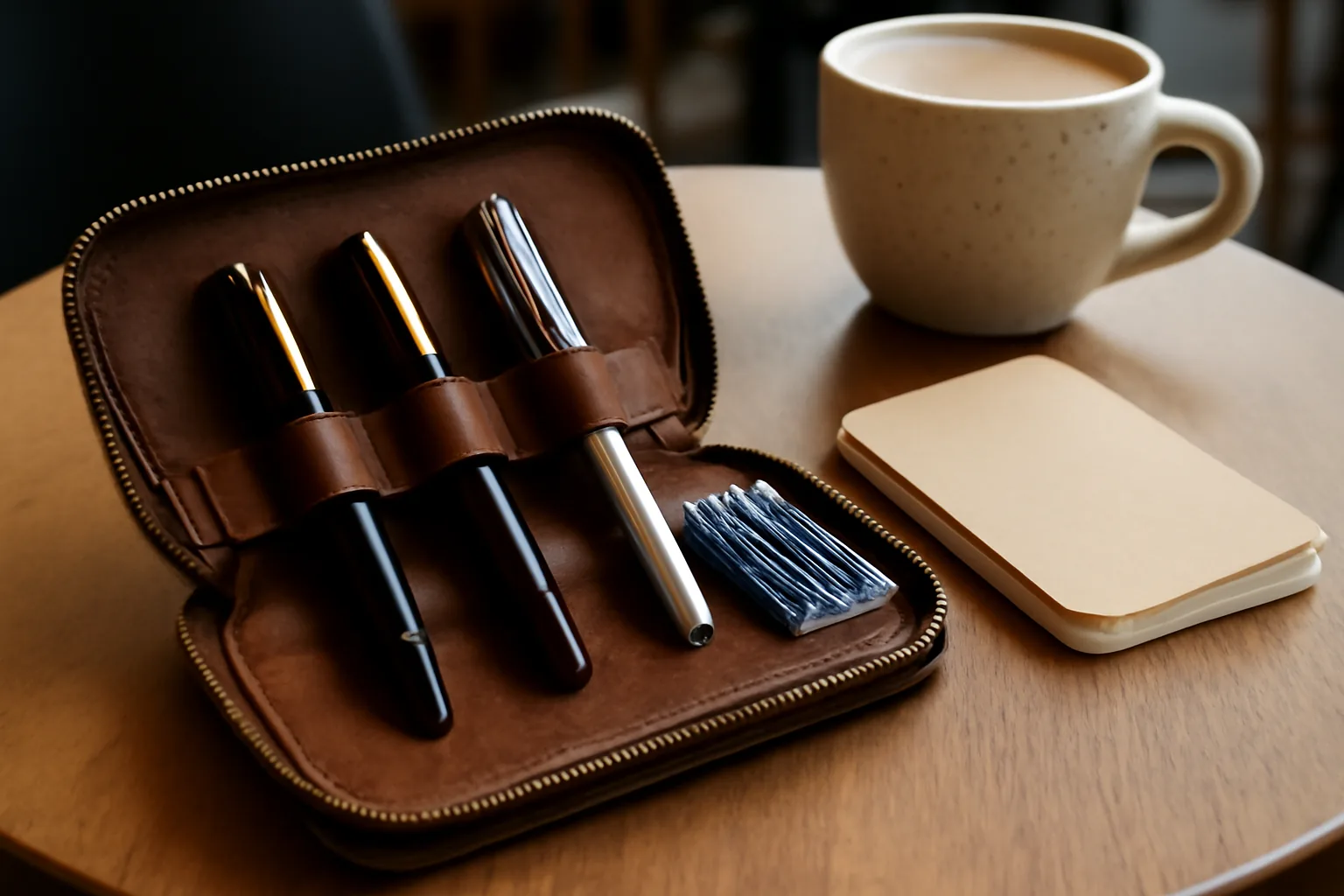
The nib sits bent sideways in my palm right now — tines splayed apart where a notebook spiral caught them and yanked hard, a $120 lesson in what happens when a Pilot Custom 74 rides loose in a jacket pocket like spare change. That’s roughly how careless my carry used to be: pens tangled in clips, caps popping off inside my bag, until this exact injury finally stopped me cold. Since then, I’ve built out my everyday carry pen case with something bordering on obsession — and it’s genuinely rewired how I write, think, and move through a day.
The mistake nearly everyone makes here: treating a pen case as mere storage. It isn’t that. A well-chosen case functions more like a filter — it forces you to narrow your carry down to the tools you actually reach for. Getting to that point took me roughly two years of trial and error, cycling through eight different cases — zippered pouches, magnetic-flap designs, roll-ups, hard shells — before I settled on the one that earns its spot in my bag every single day.
So if fountain pens, rollerballs, or pencils travel with you daily, keep reading. Below is the exact lineup currently living in my case, the reasoning behind each pen’s spot, and the logic that led me to the specific leather holder tying it all together.
How Building an Everyday Carry Pen Case Reshaped the Way I Write
Before this case existed, my pens got treated carelessly by default, not by intention — that’s simply what happens to a pen with no fixed home. Once a proper leather triple case entered the rotation, something changed. Picking which three pens to load each morning turned into a small daily ritual. Sounds like nothing. It isn’t.
What I’ve found: fewer tools, chosen deliberately, get used more deliberately. Protected and within reach, my pens get used more — I’ve caught myself pulling out a proper pen mid-meeting rather than grabbing whatever stray ballpoint is lying on the conference table. Over the past 18 months, that single shift has visibly sharpened my handwriting.
Then there’s the durability case, which isn’t abstract to me. Fountain pen nibs are precision instruments — the tines on a fine or extra-fine nib run roughly 0.3 to 0.5mm apart, a gap that a single hard knock against a metal object can spring out of alignment for good. A decent case cushions that impact, keeps pens from knocking against each other, and holds caps shut. That protection alone justifies the cost.
Three Pens, No More, No Less: What’s Actually in Rotation
I’ve cycled through carrying anywhere from a single pen to seven at once. Seven was ridiculous — I gave it a full month before admitting defeat. One pen, on the other hand, feels restrictive the moment you want a different ink or nib width mid-session. Three lands right in the middle: enough range to cover core writing needs, without adding real bulk or weight to the bag.
Slot One: The Workhorse
Currently parked here is a Pilot Custom 742, loaded with Iroshizuku Tsuki-yo, a muted teal that shows up crisp against cream paper. It carries a size 15 nib — Pilot’s label for their medium-large gold nib — which runs about $160 new. Mine came secondhand for $95 and hasn’t missed a beat in three years. This single pen handles roughly 90 percent of my journaling and note-taking.
Slot Two: Fine Nib, Precise Work
Slot two holds a Pilot Prera fitted with a fine nib — a demonstrator body, so I can eyeball the ink level without guessing. Right now it’s running Diamine Oxblood. At roughly $28 to $35 retail, it’s among the best value-for-money fountain pens I own. The snap cap seals tight enough that ink migration during the commute simply isn’t a worry.
Slot Three: Rotating Pencil or Ballpoint
This last slot changes depending on the week. Sometimes it’s a Uni Kuru Toga mechanical pencil, 0.5mm lead, HB grade, for sketching or scribbling in margins. Other times a Uni-ball Jetstream 0.7mm ballpoint takes over, useful anywhere fountain pen ink would let me down — signing receipts, filling out forms on glossy stock. Fountain pen ink and coated paper rarely get along, and the ballpoint sidesteps that entirely.
The Qualities I Now Demand From a Leather Pen Case
Across six years I’ve gone through eight different cases. Fabric pouches stretch out and lose their shape. Hard shells tack on weight I don’t need. Magnetic closures feel convenient right up until they fail — one popped open inside my bag and dumped all three pens loose at the bottom. That history is why I now hold any case I’m considering to four specific standards.
- Real leather, not a substitute — it shapes itself around your pens with use and only looks better with age
- Individual elastic or leather loops — no pen should ever make contact with another inside the case
- A closure that actually holds — snap, zipper, or tie, whichever, as long as it survives getting crushed inside a bag
- A slim closed profile — under 1 inch thick, so it lies flat inside a jacket pocket or a notebook’s cover sleeve
I learned that separation rule the hard way. My second pen case ever was a cheap two-slot pouch with both pens sharing one open compartment. On a train commute, the pens slid against each other and the nib of my Lamy 2000 carved a groove straight into the barrel of my Parker 51. Neither pen suffered functionally, but the Parker held sentimental weight, and that scratch still catches my eye every time I look at it.
The Case That Actually Kept My Pens Out of Harm’s Way
Once that Custom 74 got bent, it was obvious I needed something that would guard my pens in transit, not just corral them in a drawer between uses. Storage was never the actual problem — the problem was keeping the pens I use constantly safe while they’re riding around in my bag all day.
Where it delivers
- Each of the three slots is its own protected pocket, so there’s no tangling, no pressure on nibs, no surprise run-ins with notebook spirals.
- The leather breaks in gradually and genuinely molds around the pens over time, turning the case into something you use with intention rather than just function.
- It’s compact enough to disappear into a jacket pocket or small bag, yet structured enough that caps stay locked in place and nothing shifts during a commute.
Where it falls short
- Three slots force a deliberate rotation — there’s no room to toss in six pens on the off chance you’ll want one later.
- Leather needs occasional conditioning, particularly if it’s riding in your bag daily through changing seasons and weather.
I’ll admit: the first week I second-guessed whether limiting myself to three pens would feel restrictive. It didn’t. It made my writing practice more deliberate. If you’re ready to actually protect the tools that matter to your work, check out the DiLoro Leather Triple Pen Case Pencil Pouch Holder for Three Fountain Ballpoint Rollerball Pens and Pencils (Black).
About This Article

Written by Ellen Ashford. Watch collector, fountain pen enthusiast, and lifelong journaler. Time & Ink is where I explore the craft of analog living — from vintage timepieces and fine stationery to the simple pleasure of putting pen to paper. More about this site.
Verify this against a primary source
Specifics change, and your situation may differ from the one described here. These are the authorities worth checking directly:
- NAWCC — horological reference, archives and research library
- Smithsonian Institution — collection records for historic timepieces and writing instruments