
7S26 — that’s the caliber stamped into a Seiko 5 I picked up at an estate sale for $40, and hunting down that reference number is actually what got a notebook into my pocket in the first place. I needed somewhere to scribble the serial, the caseback markings, whatever the seller could remember about its history. A battered little Field Notes booklet handled that job, and somehow it stuck around for the better part of ten years. Except “stuck around” isn’t quite honest — what actually happened over that decade is that I kept swapping notebooks, not because any of them wore out, but because I did. I’d quit halfway through one because the pages felt cramped, or the binding went floppy, or I’d convinced myself some other brand would finally be the one that held my attention. Eventually the real question surfaced: was that first Field Notes actually the right tool, or just the one that happened to be within reach? Chasing that question down led me straight into the long-running, ink-smudged argument between Field Notes and the Moleskine Cahier. I’ve now carried both through complete years of everyday use — coat pockets, watch boxes, pen cases, workshop benches — and I’ve landed on some firm opinions about which one earns its keep.
There’s a persistent assumption I run into all the time: that these two notebooks are basically the same object wearing different labels. Sure, both are pocket-sized, both soft-cover, both cheap enough to buy without thinking twice, and both have a devoted following among analog diehards. But underneath that surface similarity, they’re built from two different mindsets entirely. One is an American workhorse meant to be filled fast and tossed. The other borrows from the European journal tradition and carries a touch more polish. Grabbing the wrong one for how you actually work is a real headache — trust me, I’ve done it more than once.
What follows is a full breakdown of how these two differ across a year of genuine use, which specs are worth caring about and which aren’t, and, plainly, which one deserves the permanent spot in your pocket.
Field Notes vs Moleskine Cahier: Comparing the Base Specs
Before feel and durability enter the conversation, the raw numbers deserve a look. A standard Field Notes notebook comes in at 3.5 × 5.5 inches with 48 pages of 60 lb. text stock — 24 sheets per booklet, in other words. Construction is saddle-stitched with staples, and the cover is a lightweight cardstock around 100 lb. A three-pack usually runs $12 to $14 depending on where you buy it, which puts each individual notebook at roughly $4 to $5.
The Moleskine Cahier shares the exact same 3.5 × 5.5 inch footprint. Where it differs is page count and paper: 64 pages of Moleskine’s ivory-toned stock, sitting around 70 gsm, or about 47 lb. in text weight. It’s also staple-bound, though the cover uses a slightly heavier cardboard than the Field Notes. A three-pack typically lands between $14 and $16 — around $5 per notebook. Barely any gap in price. A considerable gap in what it’s like to actually use one over the other.
Paper: The Spot Where These Two Actually Split
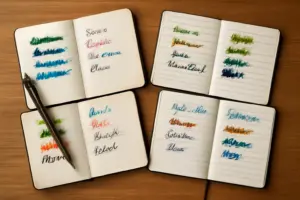
Paper is where the two notebooks stop pretending to be siblings. The 60 lb. sheets in a Field Notes handle pencil and ballpoint just fine — smooth enough, no complaints there. Fountain pens are another story entirely, and since my daily rotation runs from a Pilot Metropolitan fine nib up to a vintage Pelikan 400 medium, bleed-through isn’t a minor annoyance for me — it’s a dealbreaker. I ran Noodler’s Black, Diamine Oxblood, and Pilot Iroshizuku Tsuki-yo across both notebooks side by side. Every one of them soaked straight through the back of a Field Notes page within seconds of touching the paper.
The Cahier’s 70 gsm paper does a bit better, but “a bit” is the operative phrase — feathering is still a genuine issue once the ink gets wetter. Noodler’s Black in particular, run through my TWSBI Eco medium nib, feathered visibly on the Cahier before I’d even finished my first week of testing it. Where the Cahier does pull ahead is with drier pens and finer nibs. Ballpoint and pencil, meanwhile, don’t discriminate — a Pilot G2 and a Staedtler pencil both performed cleanly on either paper.
How Each Holds Up After a Year in Your Pocket
This one I learned the hard way: a soft-cover pocket notebook does not age well riding around in a back pocket. I ran a Field Notes Original through an entire fall — coat pocket in October, jeans pocket by December — and by November the corners had already gone soft and rounded. Enough moisture had worked into the cardstock that the spine started to separate slightly. By January, when I’d finally filled it, the thing looked like it had survived a laundry cycle. Still legible inside, but just barely.
The Cahier held up a little longer, mostly because its cover stock is a touch denser and less absorbent than the Field Notes’. “A little longer” is still the ceiling here, though. Six months of front-pocket carry left the Cahier’s cover heavily creased, and the staples had started working loose at one corner. By the eighth month, individual pages were trying to make a break for it. Neither of these is built to survive on a shelf for decades — and to be fair, that was never the point of either.
If what you’re using these for is genuine field work — quick notes, rough sketches, logging things on the fly — this wear pattern isn’t a flaw, it’s the design working as intended. Field Notes even builds that idea directly into its marketing. The Cahier presents itself as a touch more refined but ends up in the same beaten-up condition eventually. From my own carry, both notebooks give you somewhere between three and four months of genuinely hard daily use before the cover starts looking rough enough to be embarrassing.
What It’s Actually Like to Write In: Pen, Pencil, and Feel
Feel is subjective territory, but I’ll try to pin it down as precisely as I can. Field Notes paper carries a slight tooth — a faint texture that pencil users and fine-nib fountain pen writers tend to genuinely like. Dragging a Palomino Blackwing 602 across the ruled lines of a Field Notes Original is legitimately satisfying; there’s just enough resistance to give the graphite something to bite into. Between the two, Field Notes is the more enjoyable surface for pencil and ballpoint work.
Cahier paper, on the other hand, is smoother and leans more ivory in color — it reads closer to a shrunken-down traditional journal page. Ballpoints and rollerballs move across it with almost no resistance, and those extra 16 pages per booklet — 64 against Field Notes’ 48 — buy you more mileage before a fresh one is needed. That same smoothness, though, works against pencil users; softer leads like a 4B or a Blackwing Soft feel a bit slick and hard to control on Cahier stock.
Page Rulings and What Each Suits Best
Field Notes’ standard lineup gives you ruled, graph, or blank. The Cahier line offers ruled, plain, or squared. For someone in the watch-and-pen hobby like me, the graph and squared versions actually earn their keep — grid pages are where I sketch case profiles or eyeball lug widths while poking around a market stall. Both notebooks manage that reasonably well, though the details differ: Field Notes runs a tighter 3mm graph grid versus the Cahier’s 5mm squares, and that gap matters once you’re doing anything resembling technical sketching.
The Notebook That Finally Stopped My Notebook-Hopping
After enough years of rotating through pocket notebooks, I kept circling back to the same conclusion: what I needed was something that could survive real daily wear and the actual weight of daily use without disintegrating or feeling like it was meant to be thrown away. Hardcover protection ends up mattering a lot more than you’d guess once you’re wedging one into bags, jacket pockets, and the gap between car seats.
What holds up
- Six months of daily carry in, the hardcover is still rigid — no warped pages, no bent corners fighting you while you write
- Dot-grid pages let you work without lines dictating the layout, which suits sketches, serial numbers, and the odd mix of notation collectors actually scribble down
- Fountain pen and pencil both perform well on the paper, so you’re never boxed into one writing tool by cheap stock
Where it falls short
- It carries noticeably more heft than a Field Notes, and if you’re used to featherweight booklets, that added weight takes some adjusting to
- Given the price, you’ll hesitate before wasting pages on grocery lists, which forces a bit more intention into what actually goes inside
I nearly talked myself out of the upgrade because the cost felt unnecessary for “just a notebook”—until I realized that resistance was exactly the point. Spending more made me respect what I was writing down. LEUCHTTURM1917 Hardcover Medium A5 in Forest Green with dotted pages
Field Notes vs Moleskine Cahier: Common Questions
What size is a Field Notes notebook compared to a Moleskine Cahier?
The pocket sizes match: both the standard Field Notes and the pocket Moleskine Cahier measure roughly 3.5 × 5.5 inches (89 × 140 mm), so they share a pocket and a cover. The difference is page count — Field Notes runs 48 pages, the Cahier 64 — and the Cahier is also sold in larger formats that Field Notes does not match.
Which survives a year in a pocket better?
The answer is in the post above, and it comes down to how each one is bound and covered rather than the paper. Both are staple-bound; the failure points differ, and so does what happens when they get damp.
About This Article

Written by Ellen Ashford. Watch collector, fountain pen enthusiast, and lifelong journaler. Time & Ink is where I explore the craft of analog living — from vintage timepieces and fine stationery to the simple pleasure of putting pen to paper. More about this site.
Verify this against a primary source
Specifics change, and your situation may differ from the one described here. These are the authorities worth checking directly:
- NAWCC — horological reference, archives and research library
- Smithsonian Institution — collection records for historic timepieces and writing instruments