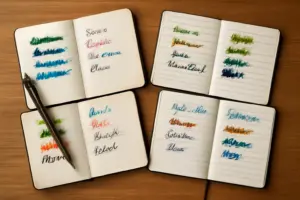
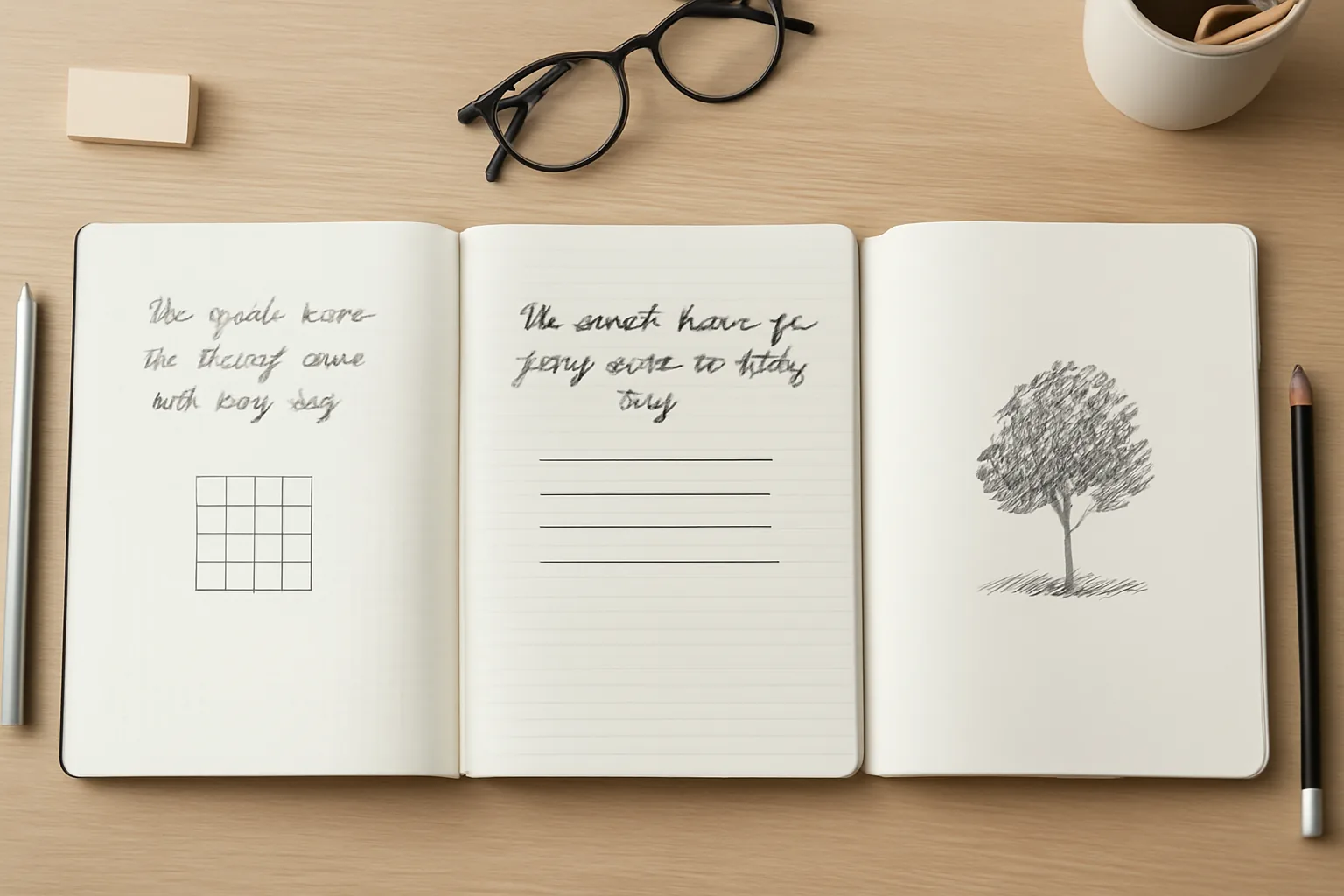
Ask ten notebook manufacturers what their ruling actually does to your handwriting, and you’ll get a blank stare — that information simply isn’t printed on the cover or the packaging. I found this out somewhere past journal number forty, once I finally stopped reaching for whatever was closest on the shelf and started genuinely interrogating the choice between dot grid, lined, and blank pages — how each one bends the way I write, sketch, and think through a problem. That single decision reshaped my daily practice more than any pen purchase ever has, expensive or otherwise. If you’ve ever closed a notebook feeling oddly unsatisfied with a page you just filled, chances are the paper format was the culprit, not you.
There’s no universal winner in this comparison — only a better or worse match for how your hand and brain move across paper. I’ve put real hours into all three formats: daily journals, meeting notes, travel logs, fountain pen trials. Each one has a spot where it genuinely earns its keep, and each has a blind spot where it works against you without announcing itself. Here’s everything that use has taught me.
Consider this your heads-up: what follows is opinionated. Those opinions came slowly, built from actual use, actual missteps, and a fair number of spreads I’d rather not revisit. I’ll flag clearly which parts are just my taste and which parts are closer to unavoidable fact.
The Real Effect Lines Have on Your Handwriting
Lined paper is the default most of us never question, and there’s real value in that familiarity. A ruled page gives your handwriting something solid to rest against. When you’re writing straight prose or taking longhand notes, that anchor lowers the mental effort involved — your hand isn’t correcting for horizontal drift; it’s simply writing.
From what I’ve seen, lines suit people who move through long, continuous paragraphs without pausing much. Meeting notes, letter drafts, straightforward journal entries in full sentences — lines carry all of that well. Most A5 notebooks settle on a 5mm to 6mm line spacing as standard, which suits the majority of handwriting sizes without crowding the page.
The trouble starts the instant you want to drop in a diagram, a margin note, or anything visual — lined pages resist that. I found this out the hard way on a 2019 trip to Kyoto, sketching a rough map of my neighborhood in a lined Leuchtturm1917. The ruling sliced straight through the drawing. It came out looking absurd, and the page felt like a loss. That trip is exactly what pushed me to start choosing my notebook format around the kind of trip I was taking, rather than sticking with habit.
Situations Where Lines Are Genuinely the Better Choice
Three scenarios favor lined paper specifically. One: extended daily journaling, the kind where you’re producing 300-plus words in a sitting. Two: academic or professional note-taking, where writing speed outranks visual flexibility. Three: deliberate handwriting practice — if you’re working on letterforms or consistency on purpose, lines give you a measurable baseline to track improvement against.
- Best for: prose journaling, meeting notes, academic writing
- Avoid when: mixing text with visuals, using variable-size lettering, or bullet journaling
- Typical ruling: 5mm–6mm spacing in A5 format
Blank Paper: Total Freedom, With a Catch
Artists, architects, and a particular breed of creative person who bristles at any pre-printed structure all gravitate toward blank notebooks, and I get it entirely. There’s a real kind of freedom in a page with zero visual clutter on it.
The catch is that a blank page asks more of you in return. With no grid to lean on, keeping your lettering consistent and your lines aligned becomes entirely your job. For nearly everyone — even people who’ve been writing by hand for decades — that translates into text that creeps upward or sags downward across the page. A paragraph might start compact and finish sprawling wide. Fountain pen users in particular lose an easy way to judge ink coverage and legibility, since there’s no structural anchor for the eye to check against.
Where blank paper truly earns its place is watercolor journaling, freehand drawing, and mixed-media pages where you’re pasting things in and painting over sections. It’s also excellent for mind mapping, where the spatial arrangement of ideas matters more than tidy rows. If your main instrument is a brush or marker instead of a pen nib, blank paper is usually the correct call.
What Blank Paper Costs You That No One Mentions
Here’s the part left off the packaging: blank notebooks frequently produce less writing, not more. Without any structure, a lot of people burn mental effort managing layout instead of actually generating content. One workshop client of mine — a graphic designer, someone whose whole job is visual thinking — switched from a blank notebook to dot grid and reported that her daily word count doubled inside two weeks. The dots supplied just enough structure to release her from layout decisions, without imposing anything visually heavy.
For most people, blank paper does its best work as a secondary notebook, not the everyday workhorse. Keep one reserved for sketches, collage, or watercolor, and let a more structured format carry the writing that has to happen reliably, day after day.
Dot Grid vs Lined vs Blank Notebook: The Case for Dots as the Default
I won’t hedge on this one: dot grid is what I point people toward first, almost without exception. It’s also what I’ve reached for daily over the past six years. The reason comes down to structural balance — dots offer a reference grid without taking over the page the way solid lines do.
Most dot grid notebooks use a 5mm spacing, identical to the standard ruled spacing, so you sacrifice nothing in terms of a writing guide. The baseline is still there, invisible but functional. But because each dot is tiny and fades into the background visually, none of them slice through a sketch or diagram the way a printed line does. Prose in one corner, a rough floor plan in another — the page reads as one coherent whole instead of a patchwork.
Dot grid is also the entire foundation modern bullet journaling is built on. That 5mm spacing lets you draft calendars, habit trackers, weekly layouts, and to-do lists with ruler-level precision, with no pre-printed layout dictating your design. That flexibility is a genuine, functional advantage — not a phrase lifted from a marketing page.
Who Dot Grid Actually Suits
From what I’ve observed, dot grid is the sensible default for people who journal regularly, keep bullet journals, use fountain pens alongside sketching, or blend handwriting with diagrams and visuals in general. It covers almost every case a lined page handles, plus flexibility a lined page simply can’t provide.
- Best for: bullet journaling, mixed text and visuals, daily journaling, fountain pen use
- Works well for: meeting notes, travel journaling, creative planning
- Consider lined instead if: you never sketch and find any grid distracting
- Consider blank instead if: you’re doing serious watercolor or collage work
Which Ruling for Maths and Quantitative Coursework?
This comes up often enough to deserve its own answer, and it is one of the few cases where the ruling genuinely changes how well the work goes rather than just how it looks.
Grid, and it is not close. Quantitative work is full of things that need to line up vertically: long division, matrices, unit conversions where the cancellations have to be visible, systems of equations solved down the page. Ruled paper gives you horizontal guidance and nothing else, so columns drift. Grid gives you both axes for free, and 5 mm squares are the standard for a reason — small enough for subscripts and exponents, large enough that a fraction fits in two cells.
- Grid (5 mm) — equations, working, matrices, anything you will sketch a graph into. The default for a maths or statistics course.
- Dot grid — a reasonable compromise if you also write a lot of prose in the same notebook. You keep the alignment cues without a full lattice behind your writing, but plotting is fiddlier.
- Ruled — fine for the interpretation half of a quantitative course, where you are writing about what a result means rather than deriving it. Poor for the derivation itself.
- Blank — only if you are already disciplined about layout. Most people are not, under time pressure, in a lecture.
One practical note: if the course involves graphing by hand, check the grid actually reaches the edge of the page. Plenty of notebooks print a grid inside a generous margin, which is fine for notes and infuriating the first time you need a full-page axis.
The Dot Grid Notebook That Finally Ended My Margin Battles
If you’re stuck weighing structure against freedom, dot grid is the format that lets you skip the decision entirely. The dots act as guardrails you can barely see, keeping your writing aligned right up until the moment you need to sketch something, map out ideas, or blow past the grid altogether — at which point they get out of the way.
Where it delivers
- Dots steer your hand without the heaviness of printed lines — your eye never feels boxed into a row, so the writing itself ends up looser and more natural than anything produced on ruled paper.
- You’re free to disregard them entirely for a sketch, a set of bullet points, or a mixed-media spread, then fall right back into alignment for a block of prose — no need to switch notebooks.
- Thanks to the A5 dimensions and hardcover spine, the Leuchtturm lies flat while you’re writing and survives being thrown into a bag without leaving creases in the pages.
Where it falls short
- Coming from ruled paper, the dots take a little adjustment — your early pages will feel like writing without a safety net, even though the grid is technically right there.
- If you rely on a hard visual break between ideas or sections, dots can’t offer the psychological wall that a printed line naturally creates.
I nearly returned my first dot grid notebook after two days, convinced it was too open-ended for serious writing—until I realized I was actually writing longer, freer passages because the subtle guidance felt less restrictive than traditional lines. That’s when I reached for the LEUCHTTURM1917 Hardcover Medium A5 in Forest Green, Dotted as my go-to for work that needs both structure and breathing room.
Notebook Rulings: Common Questions
What is the difference between dotted, grid, ruled and unruled notebooks?
Ruled gives horizontal lines only — best for prose. Grid gives a full square lattice, horizontal and vertical, which is what you want for maths, tables and diagrams. Dotted marks the grid intersections with dots instead of lines, so you keep the alignment cues without a visible cage behind your writing. Unruled (blank) gives you nothing and expects you to supply the discipline.
Should I buy a lined or grid notebook for a quantitative course?
Grid, in 5 mm squares. Quantitative work needs vertical alignment as much as horizontal — long division, matrices, unit cancellations, systems of equations — and ruled paper gives you no help with any of it. Dot grid is an acceptable compromise if the same notebook also holds a lot of written work.
Which ruling is best for everyday journalling?
Dot grid, for most people. It is the only ruling that stays out of the way of prose while still catching you when a table or a sketch turns up, which in a daily journal it always eventually does.
About This Article

Written by Ellen Ashford. Watch collector, fountain pen enthusiast, and lifelong journaler. Time & Ink is where I explore the craft of analog living — from vintage timepieces and fine stationery to the simple pleasure of putting pen to paper. More about this site.
Verify this against a primary source
Specifics change, and your situation may differ from the one described here. These are the authorities worth checking directly:
- NAWCC — horological reference, archives and research library
- Smithsonian Institution — collection records for historic timepieces and writing instruments