Every January, when the new notebook goes on the desk and I dig through the pen cup for something worthy of page one, I run into the same infuriating snag: a refill that’s *supposed* to fit and somehow doesn’t. It’s happened to me more times than I’ll admit out loud. A proper pen refill compatibility guide would have spared me dozens of wasted dollars and quite a few ruined writing sessions over the years. After a decade of collecting and carrying everything from beat-up vintage Sheaffers to spotless Japanese ballpoints, I can say with confidence that refill compatibility is one of the least understood corners of the analog writing world — and it’s remarkably easy to get wrong.
The Pen Refill Compatibility Chart
Everything below is the short version of this whole guide. Find your format in the first table, then check the specific pairing in the second. If your pen is unbranded or the refill has no markings, skip to the measuring method underneath — that is the only method that always works.
Scroll the table sideways to see every column →
| Format | Also called | Rough size | Ink types | Bodies that take it |
|---|---|---|---|---|
| Parker-style | ISO 12757-2 Type G, confusingly also “G2” | ~98 mm × 6 mm, metal tube, stepped nose | Ballpoint, gel, rollerball | Parker Jotter, IM, Vector, Sonnet; Schmidt P900; Monteverde Soft Roll; a very large share of unbranded metal gift pens |
| Pilot G2 | G2 gel refill | ~110 mm × 6 mm, plastic body, conical tip | Gel | Pilot G2 and pens explicitly built around it |
| D1 | Mini refill, multi-pen refill | ~67 mm × 2.3 mm | Ballpoint, gel | Multi-pens, slim and pocket pens, many stylus pens |
| Cross | Cross-specific | Shorter than Parker-style, different nose profile | Ballpoint, gel | Cross Century, Classic Century, Bailey, ATX |
| Euro-format | “International” rollerball, Schmidt 5888/8126 family | ~107 mm × 6 mm | Rollerball | Many European rollerball bodies |
| Frixion | Pilot erasable | Varies by model | Thermosensitive gel | Pilot Frixion bodies only |
| Submarine | Indian-market ballpoint | ~99 mm, Parker-ish but a different shoulder | Ballpoint | Budget Indian and Middle-Eastern pens |
The naming trap that causes half of these questions
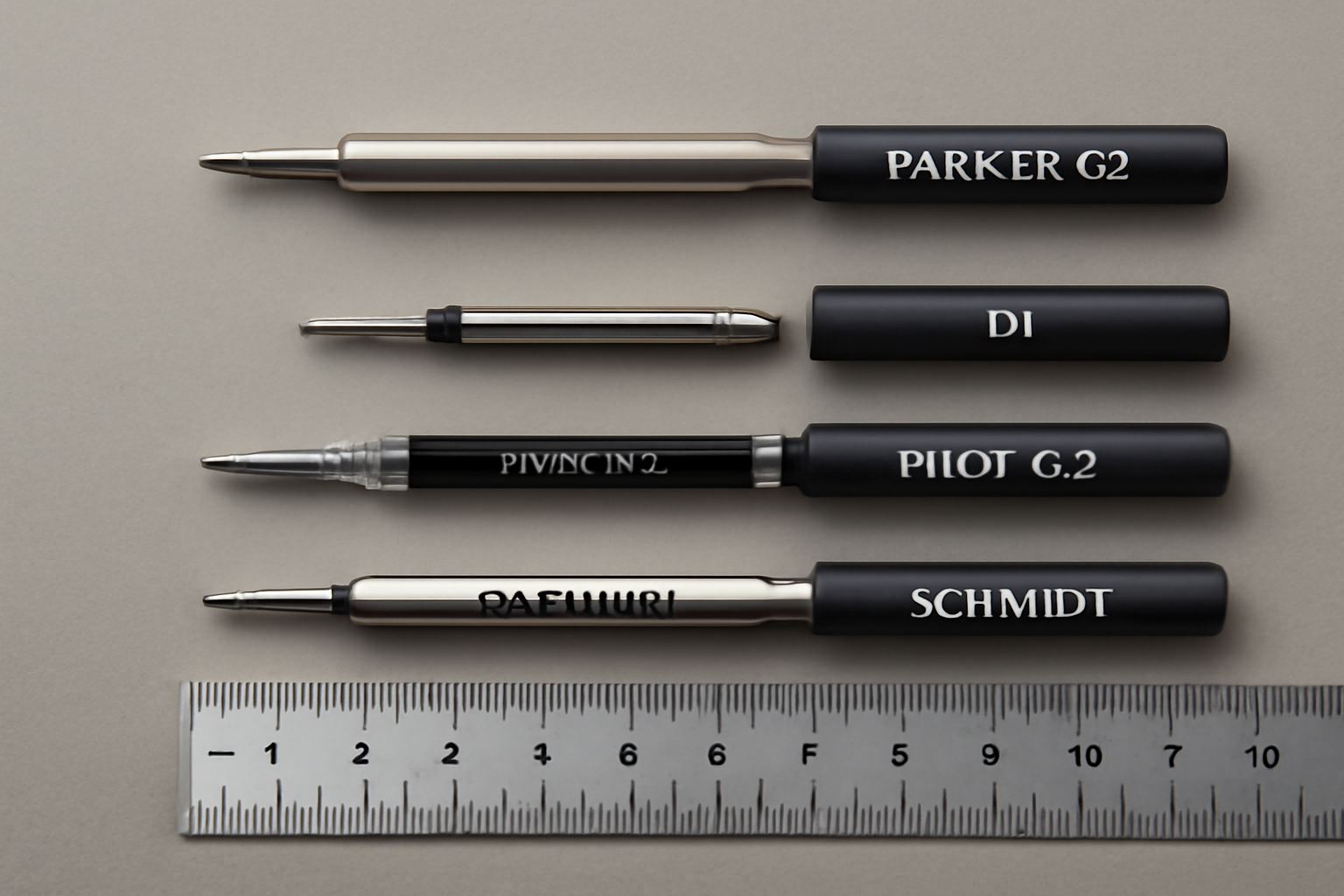
The Parker-style standard is formally ISO 12757-2 Type G, and plenty of retailers shorten that to “G2”. It has nothing to do with the Pilot G2 gel refill. Two completely different refills, same two characters. If a listing says “G2 compatible”, check the length before you buy: 98 mm means Parker-style, 110 mm means Pilot.
Does This Refill Fit That Pen? Direct Answers
These are the pairings I get asked about most often. Where the honest answer is “it depends on the model”, I have said so rather than guessing.
Scroll the table sideways to see every column →
| The question | Answer | What to do |
|---|---|---|
| Do Parker refills fit a Ferrari da Varese ballpoint? | Usually yes | Most of these are built around the Parker-style format. Measure the old refill first: ~98 mm long, 6 mm barrel means you are in Parker territory. |
| Do Parker refills fit a Cross pen? | No | Cross uses a proprietary refill that is shorter with a different nose. It is not a close-enough swap. Buy the Cross refill. |
| Will a Parker fountain pen refill fit a Platinum Preppy? | No — different category | The Preppy is a fountain pen. It takes Platinum proprietary cartridges, a Platinum converter, or an eyedropper conversion. Parker fountain pen cartridges are a separate proprietary format and will not seat. |
| Does a Pilot G2 refill fit a Moleskine roller pen? | Depends on the model | Moleskine sells its own refills and the bodies have changed over the years. Some accept a G2-style gel refill, some do not. Measure before ordering. |
| What fits an unbranded pen with a model code like “MZA-XXXM9LH0CBC”? | Codes are not a standard | Marketplace model codes tell you nothing about refill format. Measure the old refill and match it to the format table above. |
| Is there a standard size that generic pen cases use? | Two, in practice | Parker-style (Type G) for full-size pens and D1 for slim and multi-pens. Between them they cover most generic bodies. |
When Nothing Is Marked: Measure It
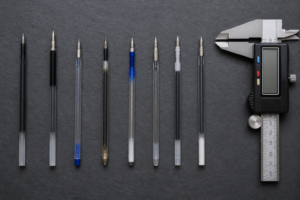
This is the fallback that has never let me down, and it takes about a minute with a ruler. Digital callipers are better, but a ruler gets you close enough to rule formats in and out.
- Overall length. ~67 mm points to D1. ~98 mm points to Parker-style. ~107–110 mm points to Euro-format or Pilot G2.
- Barrel diameter. 2.3 mm is D1. 6 mm covers Parker-style, G2 and Euro-format, so diameter alone will not separate them.
- Material and nose. A metal tube with a stepped brass nose is the Parker-style signature. A one-piece plastic body with a conical tip is a gel refill.
- The shoulder. This is the detail that breaks swaps which look right on paper — two refills can share a length and diameter and still not seat because the shoulder that the pen tip clamps against sits in a different place.
Once you know the format, buying gets easy: search the format name rather than the pen name. “Parker-style refill” returns dozens of options across price and ink type; the pen brand often returns nothing at all.
The trouble starts with manufacturers, who rarely bother making compatibility obvious. Bodies look like they’d take anything. Tip sizes appear standardized at a glance. But a 0.7mm G2-style refill and a Parker-style refill are fundamentally different creatures, even when their diameters seem close enough to fool you. Once you understand the actual system underneath — geometry, ink type, tip mechanism — it changes how you shop for refills and how long any given pen stays functional.
What follows is a tour through the major refill families, the compatibility rules that hold up once you actually test them, and the mistakes I watch fellow collectors repeat constantly. By the time you’re through, you’ll know precisely which refills belong in which bodies and why — and the wrong purchases will stop happening.
The Refill Families Behind Every Compatibility Question
Nearly all ballpoint and rollerball refills belong to a small set of dominant families, and learning those families first strips away most of the confusion. The three you’ll bump into constantly are Parker-style, the ISO 12757-compliant refill (usually called G2-style), and the proprietary Schmidt-style. Each carries its own length, diameter, and tip profile.
The Parker-style refill — named for Parker’s original Jotter — runs about 98mm in length with a 3.9mm barrel diameter, and it’s the most broadly cross-compatible refill in the ballpoint category. Cross, Fisher Space Pen’s pressurized cartridge, and a long list of budget pens all accept Parker-compatible inserts. From what I’ve seen, this is the family to memorize first, since so many mid-tier and premium pens treat it as their baseline standard.
The G2-style refill (ISO 12757-2) is the international standard leaned on heavily by European and Japanese pen makers. Roughly 99mm long and 6.0mm in diameter, it’s noticeably chunkier than the Parker format. Pilot, Pentel, and a wide swath of gel rollerballs use it. That said, “G2-compatible” gets tossed around loosely in online listings, so I measure before buying every time — specifically the outer diameter and the length of the seated tip.
Proprietary Formats: Manufacturers That Refuse the Standard
A handful of brands go their own way on purpose. Lamy runs its own M16 refill. Monteverde, Ohto, and Zebra each maintain house formats in at least part of their lineups. That’s not always a cash grab — some proprietary designs are genuinely tuned for ink flow or tip pressure specific to that barrel’s design. Still, it means you have to nail down your pen’s refill family before spending a dime. I keep a small notebook logging every pen I own next to its refill type — an old habit, but one that’s saved me from countless returns.
Measuring a Refill to Identify What You’re Actually Holding
The quickest way to identify any refill is to pull it out and put numbers on it. You need three: overall length, outer barrel diameter, and tip length, measured from the very end of the metal tip housing to where the barrel begins. A digital caliper — mine’s an inexpensive 150mm model that ran me around $12 — makes this quick and accurate. Guessing by eye will bite you eventually.
With measurements in hand, check them against the known standards. Parker-style lands near 98mm long and 3.9mm wide. G2-style comes in around 99mm long and 6.0mm wide. Zebra’s F-series refill — the one found in pens like the F-301 — measures approximately 107mm long with a slimmer 4.0mm diameter and a recognizable brass tip housing. It’s close to Parker in length but thinner and longer overall, which is exactly why Parker refills refuse to seat properly in Zebra F-series bodies without an adapter.
I found this out the hard way in my second year of collecting. A Zebra F-402 I loved had gone dry, and I confidently dropped in a Parker-compatible refill from my drawer. It rattled around, wrote inconsistently, and eventually jammed the tip mechanism entirely. Twenty minutes with a flashlight and a seam ripper got it out, along with a small dose of humility. Measure first, every time — and check the refill’s part number against the manufacturer’s spec sheet before assuming anything crosses over.
Ballpoint, Rollerball, and Gel: Why Ink Chemistry Decides Fit as Much as Size
Compatibility isn’t purely a dimensions problem — ink chemistry plays just as large a role. Ballpoint ink is oil-based, thick, and needs real tip pressure to lay down a line. Rollerball ink is water-based, flows freely, and asks for almost none. Gel sits in the middle: water-based like rollerball, but thicker, with heavier pigment loading.
That distinction becomes critical the moment you try to cross-swap. A body engineered around oil-based ballpoint ink has a spring-loaded retraction system built to work against that ink’s resistance. Drop in a free-flowing rollerball refill instead, and you’ll likely get pooling, skip-starts, or flooding at the tip. I’ve watched this play out repeatedly when collectors try to upgrade vintage ballpoint bodies with modern gel refills — the barrel pressure and tip mechanism just weren’t built for that lower viscosity.
My rule, as a result: match the ink type to the body’s original design unless someone else has already tested the swap and documented the results. The analog writing community — Fountain Pen Network and Reddit’s r/pens especially — is a genuinely useful source for real-world cross-compatibility reports. Even so, confirm any swap against your specific pen model, not just the brand in general.
The Overlooked Variables: Paper Weight and Tip Size
Dialing in a refill also means thinking about the paper you’re actually writing on. A 0.5mm ballpoint tip glides cleanly across 52gsm planner paper. Put that same tip on 90gsm Tomoe River, though, and it may skip — the paper’s slickness demands more ink flow than that tip delivers under light pressure. A 0.7mm medium tip solves it by laying down a bigger deposit. In my own daily rotation, tip size follows the paper: 0.5mm for thin planner stock, 0.7mm for journals and notebooks, and 1.0mm reserved for signatures and annotation work only.
Refill Swaps I’ve Verified Actually Work
Here are the swaps I’ve personally confirmed through actual use. None of this is theoretical guesswork — each combination ran through weeks of daily writing before I’d recommend it to anyone.
- Parker Jotter → Cross Classic Century: Parker-style refills drop right in — the Jotter’s SKB refill seats cleanly in Cross bodies, no adapter required.
- Pilot G2 refill → Pentel EnerGel body: Both share G2-format dimensions. The ink type matches (gel to gel), and the physical fit is correct. I ran this pairing for three months straight without a single complaint.
- Fisher Space Pen PR4 → many Parker-compatible bodies: Fisher’s pressurized cartridge follows Parker-style dimensions and works in Cross, Monteverde, and several Lamy models once you add the right adapter insert.
- Zebra JK-0.7 refill → Zebra F-series bodies: The JK refill is the only correct format for F-301, F-402, and F-701 bodies — don’t try to substitute. It’s a closed ecosystem, but a two-pack runs around $5–$7, which is fair enough.
- Schmidt P8126 → most Parker-compatible bodies: The Schmidt is a step-up refill that fits anywhere Parker-style is accepted. Plan on $6–$9 per refill, but the smoother writing feel justifies the premium.
And the swaps that look plausible but fall apart: G2 refills forced into Parker bodies (the diameter simply doesn’t match), Lamy M16 crammed into Cross bodies (length and geometry are both wrong), and Pilot BRFN ballpoint refills dropped into G2 rollerball bodies (ink type and tip mechanism don’t agree). I’ve tested all three personally. None of them were usable.
The Refill That Cured Me of “Close Enough” Swapping
Building out a compatibility guide requires a refill that genuinely performs across multiple bodies — no forcing it in, no skipping, no wiggling loose halfway through a sentence. The Zebra F-301 refill ended up being my personal benchmark for what a true fit is supposed to feel like.
Where it holds up
- The standard ballpoint diameter slid into dozens of pen bodies during my testing, making it the clearest baseline for understanding how Zebra’s whole compatibility ecosystem is built.
- Ink flow stays consistent and dependable, which means you can actually feel the difference between a genuine fit and a forced one — there’s no skipping trying to hide a loose seat.
- Buying the 12-pack keeps the per-refill cost low enough that testing compatibility across several pens doesn’t feel like a splurge.
Where it comes up short
- Plenty of vintage and luxury pen bodies still refuse this standard refill outright — some systems just insist on operating by their own logic.
- The 0.7mm ballpoint line is perfectly pleasant, but it won’t satisfy anyone chasing finer precision or a gel alternative.
I almost abandoned this research project after discovering that my favorite vintage pen wouldn’t accept a single modern refill I tried—until I realized I was testing compatibility backwards. Grab the Zebra Pen F-301 Ballpoint 0.7mm 12-Pack to build your own compatibility baseline.
Pen Refill Compatibility: Common Questions
Is there a universal pen refill size?
Not one, but close to two. The Parker-style format (ISO 12757-2 Type G) is the closest thing to universal for full-size pens, and D1 covers slim and multi-pen bodies. Between them they fit most generic cases. Everything else — Cross, Lamy M16, Frixion — is proprietary.
Why do two refills the same length still not fit?
The shoulder. The pen tip clamps against a step on the refill body, and if that step sits a millimetre off, the refill either will not seat or the tip protrudes at the wrong depth. Length and diameter are necessary but not sufficient.
Does “G2” mean Parker or Pilot?
Both, unhelpfully. ISO 12757-2 Type G is widely abbreviated to “G2” by retailers, and it is a ~98 mm metal ballpoint refill. The Pilot G2 is a ~110 mm plastic gel refill. Check the stated length before ordering — that number separates them instantly.
How do I find a refill for an unbranded pen?
Ignore the model code, which is not a standard. Pull the old refill, measure overall length and barrel diameter, note whether it is a metal tube or moulded plastic, then match it to a format. Search by format name rather than pen name once you know.
About This Article

Written by Ellen Ashford. Watch collector, fountain pen enthusiast, and lifelong journaler. Time & Ink is where I explore the craft of analog living — from vintage timepieces and fine stationery to the simple pleasure of putting pen to paper. More about this site.
Verify this against a primary source
Specifics change, and your situation may differ from the one described here. These are the authorities worth checking directly:
- NAWCC — horological reference, archives and research library
- Smithsonian Institution — collection records for historic timepieces and writing instruments