Ask five people what belongs on a desk and you’ll get two contradictory answers: fill it with a matching accessory set for a “put-together” look, or strip it down to bare wood and call minimalism a virtue. The second piece of advice is the one that’s wrong, in my experience — an empty desk isn’t discipline, it’s just a desk nobody’s actually using yet. I’ve bought plenty of accessories over the years chasing one promise or another, and most of what I bought created new problems instead: clutter, visual noise, a drawer that wouldn’t shut. Collecting watches, filling fountain pens, and working through notebook after notebook taught me to apply one test before anything earns permanent desk real estate: does this object justify the space it occupies? That single question has saved me hundreds of dollars and, more importantly, kept my desk functional rather than merely decorative.
The hard lesson arrived roughly six years back. I’d put together what felt like a dream setup at the time: a dedicated pen tray, a leather catchall dish, a marble coaster, a separate phone stand, a small desk clock, and a rotating organizer caddy. It photographed beautifully. In actual use, I spent more time rearranging the pieces than writing anything. My Pilot Custom 823 got knocked off the edge of that overcrowded surface and rolled straight off the desk. Fixing the nib afterward ran me $60. Point taken.
The fix wasn’t buying more organizational gear — it was owning fewer, better pieces. My desk now carries roughly five items total, and every one of them earns its place through function, durability, and how satisfying it is to use day after day. What follows is exactly what I look for, and what I’ve actually found, in desk accessories that are worth the space they take up.
Where Most Desk Accessories Go Wrong
The market for desk accessories is genuinely massive — search for organizers, trays, stands, or pads and you’ll pull up thousands of options, each promising both productivity and style. Most don’t survive past the three-month mark. That failure has nothing to do with price — plenty of the failures are expensive — and everything to do with solving a cosmetic problem instead of an actual one.
Years of trial and error have taught me this: anything living on your desk surface needs to accomplish at least one of three jobs. Protect something. Organize an item you reach for daily. Or improve the physical feel of the work itself. Miss all three and the thing belongs in a drawer, or better, a donation box. A decorative tray holding objects you touch once a week? Fails the test. A quality desk mat that protects the surface, cushions your wrist, and gives your pen a stable place to rest without rolling away? That one earns its keep.
In my experience the failure is partly psychological, too. We buy accessories in a burst of inspiration, usually right after scrolling past some gorgeously styled desk photo online. But those photos aren’t documenting working desks — they’re set dressing. A real desk has ink bottles on it, scraps of paper, reading glasses, a half-finished cup of tea. Your accessories have to work alongside that mess, not pretend it away.
The One Accessory That Anchors Everything Else
If I could keep exactly one desk accessory worth the space, it would be a good desk mat, without question. I realize that sounds like a modest pick, but stay with me. A well-made mat does more than shield your desk surface — it gives the whole workspace a sense of order, handing every other object a defined spot and cutting down the dozens of tiny decisions you’d otherwise make throughout the day.
I’ve cycled through fabric mats, synthetic leather mats, and full-grain leather ones, and the gap in durability and feel is not subtle. Fabric soaks up fountain pen ink, which rules it out for me entirely. Synthetic versions look the part at first but start cracking on the surface somewhere around the 12-to-18-month mark of regular use. Genuine leather, tanned and finished properly, does the opposite — it ages into something better than what you started with.
The specific detail that matters is the oil-wax finishing found on better leather mats. It builds a surface that shrugs off moisture, picks up a natural patina with time, and offers just enough grip to keep papers and notebooks anchored without feeling sticky. That distinction counts when you’re working a dip pen across the surface or setting down a pocket watch to wind it. Grip, not slide, is the goal.
Dimensions Matter More Than People Assume
Go too small on a desk mat and it stops being a foundation — it just becomes another object cluttering the desk. In my experience, 35 inches of width is close to the floor for a single-monitor setup that still leaves room for a keyboard, a notebook, and a pen or two nearby. Drop below 16 inches of depth and your wrists lose the support they need through a long writing session.
Thickness gets overlooked just as often, and it shouldn’t. Anything under 1.5mm barely protects the desk underneath. Wood desks in particular need at least 2mm to soak up the impact of stamps, an accidentally dropped pen cap, or firm pressure while writing. Go past 3mm, though, and the mat starts feeling spongy, which throws off fine motor control — a genuine issue if you’re using flex nibs or laying out detailed journal spreads.
My Pick: The YSAGi Real Leather Desk Mat
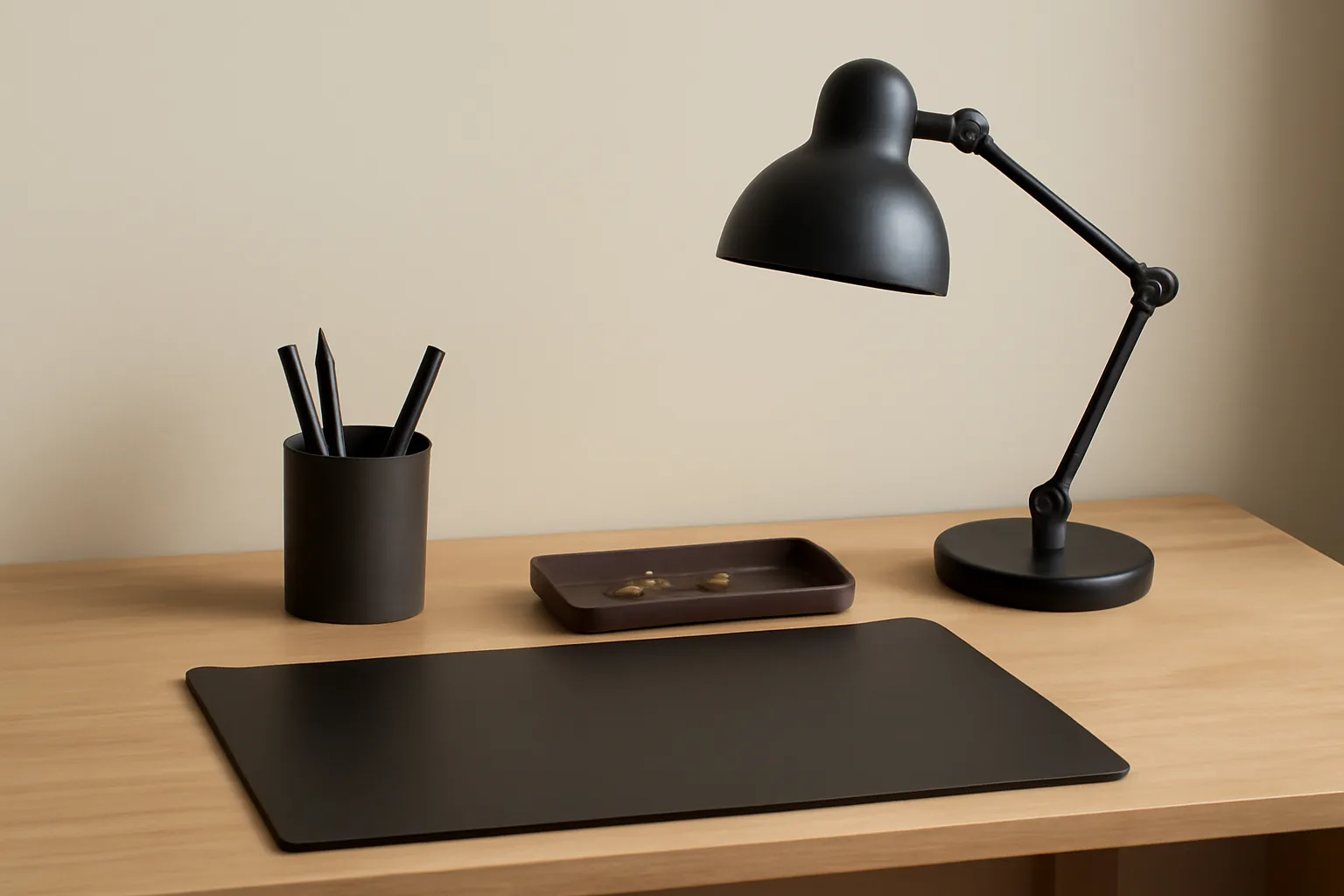
I’ve had the YSAGi Leather Desk Mat in Classic Dark Brown on my primary desk for several months now, and it’s genuinely earned its footprint. The dimensions — 35.4 inches by 17 inches — hit the sweet spot I described above. It covers my writing zone completely while leaving the back corners of my desk free for a small lamp and my ink storage caddy.
The oil-wax leather is really the whole story with this mat. It has a matte, faintly waxy texture that feels good under bare skin or under the base of a notebook alike. Writing straight onto it feels firm and even — no sponginess absorbing pen pressure unevenly across the page. The 2mm thickness hits the right mark exactly: enough to protect the walnut desktop beneath it without lifting my wrist into an uncomfortable angle.
The stitched border isn’t there just to look finished. It holds the mat’s shape over the long haul and keeps the edges from curling upward, which is where cheaper leather pads usually fail first. Months of daily use in, mine still sits perfectly flat. The dark brown leather has picked up a faint sheen exactly where my hands rest most — that’s the oil-wax tanning doing its job. Honestly, it looks better now than it did fresh out of the box.
One honest caveat: it arrives with a mild leather odor. That faded completely within about 48 hours in a room with decent airflow. That’s typical of genuine leather and not a sign of anything wrong. Synthetic leather, on the other hand, tends to off-gas chemical smells for weeks afterward — one more reason I stick with the real thing.
A Worthy Budget Alternative
If you’re not ready to commit to the YSAGi’s price point, the Elizo Real Leather Desk Mat Set at 32×16 inches is a reasonable alternative. It’s genuine leather, it includes a matching coaster and mousepad in the set, and the dimensions are workable for smaller desks. In my testing, the leather feels slightly thinner and the stitching is less refined — but for someone building their first intentional desk setup, it’s a smart starting point. I’d call it a 90% solution at a lower entry price.
The Rest of My Desk: An Edited List
Aside from the mat, my desk holds almost nothing else. Here’s what survived the cut, and the reasoning behind each one.
One Good Pen Rest, Nothing More
I keep a single-pen rest carved from hinoki cypress, styled after the Japanese approach. It holds exactly one pen, which forces me to actually decide which pen I’m using right now instead of defaulting to whatever’s closest. Before switching to this setup, I kept a five-pen display tray on the desk — and three of those pens dried out between uses because I wasn’t rotating them the way I should have. A single-pen rest fixed a maintenance problem I hadn’t even realized I had.
A note specifically for fountain pen owners: skip metal rests with sharp edges or lips that make contact with the nib section. Even light, repeated contact there can eventually affect clip tension and the threads on the section. Ceramic or wood rests that cradle only the barrel are the safer choice if you care about preserving the pen.
A Single, Shallow Inbox Tray
I keep exactly one shallow tray on the desk — no more than 1.5 inches deep — reserved for paper that still needs action. Not filing. Not storage. Just documents actively waiting on me. The shallow depth is deliberate: it caps capacity at roughly 15 to 20 sheets, which forces me to clear it before it overflows. Deep trays turn into paper graveyards. Shallow ones stay useful.
Material matters here as well. Steer clear of wire mesh trays if you’re handling handwritten pages or drafts — the grid can leave an embossed pattern on whatever paper sits beneath it. A solid wood, leather-lined, or smooth lacquered tray keeps paper in the same condition it went in.
A Watch Stand That Pulls Double Duty
This one’s specific to me, but any fellow collector will recognize the logic. Keeping a single-watch stand on the desk does two things at once: it gives whatever watch I’m currently wearing a safe, upright spot to sit during desk work, and it keeps me from ever setting it directly on a hard surface. More scratched casebacks in my collection trace back to being set down on desks than to any other single cause. A $20 to $40 leather- or suede-lined stand eliminates that risk entirely.
That said, if you own more than one watch, the desk isn’t where the rest of them should live. A proper watch box or winder tucked into a drawer or cabinet is the better call. Dust, UV exposure from desk lamps, and stray contact all threaten finishing and crystal condition over time.
What Has No Business on a Working Desk
I’ll skip the diplomacy here, since directness is more useful. The following items consistently fail my desk-accessories-worth-the-space test.
- Purely decorative objects with no function — Succulents, crystals, small sculptures belong on a shelf, not a workspace. Every inch they take up is writing space you’ve given up.
- Multi-compartment organizers full of things you rarely touch — If you’re dipping into a compartment less than once a day, that item belongs in a drawer instead. Desk organizers should only hold what you use daily.
- Redundant tools — Three pairs of scissors, two rulers, four pencils crammed in a cup. Keep your favorite of each and store the rest elsewhere. Duplicates just eat prime real estate.
- Loose charging cables with no system — They create visual clutter and snag on everything nearby. A cable clip mounted to the desk edge runs under $10 and solves the problem for good.
- Accessories sized wrong for the desk — A 47-inch mat on a 48-inch desk leaves zero breathing room. Scale counts. Aim to keep at least 10% of the surface perimeter clear.
When It’s Worth Asking an Expert First
Desk accessories mostly sit firmly in DIY territory, and for the most part that’s true here too. But a handful of situations genuinely call for a second opinion before you spend anything.
If you’re setting up a dedicated home office and plan on mounting things like monitor arms, cable raceways, or under-desk drawer systems, check the desk’s weight rating and what it’s actually made of before you start drilling. Some flat-pack desks with particleboard cores tolerate as little as 30 to 50 pounds spread across the surface. Bolt a heavy monitor arm onto particleboard without the right backing and you risk long-term structural damage. A furniture specialist or ergonomics consultant can evaluate this for you in under an hour.
The same caution applies if you’re working at an antique desk, which describes plenty of readers here. Be careful with adhesives, heavy mats, or anything applying sustained pressure to the surface. If the piece carries real historical or monetary value, paying a conservator for guidance on safe desk protection is money well spent. A genuine leather mat with a non-slip base is usually fine, but every piece of furniture is its own case.
Where This All Lands
The best desk isn’t the one with the most gear on it — it’s the one used most intentionally. Anything that earns a permanent spot on your surface should protect something, organize an item you touch daily, or make the physical act of working better. That’s the bar I hold everything to, and it’s made my own workspace noticeably more productive and more enjoyable to sit down at.
Start with a foundation. The YSAGi Real Leather Desk Mat is the single upgrade I’d recommend to anyone building or refining a thoughtful analog workspace. It anchors everything else, protects your surface, and improves daily with use. From there, add one item at a time — and ask the hard question before each one. Does this earn its footprint?
If the answer to whether something earns its spot isn’t an immediate yes, treat it as a no. Your desk will thank you for it.
About This Article

Written by Ellen Ashford. Watch collector, fountain pen enthusiast, and lifelong journaler. Time & Ink is where I explore the craft of analog living — from vintage timepieces and fine stationery to the simple pleasure of putting pen to paper. More about this site.
Verify this against a primary source
Specifics change, and your situation may differ from the one described here. These are the authorities worth checking directly:
- NAWCC — horological reference, archives and research library
- Smithsonian Institution — collection records for historic timepieces and writing instruments