Nowhere on a pen brand’s spec sheet will you find a warning about ink pooling in your cap after a warm afternoon, or a note explaining that a converter’s plunger sometimes stalls out well short of full capacity. Fountain pen converter vs cartridge gets treated like a footnote decision — pick one, fill it, move on with your day. Ten years into collecting everything from a $15 Pilot Metropolitan up to a vintage Montblanc 149 with a broad flex nib, I’d argue this choice quietly shapes more of your experience than most new owners expect. It touches your ink options, how consistent your writing feels, how much upkeep you’re signing up for, and — more than I’d like to admit — how you feel about the pen itself. I’ve earned every bit of this opinion through messy refills: spills across the desk, ink levels that dropped unevenly, converter plungers that simply refused to go all the way down.
At a pen show in Chicago, I watched someone newer to the hobby drop a lovely Lamy Safari into her bag alongside a fistful of Lamy proprietary cartridges. There’s nothing wrong with that choice on its face. But she was walking past roughly 400 bottled inks she’d have had access to with an $8 converter swap instead. That small moment has stayed with me longer than it probably should have. The filling system you choose isn’t really about convenience at all — it’s a quiet statement about what kind of writer you’re trying to become.
So let’s actually work through this properly. I’ve run both systems across dozens of pens — Pilot, TWSBI, Sailor, Kaweco, Pelikan — on paper ranging from Rhodia 80gsm to Tomoe River 52gsm. What follows is everything that testing taught me, mistakes included, so you can skip a few of them.
What Actually Separates a Converter From a Cartridge
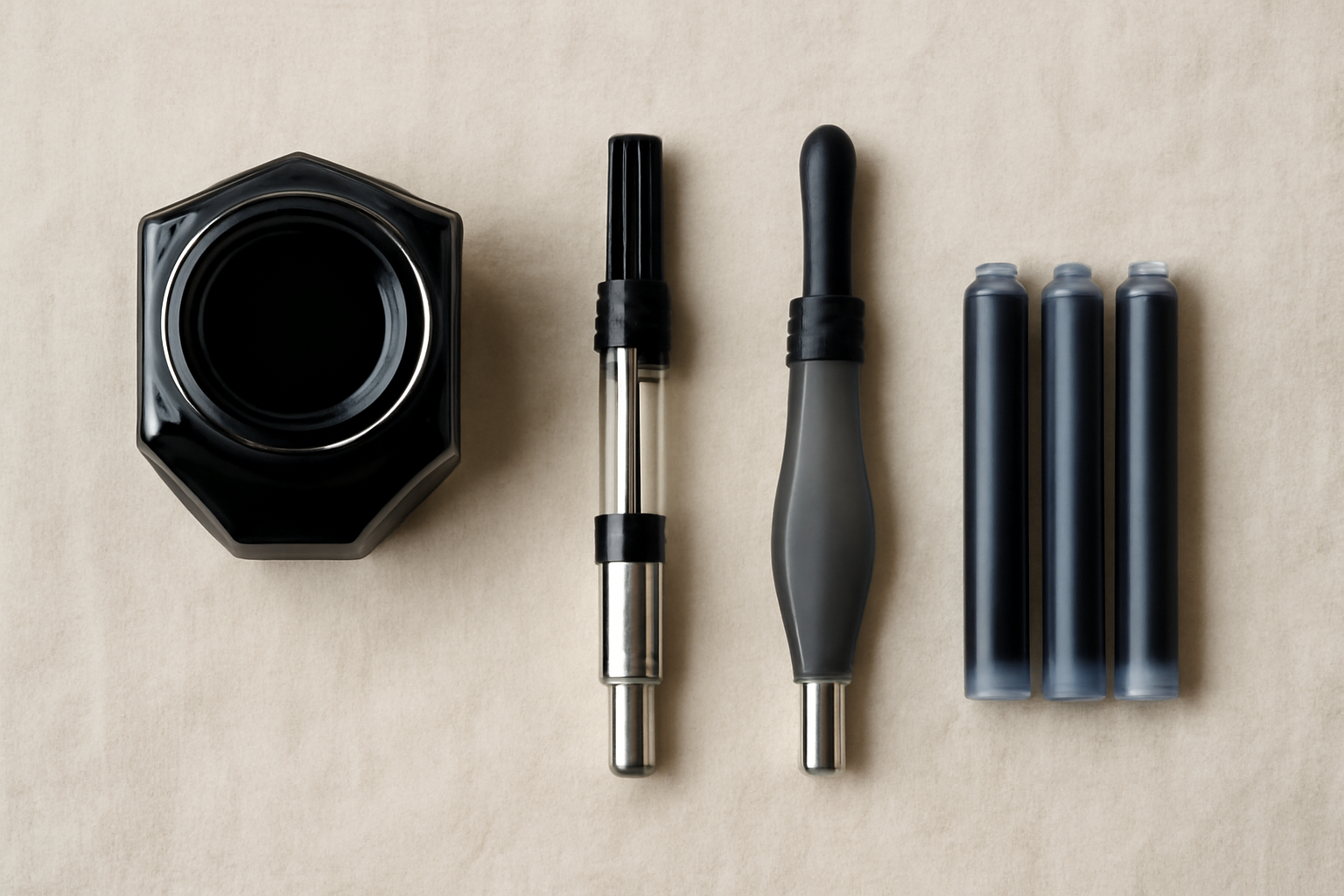
Before anything else, let’s pin down what we’re comparing. A cartridge is a sealed, pre-filled tube of ink that snaps or presses into your pen’s grip section. It’s a closed loop, single use only — once it runs dry, you throw it out and push in a fresh one. Proprietary versions, like Lamy’s T10 or Pilot’s IC-50, only work with their own brand families, which boxes you into a fairly narrow ink selection.
A converter sits in that same slot but opens the door to any bottled ink you own. Most rely on a piston or a squeeze mechanism — you dip the nib straight into a bottle of Diamine Oxblood or Sailor Jentle Ink and draw up your fill. It’s reusable, refillable, and works with thousands of bottled inks spanning every price bracket. A standard international converter is built to fit a wide range of brands — Kaweco, Platinum, and plenty of others — so cross-brand compatibility stops being a headache.
From what I’ve measured, the volume gap between the two isn’t nothing. A standard Lamy T10 cartridge carries roughly 0.7ml. The Lamy Z28 converter holds about 0.65ml — close enough to call a wash. But piston-fill converters in certain Pilot models climb closer to 0.9ml to 1.0ml. Over the course of a writing session that gap becomes noticeable, particularly if you’re journaling daily with a medium or broad nib that burns through ink fast.
Why the Ink Selection Argument Favors Converters
This is the category where converters pull decisively ahead. Stick with cartridges and you’re boxed into whatever your pen’s brand manufactures, or whatever third-party maker has shaped a cartridge to fit that specific spec. Lamy offers roughly 10 cartridge colors, which covers casual writing just fine. But the bottled ink world holds thousands of choices by comparison — shimmer-loaded inks like Diamine Shimmertastic, iron gall formulas like Rohrer & Klingner Salix, water-resistant options like Noodler’s Bulletproof Black.
As a concrete example: my daily-use Pilot Custom 74 with a fine nib takes the CON-70 converter, which holds around 1.0ml. I load it from a 50ml bottle of Iroshizuku Tsuki-yo, a blue-green ink that shades beautifully on Clairefontaine 90gsm. That one $28 bottle carried me through nearly 18 months of regular journaling. Set that against buying cartridges in packs of five at $5–$8 a pop, and the arithmetic isn’t close.
To be fair, proprietary cartridges do hold one legitimate edge: predictable color. If you need an exact corporate blue or an archival black a manufacturer has already vetted for UV stability and acid-free composition, their own cartridge may be the safer bet — it’s formulated with that specific job in mind. Pelikan’s 4001 Royal Blue cartridge, for instance, carries a solid, long-established archival reputation. When you’re writing something meant to survive on paper, that reputation counts for something.
Capacity, Consistency, and How It Feels to Actually Write With Each
Volume and flow consistency are where I put in the most direct side-by-side comparisons. I ran a Kaweco Sport in EF against a TWSBI Eco fitted with a 1.1mm stub — two tools that behave quite differently on paper. The Kaweco takes either a Kaweco short cartridge, at roughly 0.6ml, or the Kaweco converter, which comes in at about the same due to the pen’s compact body. In terms of ink flow, the two were nearly indistinguishable.
The TWSBI Eco skips cartridges entirely in favor of a built-in piston, holding a generous 1.8ml — close to triple a standard cartridge’s volume. Writing daily with that stub nib, I can go almost two weeks between refills. That kind of dependability matters more than it sounds like it should; breaking your writing rhythm to swap a cartridge halfway down a journal page is a specific kind of annoying that’s hard to appreciate until you’ve lived it.
That said, a cartridge seated even slightly wrong can produce erratic flow. I’ve had Lamy cartridges spring a slow leak right at the seal on hot days, leaving ink pooled in the cap and flooding the nib when I uncapped it. Converters aren’t entirely immune to this failure either, but a well-made piston converter tends to seal far more dependably in my hands. The Pilot CON-40, specifically, has gone four straight years in daily rotation without a single failure.
The Mess That Taught Me the Lesson
Back when I was newer to all this, I refilled a spent Pilot cartridge myself using a syringe loaded with Noodler’s Heart of Darkness — a notably thick, water-resistant ink — and sealed the opening with a strip of tape. That held together for about a week before the tape failed inside my bag. The result: black ink on a notebook, on two watch straps, and soaked into my canvas pen roll. The $12 pen roll made it out fine. My dignity did not. That single mess is what shoved me fully over into converter territory, and I haven’t looked back since.
What Each System Costs You Over Time — In Care and In Cash
Cartridges win outright on ease of use. No rinsing, no waiting for anything to dry, no wondering about leftover residue clogging a converter mechanism. Pull the empty one, click in a fresh one, and you’re back to writing within seconds. If you’re the kind of person tossing a pen in a bag between meetings or flights with zero interest in upkeep, that simplicity is genuinely worth something. I keep a Pilot Varsity — a $4 disposable cartridge pen — in my travel bag for exactly this reason.
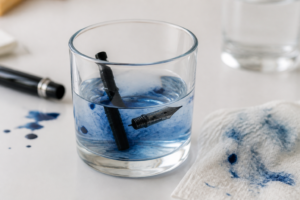
Converters ask more of you, but they pay it back. A solid piston converter such as the Pilot CON-70, running $10–$12 at retail, will outlast dozens of cartridge cycles if you treat it right. Rinse it under room-temperature water, let it air dry nib-down on a microfiber cloth, and it keeps performing year after year. I’ve got a Sailor converter I’ve been running since 2018 — over six years of fills now, with zero decline in how the piston seals.
Add it all up, and the long-run economics tilt hard toward converters. A 50ml bottle of decent ink runs $15–$28 and yields roughly 50 to 70 fills at typical converter volumes — call it $0.30–$0.40 per fill. A five-pack of brand-name cartridges usually costs $5–$8, which puts the per-fill price at $1.00–$1.60. Stretch that across a year of daily writing and the gap stops being trivial — it’s real money, and real freedom in ink choice.
The Ear Syringe That Made Filling a Converter Stop Feeling Like a Chore
Go the converter route and you’ll bump into the same limitation I did eventually: the built-in plunger doesn’t always pull ink as fully or as evenly as you’d like, and filling straight from a bottle can feel clumsy and imprecise. A proper ear syringe solves that problem almost entirely.
Where it earns its keep
- The soft rubber bulb hands you real control over how ink moves — you can top a converter off completely without trapping the air bubbles a built-in plunger tends to leave behind.
- It’s gentle enough to use on expensive vintage pens without risking pressure damage to the feed or nib — a lesson I learned the hard way with that Montblanc.
- Given the price, it makes sense to dedicate one syringe per ink color, which skips the cleaning ritual that otherwise kills your writing momentum.
Where it falls short
- Squeeze it too hard too often and the rubber bulb wears down — mine began sticking after about a year of daily use, which undercuts the entire benefit.
- It only fixes the filling process; converters themselves still hold less ink than cartridges, so you’re topping off more frequently no matter what.
I almost gave up on converters entirely after flooding my writing desk with Noodler’s Black one afternoon, but that moment taught me I needed better equipment, not a different filling system. The 2 Pack Ear Syringe 2oz / 60ml Rubber Squeeze Bulb transformed my filling process from stressful to meditative.
About This Article

Written by Ellen Ashford. Watch collector, fountain pen enthusiast, and lifelong journaler. Time & Ink is where I explore the craft of analog living — from vintage timepieces and fine stationery to the simple pleasure of putting pen to paper. More about this site.
Verify this against a primary source
Specifics change, and your situation may differ from the one described here. These are the authorities worth checking directly:
- NAWCC — horological reference, archives and research library
- Smithsonian Institution — collection records for historic timepieces and writing instruments