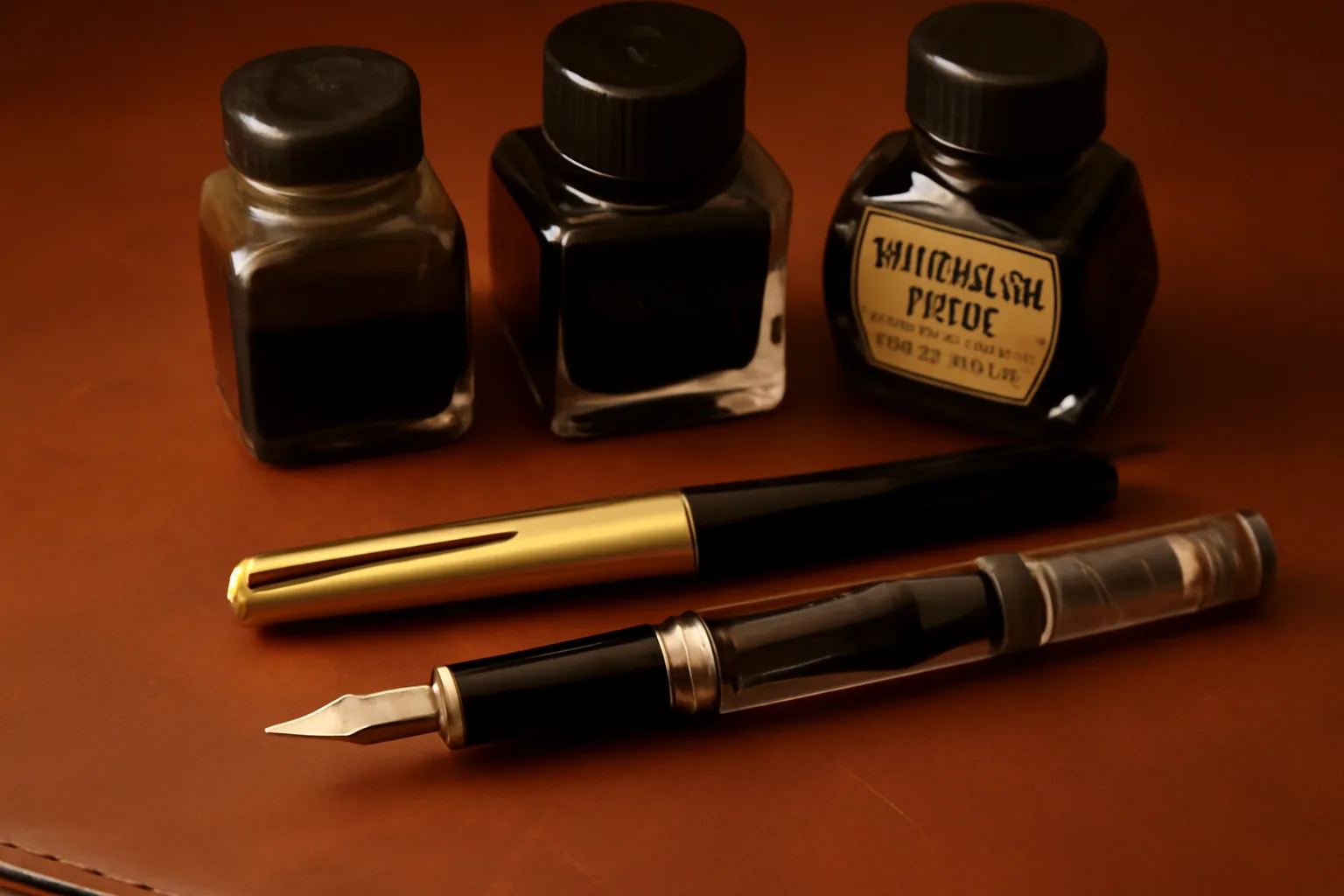
Right now, on the desk in front of me, sits a Parker 51 I handed over $340 for at an estate sale — the seller’s word was “bargain,” my husband’s word for it was considerably less flattering. Uncap it, ink it, and set the hooded nib against a sheet of Rhodia, and you’ll feel exactly what convinced me that the vintage-versus-modern question almost never comes down to the object itself. It comes down to what that object stirs in you, and what it moves you to do with your hands. Every buying decision I make now gets filtered through that one distinction.
Fountain pens and vintage paper goods have occupied more than a decade of my collecting life at this point. The rotation on my desk currently spans a 1952 Esterbrook J all the way to a 2023 TWSBI Eco, with plenty of ground covered in between. Daily journaling has been non-negotiable for eight straight years — north of 2,900 consecutive entries, written across vintage composition books, modern dot-grid notebooks, and every format that falls between those two poles. So when someone asks where the real value sits, vintage or modern, I’m not speculating. I’m reporting back from the notebook itself.
What I’ve settled on, after all that, is this: the answer isn’t murky, just layered. Vintage stationery earns its keep in a handful of specific categories, and holds that ground exceptionally well. Modern stationery takes other categories outright, cleanly and without much argument. Knowing which is which is what actually protects your wallet, sharpens your collection, and makes the daily habit of writing meaningfully more satisfying.
Unpacking What “Value” Really Means in Vintage vs Modern Stationery
Most people flatten “value” down to a single question — was it worth the money? My own experience has split stationery value into four separate strands instead. There’s monetary value: what it would fetch if you turned around and sold it. There’s functional value: how well the thing actually performs the job it was built for. There’s emotional value: the ritual and satisfaction wrapped up in using it. And there’s historical value: the craft and cultural weight the object itself carries. Vintage and modern stationery don’t compete evenly across those four — each camp owns a different set outright.
Take historical and emotional value first — vintage wins there almost every time. A 1952 Sheaffer Snorkel arrives with seven decades of survival already built in. Somebody wrote with it — love letters, maybe, or the correspondence that shaped an entire company. That backstory adds real weight to the object sitting in your hand. Functional value and consistency, though, belong squarely to modern stationery. Pull a brand-new Pilot Custom 823 out of its box and it will perform flawlessly, every single time, no exceptions. That reliability counts for a great deal if you write daily rather than collect occasionally.
Monetary value is the one that gets genuinely messy. A Parker Vacumatic in mint condition can bring anywhere from $150 to $400 depending on color and condition. Meanwhile, a modern Nakaya Piccolo starts around $500 and holds that value remarkably well, thanks to its hand-applied urushi lacquer process. Neither era has an automatic lock on resale strength here. Condition, scarcity, brand reputation, and whatever collectors happen to be chasing this year all factor in together, and reading that market accurately takes real homework.
The Categories Where Vintage Stationery Still Has the Edge
There are places where vintage stationery holds a genuine, documentable edge over anything new. Here’s what a decade of hands-on testing has actually confirmed for me.
The Flex and Feel of Pre-1960s Nibs
Nibs made before 1960 were commonly 14k or 18k gold, hand-ground for tipping in a way factory production rarely bothers with today. That combination produces the springy, line-varying “wet noodle” flex that modern mass manufacturing has never really managed to reproduce. My 1948 Waterman 52 swings from a hairline stroke to a 3mm broad line under almost no downward pressure at all. I’ve put dozens of modern flex nibs priced under $200 through their paces, and not one has come near that sensation. If vintage-style line variation is what you’re chasing for calligraphy, an authentic old nib is simply the better tool for the job.
Why Vintage Journal Paper Feels and Ages Differently
Paper goods from that era — especially mid-century American composition books and old British ledger stock — were frequently milled with a higher rag content than what’s typical now. Cotton fiber, rather than wood pulp, resists feathering, yellows far more slowly, and simply feels different under a nib than most modern paper manages. I still own fountain pen journals from the 1940s whose pages take ink beautifully to this day. That longevity isn’t nostalgia talking. It’s chemistry.
Finding vintage paper you can actually use, though, is its own separate challenge. Foxing, moisture damage, and brittle pages are the norm rather than the exception. I’ve handed over $8 at estate sales for blank books that turned out completely ruined by water damage once I got them home. Whenever it’s at all possible, examine vintage paper goods in person before any money changes hands.
The Ground Modern Stationery Holds Without Argument
Let me be blunt about something here: there’s a strain of vintage romanticism circulating online that sells modern stationery short. The advances in current production are real, and worth taking seriously. Dismissing them outright is the kind of mistake collectors make when nostalgia gets ahead of judgment.
Warranties, Consistency, and Not Gambling on Restoration
New fountain pens ship with a warranty attached. A Lamy Safari runs about $35 and writes reliably from the very first fill. Vintage pens, by contrast, need real work before they can be trusted — fresh sac material (usually silicone or latex), pressure bar adjustment, nib smoothing with 12,000-grit micromesh. Professional restoration typically runs $40 to $80 per pen, and that figure belongs in your math anytime you’re calling a vintage find a “deal.”
I learned this the expensive way with a 1955 Sheaffer Snorkel I picked up for $25 at a flea market, thrilled with myself at the time. Then I discovered the sac had disintegrated entirely inside the barrel. Restoration ran $55. That $25 bargain quietly turned into an $80 pen. It writes wonderfully now, no complaints there — but a brand-new pen with equivalent performance would have cost less than what I ended up spending altogether.
How Modern Ink Chemistry Changes the Equation
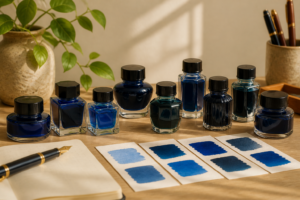
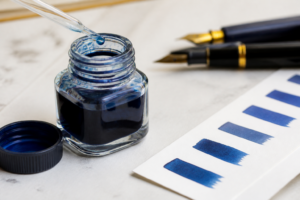
Ink formulation has come a long way over the past decade. Iron gall inks, pigmented inks, shimmering inks loaded with gold particles, pH-neutral archival formulas — all of it is readily available now from names like Diamine, Noodler’s, and Pilot Iroshizuku. Plenty of vintage pens simply can’t handle pigmented or iron gall ink safely, with corrosion and clogging as real risks. Modern pens, by contrast, are engineered with these formulas in mind from the outset. If ink variety matters to your writing practice — and for a serious journaler, it should — modern pens hand you considerably more room to experiment.
A Modern Wooden Pen That Splits the Difference Between Old and New
Truth be told, a $340 estate-sale splurge isn’t in everyone’s budget — and probably shouldn’t become a habit even for those it is. But the pull toward that vintage feeling, that sense of weight and intention in your hand, doesn’t disappear just because you’re trying to be sensible about money. The cobee wooden fountain pens land squarely in that gap: they deliver the look and feel of the real thing without the guilt of collecting, or the fragility that comes bundled with anything genuinely old.
What I Like About Them
- Writing with wood forces a certain unhurried pace — there’s something deliberate about a pen that feels substantial and handmade, even though nothing about it is actually old.
- Owning three of them means one stays inked on the desk, one lives in my bag, and one sits as backup — no mental math, no worrying about “damaging the investment” the way I would with something irreplaceable.
- The price point makes it possible to try fountain pens as an actual daily practice, without the financial hurdle that had me circling vintage listings for years without ever buying.
Where They Fall Short
- They don’t carry the rare nib precision or the backstory that makes vintage pens feel like artifacts — these are new tools, plain and simple, not heirlooms.
- Wood finishes need gentler handling than metal bodies do; if you’re rough on your gear or prone to dropping things, that’s worth knowing before you buy.
I held off ordering these for months, worried they’d feel like a compromise—a “settling” after my Parker 51 awakening. But they arrived and I immediately inked one, and that hesitation dissolved the moment the nib touched paper. cobee® Vintage Wooden Fountain Pens Set (3-piece, Model B)
About This Article

Written by Ellen Ashford. Watch collector, fountain pen enthusiast, and lifelong journaler. Time & Ink is where I explore the craft of analog living — from vintage timepieces and fine stationery to the simple pleasure of putting pen to paper. More about this site.
Verify this against a primary source
Specifics change, and your situation may differ from the one described here. These are the authorities worth checking directly:
- NAWCC — horological reference, archives and research library
- Smithsonian Institution — collection records for historic timepieces and writing instruments