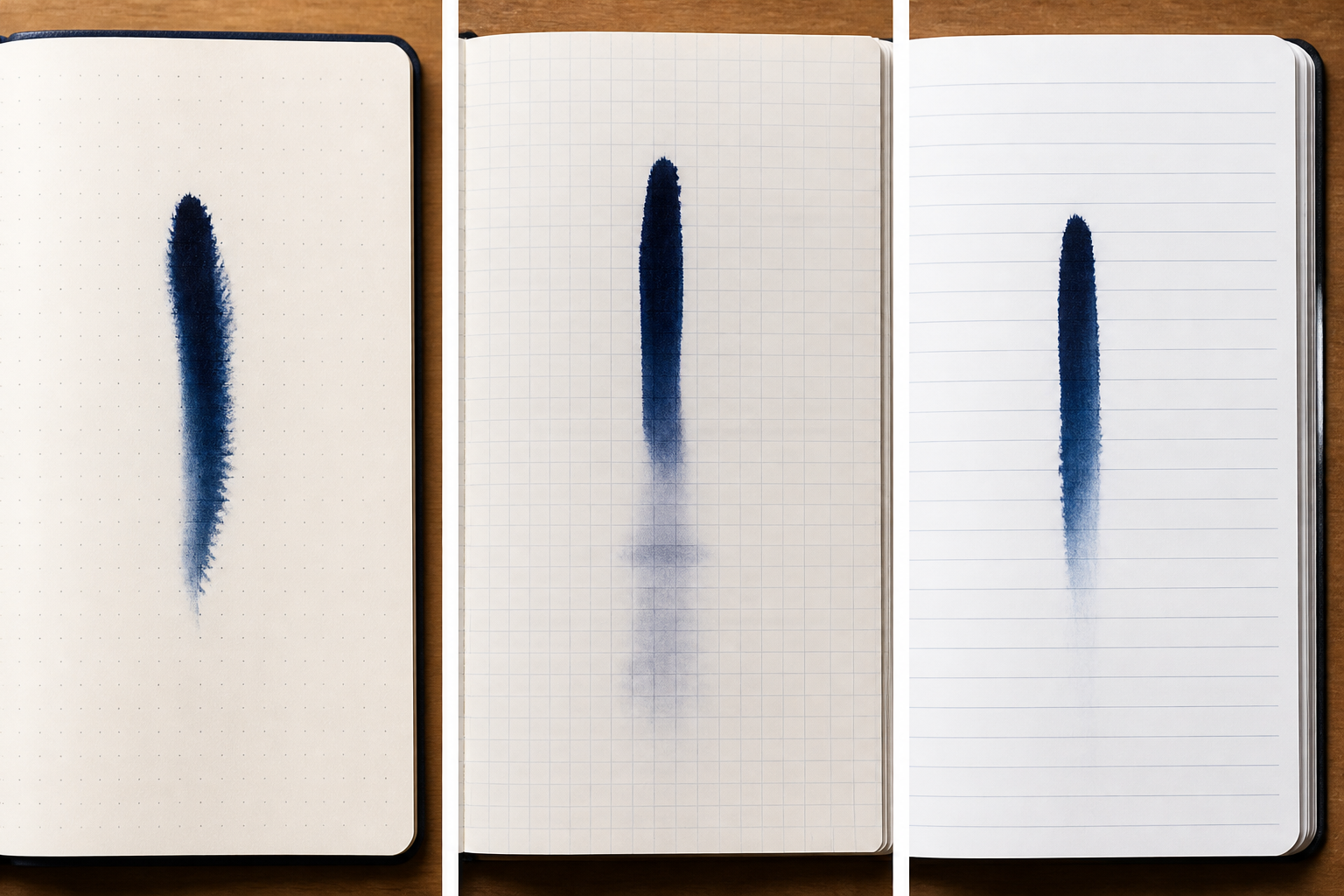
You’ve just filled your favorite fountain pen, sat down to write, and noticed the ink has spread across the page in a way that looks wrong. But wrong how? The problem might be feathering, bleeding, or ghosting—three distinct issues that share one thing in common: they all make your writing look messier than it should. The confusion is understandable; they’re visual cousins. But the cause of each one lives in a different place, and solving the wrong problem won’t fix the page in front of you.
The real issue almost never lives in your pen alone. It lives in the mismatch between your ink and your paper. Understanding the difference between these three problems means you’ll stop blaming your pen and start making choices that actually work.
Feathering: When Ink Spreads Along the Fibers
Feathering is ink that bleeds along the paper fibers, creating a fuzzy, thread-like spread that follows the grain of the page. When you look at a feathered line under good light, the edges look spiky or hairy—as if the ink has traveled outward along invisible roads in the paper itself.
What causes feathering
Feathering happens because the paper’s fibers are too absorbent or too loosely bound. When your fountain pen deposits ink on this kind of paper, the liquid wicks into the fiber structure and spreads horizontally before it can dry. It’s not that the ink is too wet; it’s that the paper is too eager to soak it up and distribute it.
Cheaper paper—the kind often used in notebooks, notepads, and mass-market journals—feathers easily. Wood-pulp paper (as opposed to cotton fiber paper) is more prone to feathering. Thin, sketchy papers tend to feather more than substantial, densely pressed sheets.
How to spot feathering
- The spread happens along the line of writing, not perpendicular to it
- Under magnification or close inspection, the edge looks ragged or hair-like
- The effect is more noticeable on lighter-colored papers
- Only the edges of the line feather; the center of the line stays relatively crisp
Solutions for feathering
The best fix is to switch to paper that resists feathering. Look for:
- Heavier paper (at least 80–90 gsm for notebooks; 100+ gsm for writing paper)
- Cotton-blend or 100% cotton fiber paper (often labeled as “rag paper”)
- Coated or sized paper (these have a surface treatment that slows ink absorption)
- Papers marketed specifically for fountain pens (manufacturers often list this on the package)
You can also try using a thinner-nibbed pen, which deposits less ink per stroke and gives the paper more time to absorb gradually rather than flood. A drier ink—one with lower water content—can help too, though this is harder to control when you’re buying bottled ink.
Bleeding: When Ink Soaks Through to the Back
Bleeding is ink that passes through the paper entirely, appearing on the reverse side. You might also see it as a dark shadow behind your writing, even if it hasn’t fully saturated through. This is the most dramatic of the three problems and the hardest to ignore.
What causes bleeding
Bleeding occurs when the paper is simply too thin or too porous to hold the volume of liquid ink a fountain pen deposits. The ink soaks through the entire thickness of the sheet because there’s not enough fiber or sizing to stop it. This is a volume problem—your pen is delivering more liquid than this paper can handle.
Thin copy paper (20 lb bond or lighter), onionskin, and some cheap notepads bleed reliably. Bleeding is especially common in inexpensive spiral notebooks and moleskine-style journals with poor-quality paper. It also happens more often with wetter inks and broader nibs, which deliver larger amounts of liquid.
How to spot bleeding
- Ink appears on the back of the page
- The reverse side shows a dark shadow or wet spot that mirrors your writing
- The problem worsens with broader nibs or wetter inks
- You can sometimes see the wet ink pooling or spreading on the back side in real time
Solutions for bleeding
Bleeding requires thicker or more resistant paper. Your options:
- Switch to heavier paper (at least 100 gsm; 120+ gsm is safer)
- Use paper made for fountain pens (these are specifically formulated to resist both bleeding and feathering)
- Try paper with better sizing (clay-coated or sized papers hold ink on the surface longer)
- Use a finer nib (narrower lines deposit less total ink, reducing saturation)
- Try drier inks (though this is somewhat ink-dependent and not always controllable)
Unlike feathering, you can’t fix bleeding by simply accepting it or working around it. The paper either has the substance to hold the ink, or it doesn’t.
Ghosting: The Faint Reverse Shadow
Ghosting is the faintest of the three problems: a light, readable shadow of your writing that appears on the back side of the page, even though the ink hasn’t truly bled through. It looks like a ghost of your words. You can still write on the reverse side without issue, but the shadow is visible.
What causes ghosting
Ghosting happens when ink sits on the paper long enough for some moisture to transfer to the back side, but not enough to saturate it fully. The paper absorbs the ink normally on the front, but the back side picks up moisture from the wet ink. This is often a time and humidity issue—if you close the book or stack pages while the ink is still damp, ghosting is more likely.
Ghosting is actually the mildest of the three problems and the most dependent on your environment and handling. It’s also the most common in decent-quality paper when conditions are humid or when you close a book too quickly.
How to spot ghosting
- A faint shadow of your writing appears on the back side
- The shadow is light enough that you can still read through the page without strain
- The reverse side feels dry, and the ink hasn’t actually soaked through
- It’s most visible when you hold the page up to light
Solutions for ghosting
Ghosting is partly a paper issue and partly a handling and environment issue.
- Use slightly heavier paper to provide more resistance to moisture transfer
- Leave pages open longer before closing the book (let ink dry fully, especially in humid conditions)
- Avoid writing in very humid environments if possible
- Use a less wet ink (lower water content reduces transfer)
- Accept it as a minor cosmetic issue in many fine papers; it’s often not considered a flaw
The Overlap: When One Problem Looks Like Another
These three problems can occur together, or one can mask another. Thin, poorly sized paper might both feather and bleed. Paper that bleeds usually ghosts as well. Ghosting can make you think you have a feathering problem until you look closely at the edge of the line.
The key distinction:
| Problem | Location | Cause | Fix |
|---|---|---|---|
| Feathering | Edges of the line spread along fibers | Absorbent or loosely bound paper | Heavier, denser, or sized paper |
| Bleeding | Ink appears on back of page | Paper too thin or porous | Thicker, more substantial paper |
| Ghosting | Light shadow on back side | Moisture transfer while ink dries | Better paper, drier ink, or faster drying time |
Finding the Paper That Works
The surest way to eliminate all three problems at once is to use paper specifically designed for fountain pens. These papers typically use cotton fiber, proper sizing, and adequate weight to handle fountain pen ink without feathering, bleeding, or significant ghosting.
If you’re working with paper you already own, start by identifying which problem you actually have. Look at the edges of your writing (feathering), check the back of the page (bleeding), and hold it to light (ghosting). Once you know the real problem, you can make a targeted choice: either change your ink, change your nib, or change your paper.
In most cases, the paper is the answer. A better page turns nearly any pen and ink into a writing tool that feels refined and controlled. That mismatch you’ve been blaming on your pen? It was waiting in the paper all along.
About This Article

Written by Ellen Ashford. Watch collector, fountain pen enthusiast, and lifelong journaler. Time & Ink is where I explore the craft of analog living — from vintage timepieces and fine stationery to the simple pleasure of putting pen to paper. More about this site.
Verify this against a primary source
Specifics change, and your situation may differ from the one described here. These are the authorities worth checking directly:
- NAWCC — horological reference, archives and research library
- Smithsonian Institution — collection records for historic timepieces and writing instruments