
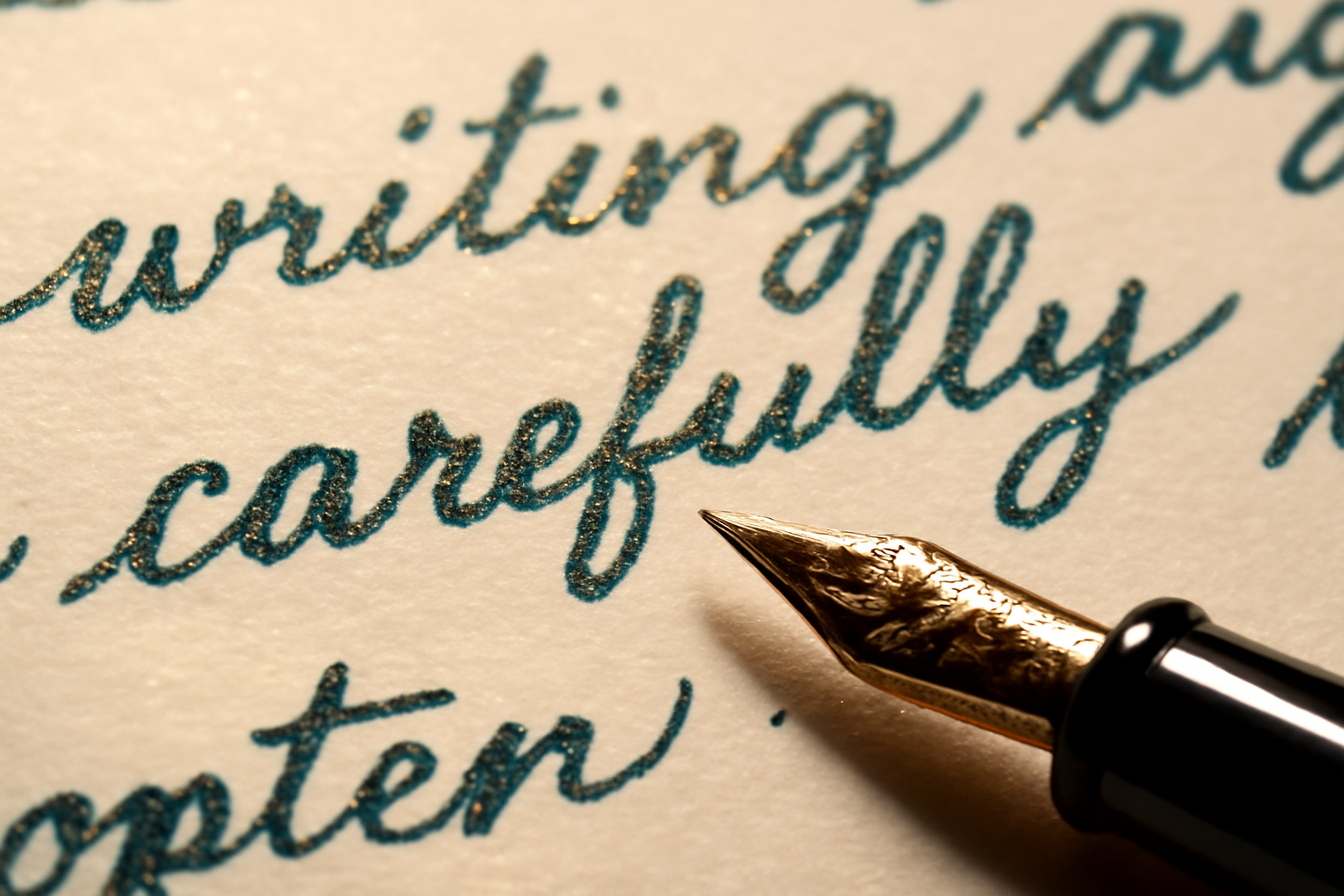

Here is the myth I need to bust straight away: shimmer ink is not simply “sheen with sparkle added,” and treating it that way is exactly how you end up scrubbing metallic grit out of a converter on a Saturday you’d rather have spent writing. That deep, shifting purple I once uncapped for the first time honestly did look like crushed stars — it caught light from three angles at once and I was sold instantly. What nobody mentioned in that moment of infatuation was the hour I’d eventually lose flushing sparkle residue out of a converter I’d been babying since 2016. Shimmer and sheen inks earn their beauty honestly. They also demand real upkeep, and any collector filling a favorite pen for the first time deserves the unglamorous version of the story before they commit.
Over a decade-plus of collecting fountain pens and other analog gear, my rotation has stretched from a $15 workhorse Pilot Metropolitan to a restored Pelikan 400NN I chased for two full years before the price finally made sense. Along the way I’ve run dozens of specialty inks through my pens — shimmer formulas, heavy-sheen dyes, iron gall, the whole spectrum. A handful of those trials turned out gorgeous. Others cost me nibs, converters, and, on one memorable occasion, an unfortunate blotch on a document that really needed to stay clean. What follows is the working knowledge I’ve accumulated, not the marketing copy printed on the box.
So let’s get into the mechanics — what separates shimmer from sheen, how each one actually behaves inside a pen over months and years, and the situations where a plain, well-mannered ink is simply the wiser call.
Shimmer and Sheen Are Two Different Animals
Nearly everyone new to this hobby lumps these two terms together, and I get why — both sound like marketing flourishes, and both give you something eye-catching on the page. But underneath, they’re describing two completely different physical processes, and that difference shows up dramatically once the ink is living inside your pen.
Shimmer ink carries real suspended matter — actual metallic or mica flecks floating in the liquid. Those are solid particles, not a trick of light, and once the page dries they catch and bounce light back at you, producing that glittering, faintly three-dimensional shine. Diamine’s Shimmertastic line and Robert Oster’s shimmer bottles are the names most collectors reach for. The particles are ground fine, but fine is not the same as absent — they will drift downward and settle in the bottle, in the converter, and in the feed channel the moment a pen sits idle.
Sheen ink, on the other hand, contains no particles whatsoever. What you’re seeing is an optical trick — a thin-film interference effect that emerges as the ink dries on the page. Given the right dye concentration and the right paper, the ink throws off a second color along its edges or wherever it pools. Pilot’s Iroshizuku line built its reputation on exactly this behavior — a deep blue that flashes red or gold at the rim. No solids, no sediment. That’s why sheen inks treat your pen’s internals so much more gently, even while delivering visual drama that rivals anything shimmer can do.
Inside the Pen: What Shimmer Ink Is Actually Doing
I’ll be blunt here, because I notice the wider pen community tends to soften this point. Shimmer ink genuinely can wreck a pen’s performance, and how likely that is depends on your nib width, your feed’s design, what your pen is made of, and how often it actually gets used. Let me walk through what I’ve seen firsthand.
Left uncapped and idle, the mica in shimmer ink drops out of suspension fast. A broad or stub nib — a 1.1mm or 1.5mm grind, say — has a wide enough channel that particles keep moving without much trouble. Fine and medium nibs are where the trouble starts, in my experience. I once loaded a Lamy Safari’s fine steel nib with Diamine Blue Lightning and left it capped for three days; when I uncapped it, there was a visible crust of sparkle dried around the tipping. Clearing that took two 30-minute soaks in cool water plus a full bulb-syringe flush. The pen recovered completely, but I was irritated with myself the whole time.
Vintage pens and anything with a rubber sac deserve a separate warning. Metallic particles can chew through aging rubber and latex faster than plain dye ink would. I would never, for instance, load shimmer ink into my Pelikan 400NN or any pen relying on a delicate vacuum or lever-fill sac — the visual reward just doesn’t justify the mechanical risk. Modern cartridge-converter pens with steel nibs handle it far better, as long as you’re disciplined about flushing them every two to three weeks without exception.