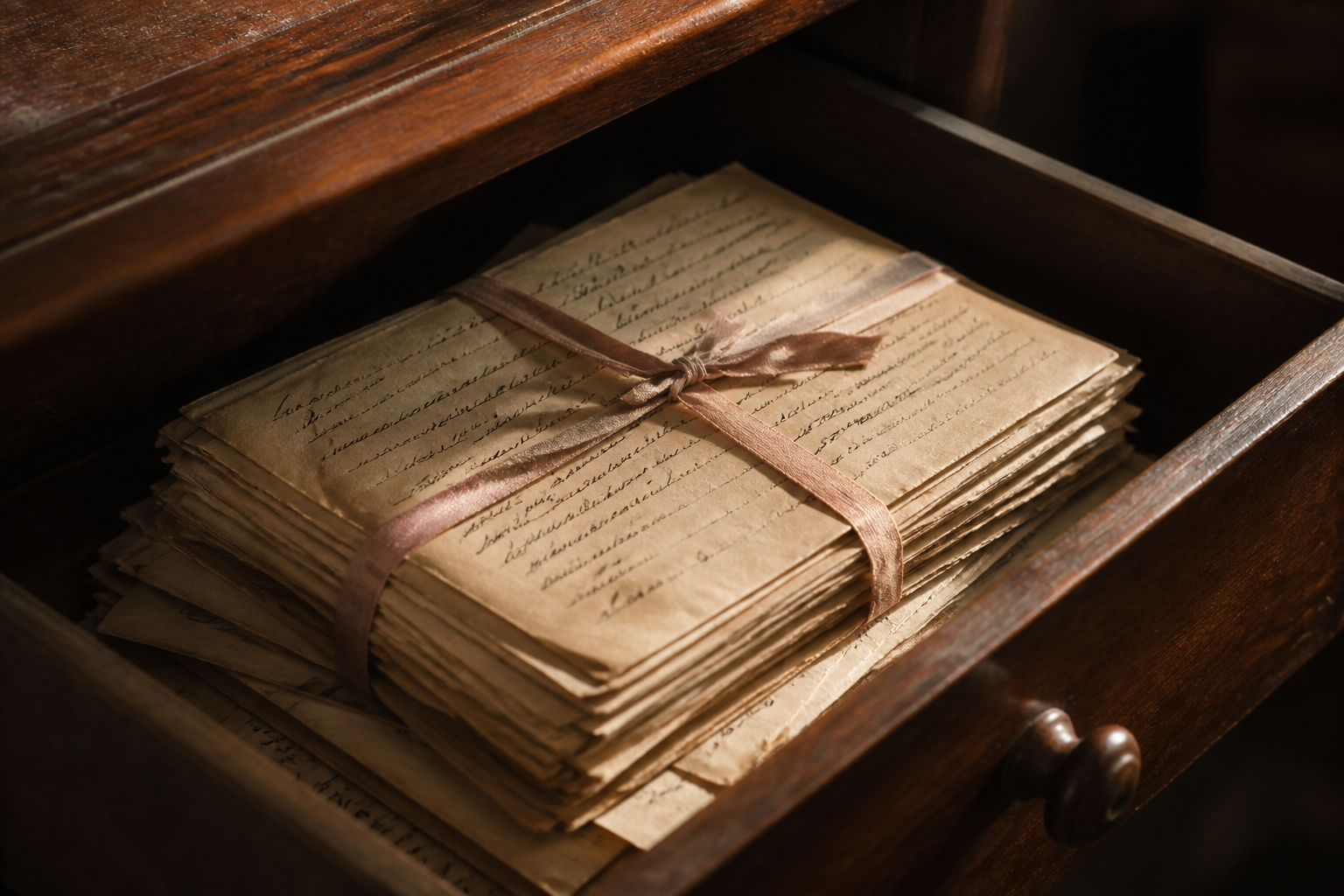
A Locked Drawer Came Down From the Attic With Everything Else
The desk itself I was ready for — three pieces wrapped in moving blankets that reeked of cedar and old wool, exactly what you’d expect from an attic in November. What caught me off guard was the shallow center drawer, still locked, with a small brass key stuck to the underside of the lid using a strip of brown packing tape that had turned to dust in my fingers. That tape had probably outlived its usefulness by four decades. Once I worked the drawer open — slowly, coaxing the swollen wood with a flat-head screwdriver — I pulled out a rubber-banded stack of letters. Forty-one, by my later count. Dated somewhere between 1951 and 1959. I hadn’t planned to think about how ink and paper hold up over time that afternoon, but the question landed in my lap anyway, and it felt anything but academic.
I ended up on the floor of my spare room for close to two hours, just working through them. My grandmother had corresponded with her sister in Bristol all through the 1950s. Small, careful handwriting. Stamps that had kept their color in patches. And the ink — in places — looked as crisp and readable as if she’d set it down last week.
Other places, not so much.
A Close Look at How These Materials Held Up Over Seven Decades
I laid everything out on the kitchen table, roughly by date. The oldest batch — 1951 to around 1954 — sat on a heavier, faintly cream sheet with a subtle laid texture, the kind of thing I recognized right away as rag or cotton-content stock. Starting somewhere around 1956, the paper turned thinner and had clearly been bright white when new — the sort of stock meant for everyday office correspondence, nothing special.
Seventy years later, the gap between those two papers wasn’t a close call. The rag sheets had aged into a warm ivory. Foxing was barely present — those rust-colored freckles that show up when mold or trace metals react with moisture over long stretches. The folds were still pliant; I could open each letter all the way without worrying it would split along the crease.
The wood-pulp sheets hadn’t been so lucky. Several edges had gone a deep amber — acidic degradation, in the technical term. Lignin, the polymer holding wood fiber together, breaks down over the years and throws off acidic byproducts that eat away at the cellulose. The result is paper that discolors, stiffens, and eventually tears itself apart. Two of the more recent letters already had small splits at the fold that I certainly hadn’t put there. The paper had simply failed at its own weak points.
And the Ink Told an Entirely Different Story
On the rag-content pages, the ink had held up remarkably well — dark, solid lines with next to no fading. Given how deep the color sat, and a faint reddish-brown cast some strokes showed against the light, my guess is my grandmother reached for an iron gall ink, the same formula scribes relied on for centuries and monks used in illuminated manuscripts. The chemistry is straightforward: iron sulfate and tannic acid react in water to form a compound that fuses to the cellulose fibers themselves. It doesn’t sit on the surface — it becomes part of the sheet. Seven decades on, that bond hasn’t let go.
My great-aunt’s side of the correspondence had a rougher time of it. Two letters from around 1957 in particular had gone nearly transparent — maybe sixty percent of the writing still legible, the rest reduced to faint gray traces. My best guess is a dye-based ink, likely the fast-drying, water-soluble kind common in postwar cartridge pens. Dye doesn’t bond to fiber; it just sits suspended on the page, exposed to UV, humidity swings, and plain old time. Seventy years of that combination will do exactly what it did here.
Before I did anything else, I photographed the whole stack. That step felt non-negotiable.
Where My First Instincts Failed Me
My first move was almost to flatten a few of the more curled letters under a heavy book — thankfully I stopped myself before doing it. Pressing aged paper into storage without controlling humidity invites new creases and stress fractures you can’t undo. Instead I gave each letter its own space, flat, inside acid-free archival folders — conservator-grade stock, pH above 7.0. I happened to have a few left over from an earlier project with some 1940s watch catalogs. Without those on hand, I’d have simply left the letters untouched until I could track down the right materials.
The error I actually committed was quieter. I went through several letters bare-handed during that first sitting, no cotton gloves. Skin oils transfer onto paper and speed up acidic breakdown right at the contact points — I know this cold, in theory. In practice, sitting on the floor absorbing my grandmother’s handwriting, it slipped my mind entirely. So now those particular pages will need a little extra caution in how they’re stored going forward.
Knowing a fact and actually applying it while your emotions are running the show turn out to be two separate skills.
What the Chemistry Is Really Saying
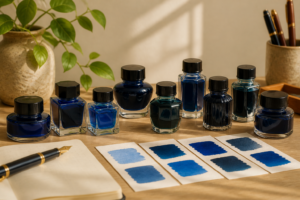
That afternoon with the letters got me reconsidering, in earnest, what I currently write with and on. I’ve kept a fountain pen habit going for roughly ten years now, and I run through somewhere between thirty and forty ink formulations annually at this point. Even so, I’d been picking inks almost entirely for how they behaved on the page — flow, shading, sheen, dry time — with longevity barely entering the equation.
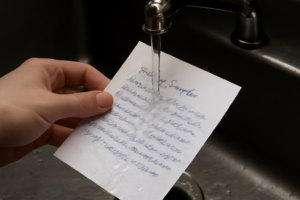
That’s backwards, really. Iron gall inks last because of the cellulose bond I mentioned. Carbon-based inks — the pigmented, archival-grade formulas — last because carbon particles are chemically inert and physically stable; they simply don’t react to light or moderate humidity the way organic dye molecules do. From what I’ve seen, a properly made carbon ink also shrugs off water exposure impressively well, which matters if storage conditions are ever less than ideal.
The honest tradeoff with iron gall: the acidity that lets it bond so well to fiber can, given enough time or high-acid paper, contribute to degradation right along the writing line — what archivists refer to as ink corrosion. On well-buffered rag paper, that effect stays negligible over a human lifespan. On cheap acidic stock, it just adds to the damage already underway.
Which is the whole point — paper carries as much weight as ink does. They’re a matched pair, not separate variables.
How This Changed the Way I Write Letters Now
I do write letters, though not as often as I’d like — call it six to ten a month, rotating through a couple of pens depending on my mood and whichever nib feels right that day. Since going through my grandmother’s stack, though, the whole exercise sits differently with me.
Cotton or rag-content paper — at least 25 percent cotton fiber, more if I can get it — is what I pull out for anything that actually matters. It runs more per sheet than wood-pulp stock, sometimes noticeably more. I’ve made peace with that cost, given what it’s being asked to outlast. A label that just says “acid-free” only tells half the story; genuinely archival paper is acid-free and alkaline-buffered both, landing around pH 8.0 to 8.5, which builds in a cushion against acid exposure down the road.
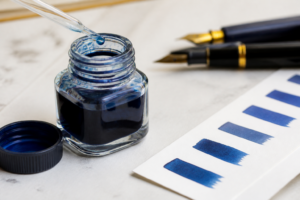
Ink gets the same scrutiny now. Iron gall and pigmented carbon formulas are what I reach for whenever permanence is the goal. Dye-based inks — gorgeous as some of them shade — get reserved for scratch pages and notes I don’t expect to outlive ten years.
Storage rounds out the equation. UV exposure breaks down both ink and paper over time. Humidity climbing past roughly 55 percent invites the mold behind foxing. Temperature swings force materials to expand and contract, putting strain on paper fibers and ink bonds alike. A dark, dry, cool drawer isn’t glamorous as archives go — but it explains exactly why some of my grandmother’s letters made it through intact while others fell apart.
What Writing by Hand Quietly Proves
I keep circling back to why any of this matters — why watching seventy years of ink and paper age should feel like it’s arguing for something at all. My grandmother wasn’t writing with an audience in mind. She was telling her sister about the children, a recipe, a difficult neighbor, the going price of wool. Nothing momentous. She had no reason to think I’d be reading her words in a spare room sixty-odd years later.
And yet I did read them. The medium is what made that possible. A digital file from 1995 is already, more often than not, unreachable — wrong format, dead hard drive, a platform nobody supports anymore. A carefully written letter on decent cotton paper, tucked into a drawer, crosses decades without needing any infrastructure at all. No software required. No power source. No compatibility negotiations with anything.
That’s not a minor point. To my mind, that’s the quiet, serious case analog writing has been making the whole time — that paper and ink, whether they age gracefully or fall apart, prove permanence is still within reach if you pick the right materials and keep them shielded from light.
My grandmother didn’t make the archivally correct choice with every single letter she wrote. I don’t either. But enough of what she chose survived in good shape, and because of that, I still have her voice — how she described one ordinary Sunday in 1953, how she worried about more or less the same things people worry about today.
That strikes me as reason enough to take some care with what I write.
About This Article

Written by Ellen Ashford. Watch collector, fountain pen enthusiast, and lifelong journaler. Time & Ink is where I explore the craft of analog living — from vintage timepieces and fine stationery to the simple pleasure of putting pen to paper. More about this site.
Verify this against a primary source
Specifics change, and your situation may differ from the one described here. These are the authorities worth checking directly:
- NAWCC — horological reference, archives and research library
- Smithsonian Institution — collection records for historic timepieces and writing instruments