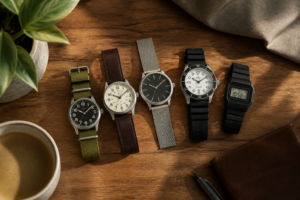
Forty-seven dollars. That’s the entire sum that changed hands at a Cincinnati flea market for the first watch I ever bought with actual intention — a battered Seiko 5, crystal full of hairline scratches, bracelet so tight it yanked arm hair with every twist of the wrist. I strapped it on and didn’t take it off for two straight years. That scuffed-up piece taught me more about assembling a beginner watch collection on a real budget than any spec-obsessed forum thread or YouTube deep-dive ever managed. The assumption most people carry is that meaningful collecting requires thousands of dollars sitting idle. It doesn’t. What it actually requires is a workable framework, a fair amount of patience, and enough honesty with yourself to know what you actually want strapped to your wrist.
Ten-plus years into this habit now, my box sits at 23 pieces, with a $65 Casio anchoring one end and a $1,400 Hamilton Khaki Field Mechanical anchoring the other. Somewhere in that span I’ve made a handful of genuinely smart buys, a couple I still wince about, and I’ve mapped out exactly where the value sits for anyone starting this hobby on a tight budget. What follows is the three-watch foundation I hand to every new collector who corners me at a swap meet asking where to begin — and how to get there without torching your bank account.
Why Three Is the Right Number to Start With
Landing on three watches might look like a random target, but it isn’t. Veteran collectors have a name for this setup — the “holy trinity” approach — one relaxed everyday piece, one dress watch, one sport or field watch. Stacked together, that trio covers something like 95% of whatever your wrist actually needs day to day. You’re not overloaded with redundant pieces, and you’re never caught without the right watch for the moment. For someone just starting out, that equilibrium matters more than almost anything else.
Back in 2013, when I put together my own starter trio, I set myself a hard ceiling of $400 total — no exceptions. At the time that number felt punishingly tight. In hindsight, that limitation was the best thing that could’ve happened to me. It pushed me to actually research instead of skim, to weigh movement quality above a flashy dial, and to think in terms of years worn rather than instant gratification. That $400 bought three watches I still own, unbroken, today. Frankly, that beats the returns on most things I’ve put money toward.
There’s a mechanical upside to the three-watch approach too — it protects your movements. Cycling through three watches instead of leaning on one single piece every day stretches out your service intervals considerably. Most mechanical calibers need attention every 3 to 5 years as it is. Rotation eases the load on the mainspring and escapement, which means fewer trips to the bench. And those trips aren’t cheap — a proper service from a reputable watchmaker runs $150 to $350 depending on the caliber involved.
Watch One: The Everyday Beater (Budget: $50–$120)
Your everyday piece absorbs the most punishment of the three. It clips doorframes, soaks up sweat at the gym, and rides along from workout to grocery run without complaint. This is not the slot where you spend big — this is the slot where you spend wisely.
My go-to suggestion is the Seiko 5 line — the SNXS79 specifically, or the newer SRPE55 if a more contemporary case shape appeals to you. The SNXS79 houses Seiko’s caliber 7S26, a 21-jewel automatic that holds time to roughly ±15 seconds a day. Depending on where you source it, expect to pay somewhere between $65 and $85. For that money you’re getting a genuine automatic Japanese movement, water resistance rated to 100 meters, and a day-date function — nothing else at this price bracket comes close to matching it.
If the idea of babysitting an automatic feels like too much right out of the gate, the Casio MQ24-7B2 quartz is $15 you won’t regret spending. Quartz accuracy sits around ±15 seconds per month, which blows most entry-level automatics out of the water. There’s zero shame in starting there — I spent my first three years in this hobby wearing quartz exclusively, using that time to study movements, case construction, and finishing without the added headache of regulating an automatic.
Judging Case Quality at This Price
At this budget level, stick to stainless steel — 316L surgical-grade specifically, which is what most reputable brands use. Steer clear of anything listing the case material as vague “alloy” or “metal.” That vagueness is never accidental. If water resistance matters to you, check whether the crown screws down. A push-pull crown is perfectly fine for daily wear, but don’t count on it holding up reliably through a swim or a downpour.
Watch Two: The Dress Piece (Budget: $100–$200)
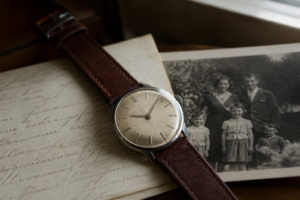
A dress watch has exactly one job: vanish beneath a shirt cuff and finish off a formal or professional look without demanding attention. Slim case, uncluttered dial, few if any complications. This is the piece that quietly earns you respect at a wedding or across a boardroom table.
From what I’ve seen, Tissot’s Everytime line offers the strongest value going in this category. The Tissot Everytime Small (T109.210.16.031.00) runs on the ETA G10.212 quartz caliber, keeps admirably tight time, and sits at 38mm — genuinely slim enough for a suit cuff. Street prices land around $175 to $195. Tissot is a Swiss Made brand operating under COSC oversight, and even their pieces that skip COSC certification show finishing well beyond what the price tag suggests.
I learned this lesson the expensive way — through disappointment, not dollars. My first dress watch was a generic $40 fashion piece stamped with a logo I couldn’t even place, a dial that turned sickly under office fluorescents, and a movement that wandered three minutes a week. Photographed, it passed. In person, it read exactly as cheap as it was. Put a bit more money into this slot — you’ll be wearing it during moments you’ll actually remember.
Where a Strap Swap Pays Off
One of the smartest value moves in this hobby is picking up an affordable watch and putting money toward the strap instead. A solid Italian leather strap from Hirsch or Strapcode runs $25 to $45 and completely reshapes even a mid-tier watch. On a dress piece especially, trading a plain black strap for a warm tan or cordovan brown alters the whole personality of the thing. It’s a small trick, but it’s the kind that separates people who collect from people who just accumulate.
Watch Three: The Field or Sport Piece (Budget: $120–$250)
Your field or sport watch does the heavy lifting. It’s built for outdoor days, casual weekends, and any occasion where your dress watch feels too delicate and your Seiko 5 reads a little too laid-back. This is honestly the category I enjoy researching most, because even at modest price points the options genuinely compete with each other.
My top pick here is the Orient Mako II (FAA02004B9) — a Japanese automatic diver built around the Orient caliber F6922, beating at 22,800 vph, with hand-winding and hacking capability, two things many beginner-tier automatics leave out entirely. Water resistance is rated to 200 meters and meets ISO 6425 diver’s watch standards. Typical street pricing runs $130 to $160. For a genuinely ISO-certified diver at that number, nothing else in the market really competes.
If a field watch look suits you better, the Hamilton Khaki Field Quartz (H68551833), priced around $195, is outstanding. Hamilton falls under the Swatch Group umbrella and builds its movements in Biel, Switzerland, under legitimate Swiss Made certification. The Khaki Field traces its design lineage back to WWII-era U.S. Army contracts, and that heritage shows up in the legibility, the dial layout, and how the case holds up over time. It wears at 38mm and looks right at home in nearly any casual setting you put it in.
The Storage Snag That Nearly Sank My Rotation
Commit to three watches and you’ll hit a problem nobody warns you about: they need somewhere to live that keeps them safe and actually makes you want to reach for them. Toss them in a drawer and you’re signing up for scratched crystals, tangled bracelets, and a slow, quiet death of your budget collection before it’s even had a chance.
What worked for me
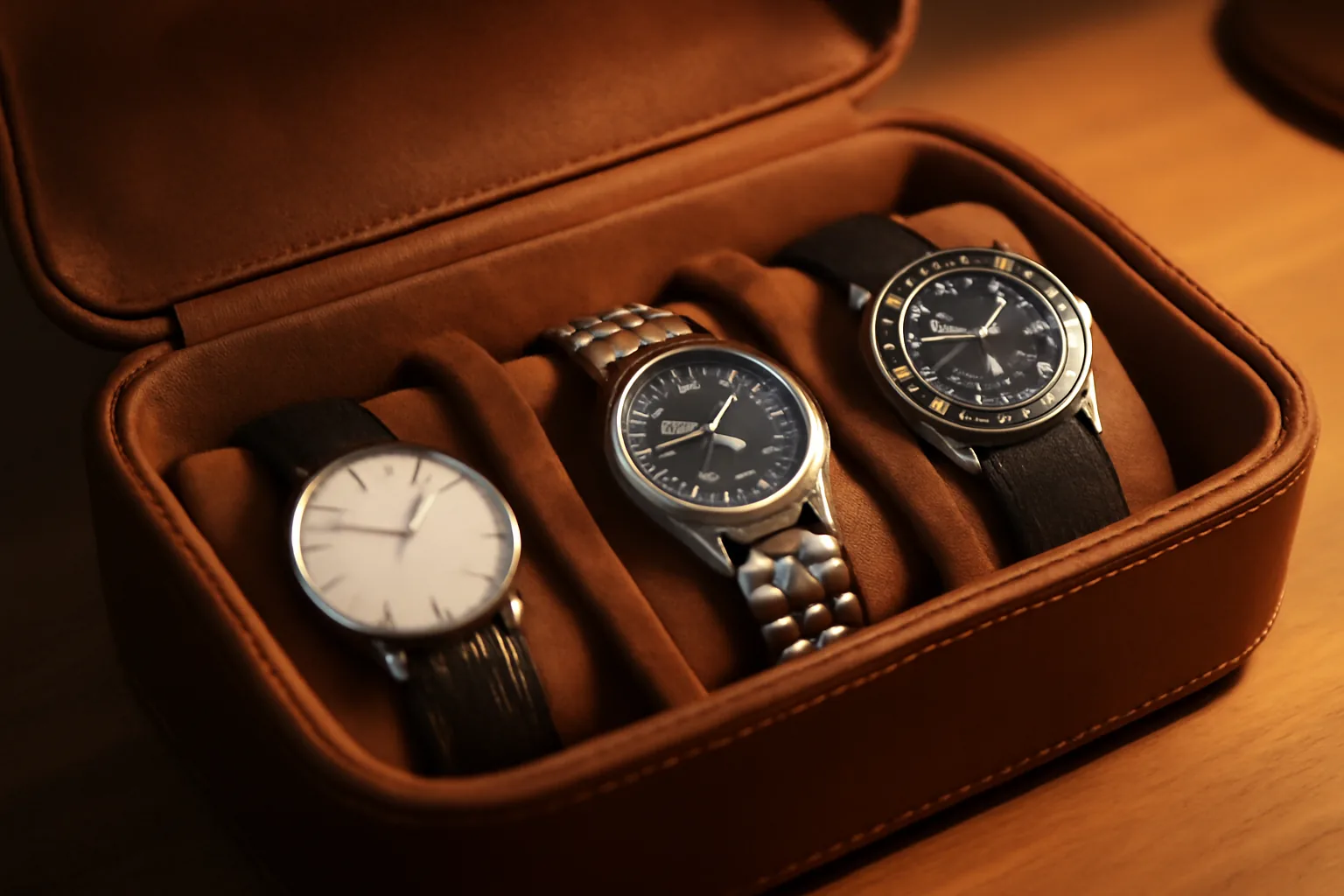
- Separate cushioned compartments keep the watches from ever touching — no bracelet tangles, no case scratches piling up over months of storage.
- Twelve slots gave me room to expand without rushing into a second box, which oddly enough slowed me down and made watch #4 a deliberate choice rather than an impulse grab.
- The brown leather shell looks deliberate sitting on a shelf or nightstand — it makes the whole collection read as a real pursuit rather than a heap of stuff.
Where it fell short
- There’s no transparent lid, so you can’t take stock of your collection with a glance — you have to open it up just to remember what’s inside, which undercuts the whole point of rotating with intention.
- The clasp feels a touch flimsy for something opened daily; I handled mine carefully for the first six months, half-expecting it to snap.
I almost went with a clear acrylic case because I wanted to display my watches like art, but then I realized that meant dust accumulation and the psychological pressure of everything being visible. ProCase Watch Box Organizer — 12 Slot, Brown solved that by keeping my rotation private but organized—a small choice that made me respect my three watches more.
About This Article

Written by Ellen Ashford. Watch collector, fountain pen enthusiast, and lifelong journaler. Time & Ink is where I explore the craft of analog living — from vintage timepieces and fine stationery to the simple pleasure of putting pen to paper. More about this site.
Verify this against a primary source
Specifics change, and your situation may differ from the one described here. These are the authorities worth checking directly:
- NAWCC — horological reference, archives and research library
- Smithsonian Institution — collection records for historic timepieces and writing instruments