I still remember the moment I understood that not all blue ink is created equal. I had just loaded a Pilot Metropolitan with a generic “blue” cartridge and written a full page of notes. The result looked flat, lifeless, and forgettable — closer to a ballpoint smear than anything worth calling penmanship. That experience sent me down a rabbit hole that lasted years. Searching for the best blue fountain pen ink turns out to be one of the most rewarding, occasionally maddening, quests in the analog hobby. There are hundreds of options, and the difference between a mediocre blue and a genuinely great one is visible the moment ink hits paper.
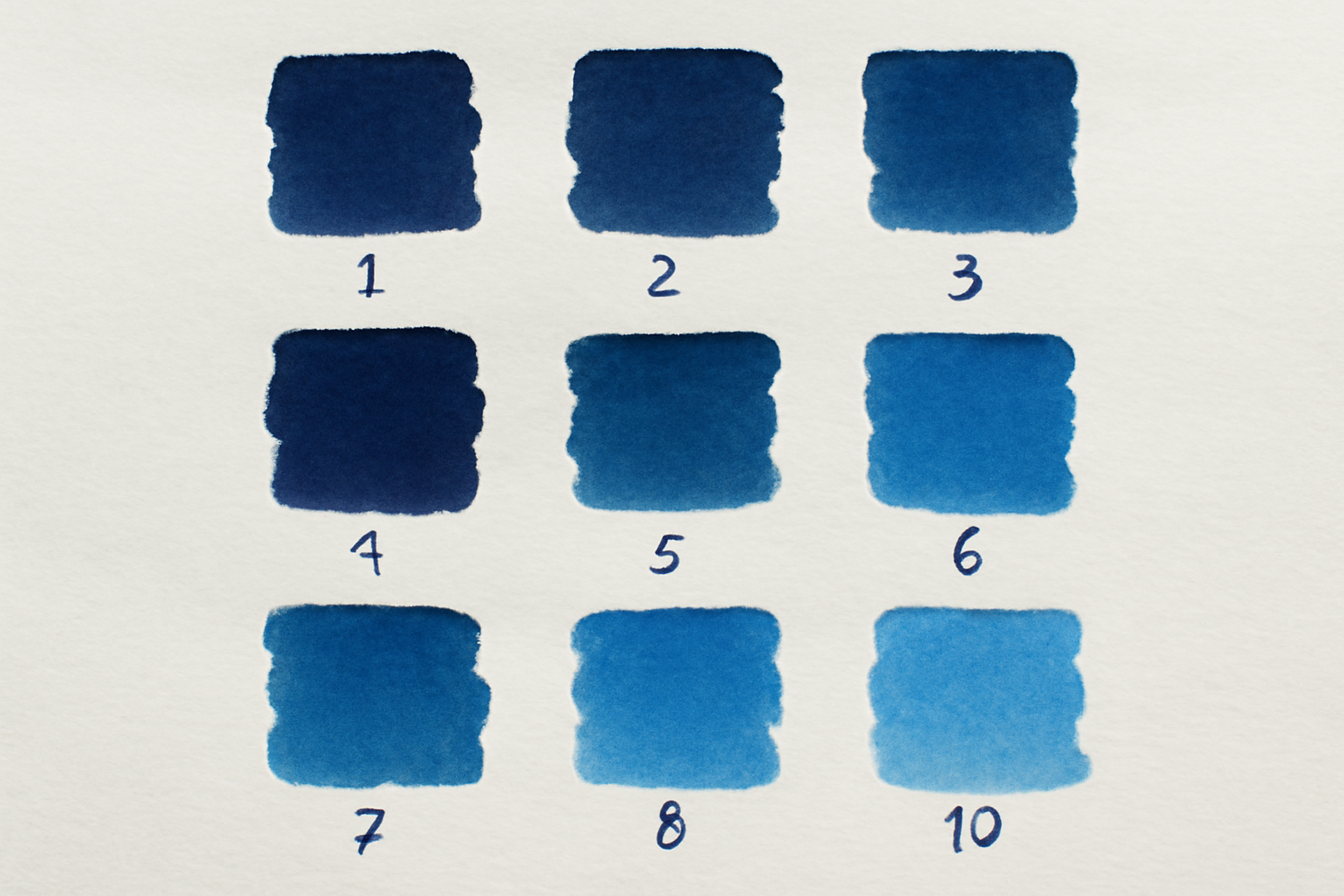
Over the past decade, I have filled dozens of pens — from a vintage Sheaffer Snorkel to a modern TWSBI Eco — with blues from Diamine, Waterman, Sailor, Pilot, Monteverde, and more. I keep meticulous swatch cards on Rhodia dot pad paper, 80 gsm, and I re-test every ink on Tomoe River 52 gsm before making any final call. That obsessive comparison process is what this list is built on. These are not recommendations borrowed from forums. Every bottle here has sat on my desk, run through my pens, and earned its place through real use.
Below I rank ten blue inks I have personally tested, explain why each one earned its spot, and name the two that I keep coming back to most. If you are ready to stop settling for flat cartridge blue and start writing with something genuinely beautiful, keep reading.
What Makes a Blue Fountain Pen Ink Actually Great
Before diving into the list, I want to establish what I am actually evaluating. “Blue” covers enormous ground. You have cornflower blues, navy blues, teal-leaning blues, blue-blacks, and cerulean options that almost read as grey in certain light. Each has its place. However, my criteria stay consistent across all of them.
First, I look at shading — the way an ink pools slightly in letter curves and lifts on upstrokes, creating tonal variation within a single word. It is the property that makes handwriting look alive rather than printed. Second, I evaluate flow and lubrication, specifically how the ink behaves in fine and extra-fine nibs, which punish poorly formulated inks the most. Third, I consider dry time on standard 80 gsm office paper, because beautiful ink that smears after fifteen seconds is simply not practical for daily writing.
Finally, I factor in water resistance, price per milliliter, and availability. A stunning ink that costs $45 for 30ml and sells out in minutes is a luxury, not a recommendation. I want every pick here to be something you can actually buy and reasonably afford to use every day.
My Ranked List of 10 Blue Fountain Pen Inks
The Blue That Finally Proved My Generic Cartridge Wrong
After years of chasing that elusive depth and character in blue ink, Kon-peki became my reference point—the standard against which I measured everything else. It’s the ink that transformed my skepticism into obsession, and the one I keep coming back to when nothing else feels quite right.
What works
- The color shifts from a bright, almost turquoise blue in thin strokes to a deep, contemplative teal in wet writing—each page tells a different story depending on pen and pressure
- It flows with remarkable consistency across different nib sizes without feathering or bleeding through even moderately thin paper, making it reliable for extended writing sessions
- The 50ml bottle lasts longer than expected and costs less per milliliter than most premium inks, making the initial investment feel less like a splurge and more like discovering a secret deal
What doesn’t
- It’s not a one-and-done ink for every situation—the very shimmer and depth that makes it beautiful can feel like overkill if you’re just jotting grocery lists or need a straightforward, no-nonsense blue
- The bottle design is purely functional with no measuring marks, so refilling cartridges or converters requires a steady hand and a moment of faith that you won’t overflow your pen
I nearly gave up on it the first time I overfilled a converter and watched ink drip onto my journal—a small disaster that almost sent me back to safe, predictable cartridges. But I’m genuinely grateful I didn’t. You can find the Pilot Iroshizuku Kon-peki 50ml bottle on Amazon here.
Pilot Iroshizuku Kon-peki 50ml bottle
I’ve used this bottle for months without feathering, and the per-milliliter cost still beats most premium inks.
Check Price on Amazon →This post contains affiliate links. As an Amazon Associate, I earn from qualifying purchases at no extra cost to you.